
The complete guide
Lighting a Tall Entrance, A Buyer's Guide to Ring Chandeliers
The problem with tall rooms
A double-height entrance looks fantastic in a photograph and behaves badly in real life. The ceiling is three or four metres up. Whatever you fix to it is miles from the people standing underneath. A flush fitting disappears. A short pendant hovers in mid-air with nothing around it. And in both cases, the light spreads across the roof void instead of coming down to where it is useful.
The result is a room that feels dim at head height even though the fitting is working perfectly. Walls stay in shadow. Faces look grey. The stair treads catch almost nothing. People compensate by adding wall lights, then a floor lamp, then a strip of LEDs under the handrail, and the entrance ends up with four different light sources and still no real presence.
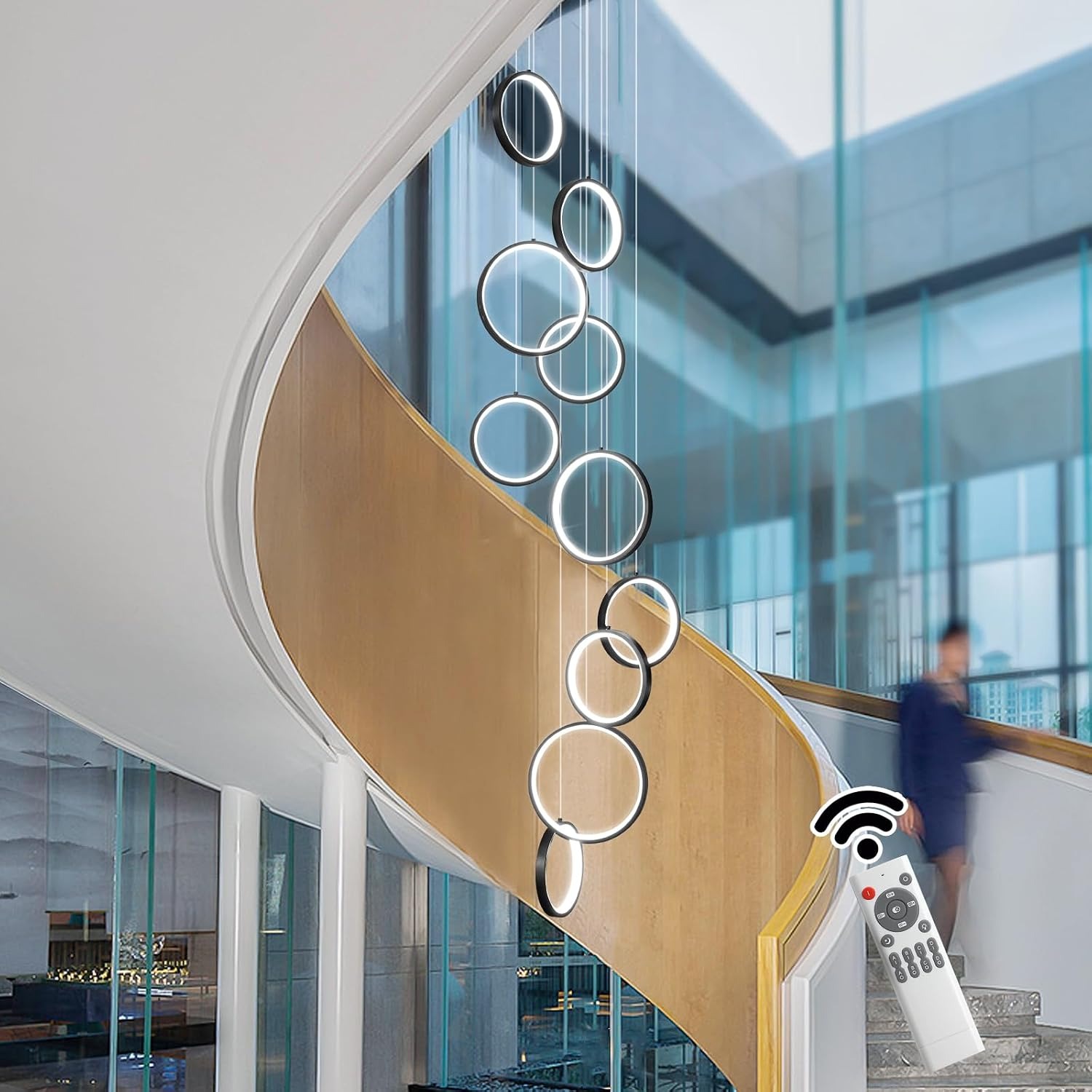
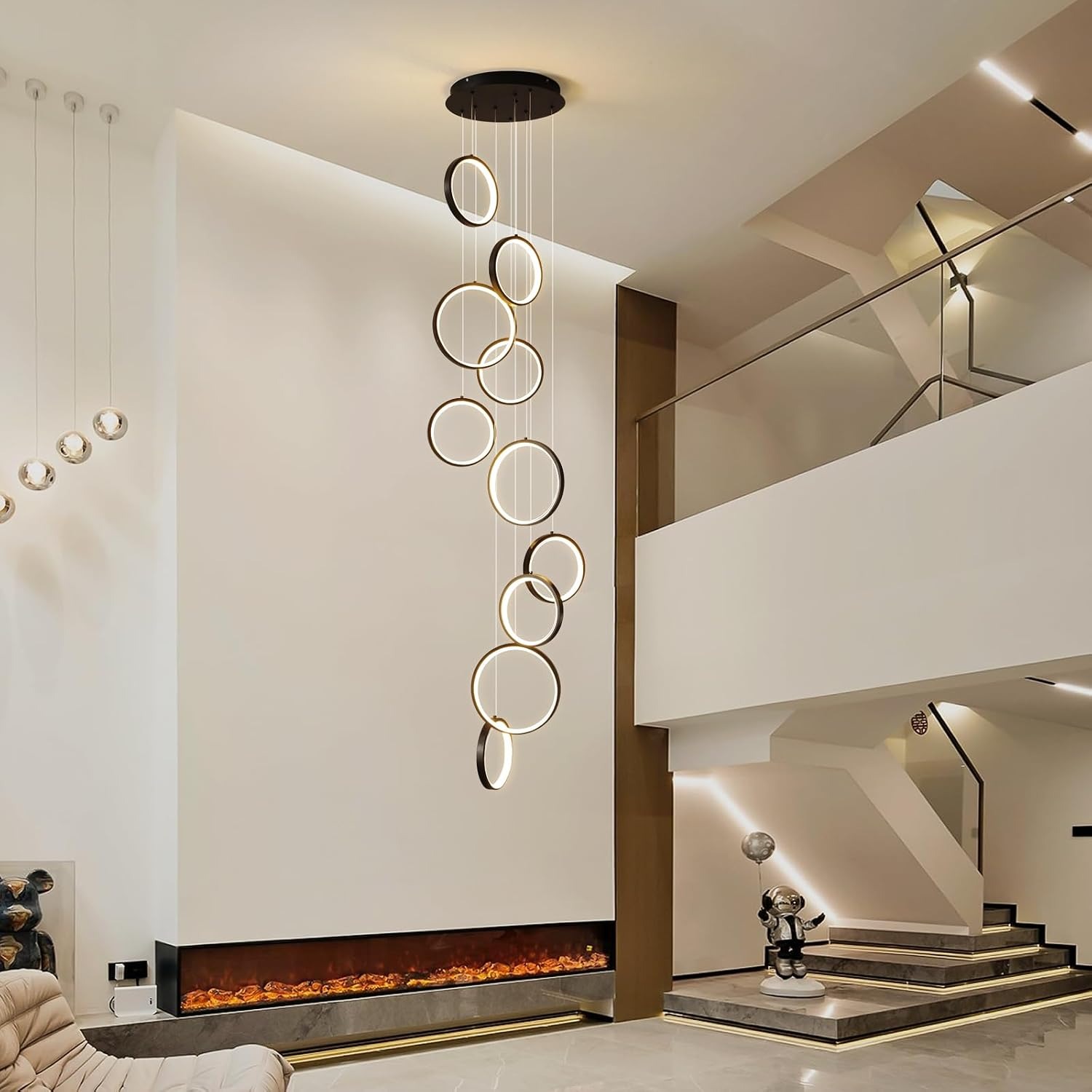
A long-drop chandelier solves it differently. Instead of one bright point at the top, it hangs a column of light down through the void. The light arrives at multiple heights. The eye reads the vertical space properly. And the fixture is close enough to the viewer to actually be seen.
How a ring chandelier works
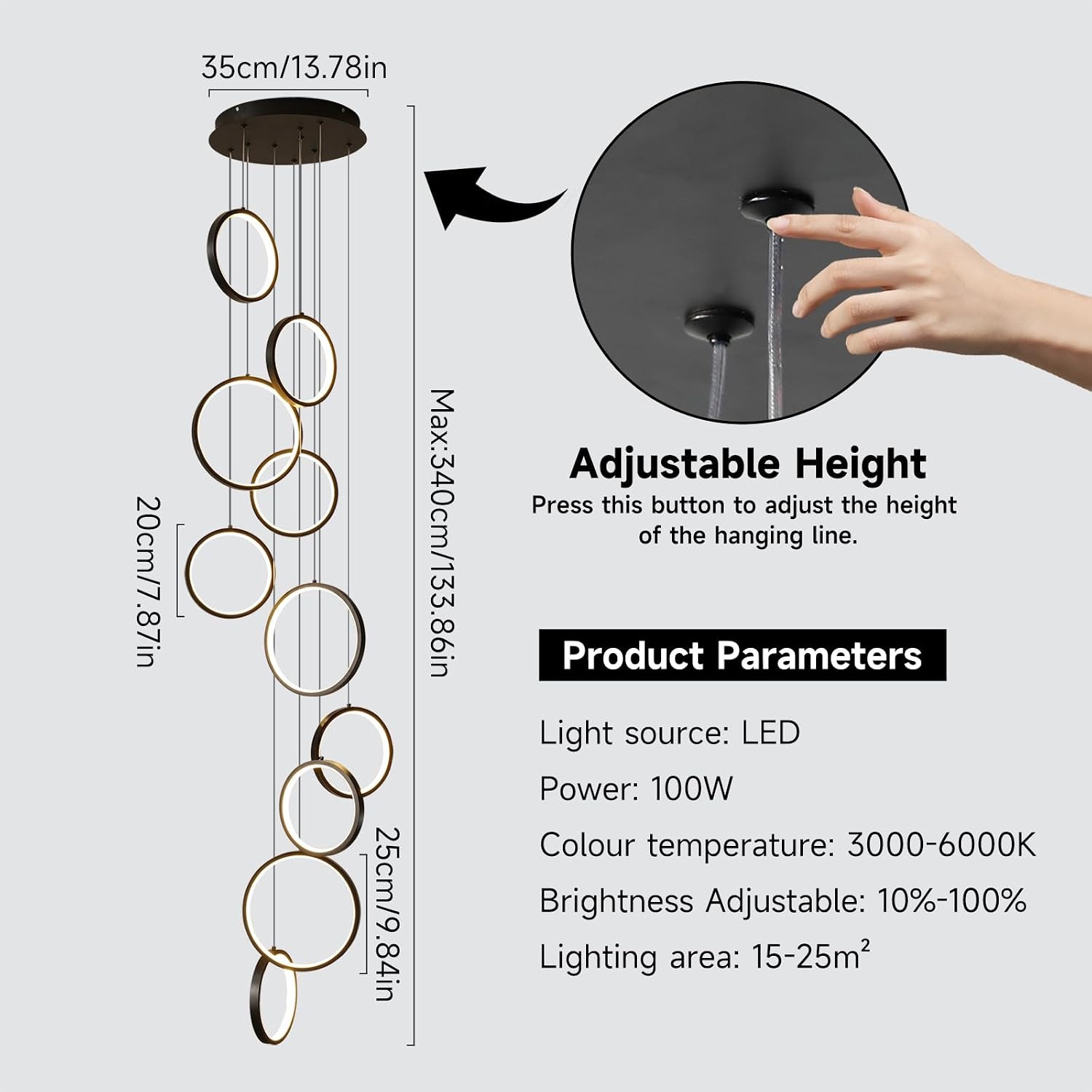
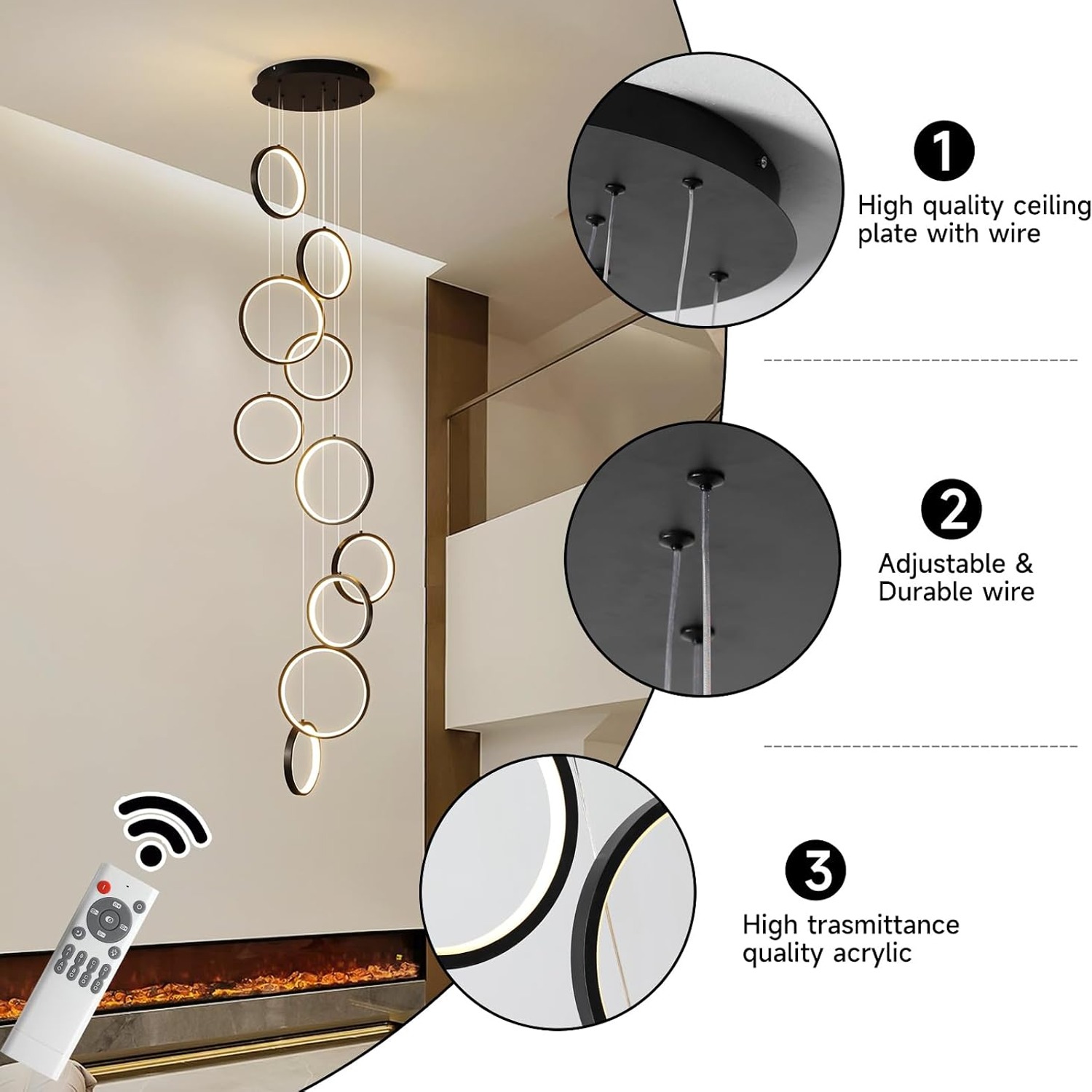
This one is built around ten circles. Seven are smaller, three are larger, and they hang at different depths on fine cables from a single round baseplate about 35cm across. Each ring is an aluminum channel with an LED band inside, black on the outside face and white where the light emerges.
The staggering is the point. If the rings sat at even spacing in a straight line, the fixture would look like a ladder. Mixing two sizes at uneven depths means you see overlapping circles from almost any angle, and the shape changes as you walk up the stairs or cross the hallway. It gives a static object some movement.
Total height is 339.85cm from baseplate to lowest ring. That is a serious drop, and it is the reason the fixture earns its place in a tall stairwell where a normal pendant would not. The whole thing weighs 3.49kg, which is light for its size because aluminum does most of the work.
Power is 100 watts across the ten light sources, with a maximum output of 1300 lumens on a 110 volt supply. The suggested coverage area is 10 to 25 square metres, which fits most entrances and stairwells comfortably.
Dimming and colour, and one thing to check
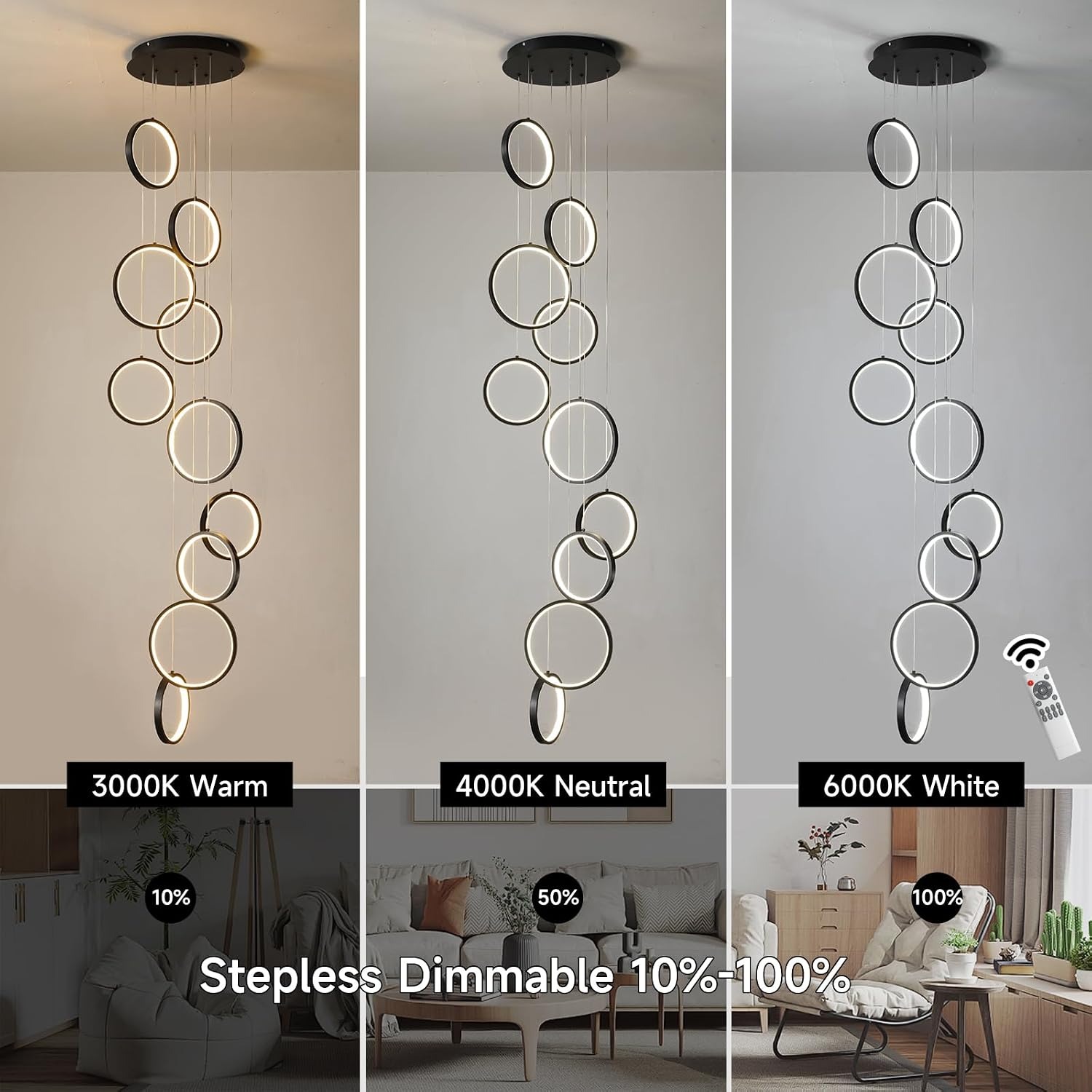
Brightness is stepless from 10% to 100%, so there are no fixed stages to click through. You hold the button and stop where it looks right. Colour temperature moves across 3000K to 6000K, covering warm, neutral and white, with a listed nominal value of 4500K.
That range matters more than people expect. A foyer at seven in the morning wants cool, clear light so the space feels awake. The same foyer at nine at night wants something closer to candlelight so it does not glare at you when you come through the front door. One fixture doing both saves you from the usual compromise.
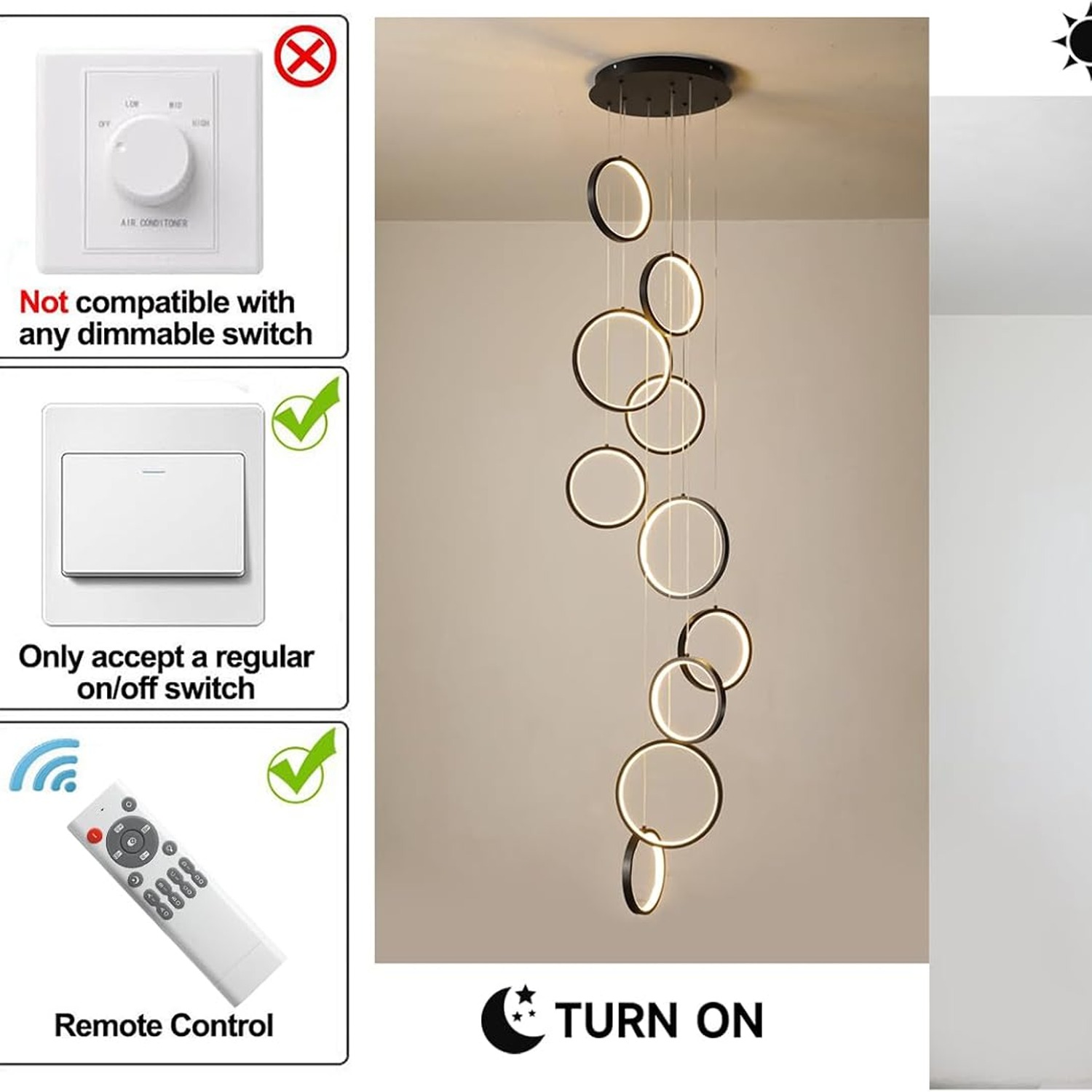
Now the thing to check before you order. This fixture is not compatible with a wall dimmer switch. If your entrance is already wired through a dimmer, mention it to your electrician so the circuit can be changed before installation day. It is a five minute job if you know in advance and an annoying surprise if you do not.
Who it suits
The obvious fit is a two-storey entrance hall. The next is a stairwell with an open void, where the rings can cascade down beside the stairs and be seen from both floors. After that, high-ceilinged living rooms, dining rooms with a tall pitched roof, and home offices in converted spaces with exposed structure.
It suits a particular taste, too. There is no crystal, no glass, no ornament. The look is plain geometry in matte black, which lands squarely in the modern and minimalist camp. If your house leans traditional, this will fight with it. If your house has clean lines, square-edged joinery and a neutral palette, it will sit in naturally as a minimalist chandelier that does its job without shouting.
It is indoor only, and not water resistant. That rules out bathrooms, covered outdoor entries and anywhere humid.
Choosing the right size and drop
Three measurements decide whether this works in your space.
First, ceiling height at the exact fixing point. Not the average height of the room, the height where the baseplate will go. In a stairwell with a sloped or stepped ceiling, this can differ by half a metre from where you assumed.
Second, the clearance you need below the lowest ring. Think about the tallest person who will walk under it, any door that swings nearby, and whether you ever need to move furniture through. A comfortable clearance below the lowest point is usually about 2.1 metres over a walking area, more if the fixture hangs over stairs where people are elevated.
Third, the width of the void. The fixture occupies a footprint of roughly 34.8cm square, but the rings need visual breathing room. If the stairwell is narrow, a slimmer long drop chandelier may suit better.
Do the arithmetic before you buy. Ceiling height minus 339.85cm gives you the clearance you will end up with. If that number is too small, the suspension cables can be shortened at installation, since adjustable height is one of the listed features. Your electrician will set it on the day.
Installation, honestly
The manufacturer supplies the fittings pre-wired and pre-threaded, so the fixture itself is not complicated. You fix the baseplate to the ceiling, make the connection, hang the rings and set the drop.
The complication is not the wiring, it is the access. Working at four metres above a staircase is not a stepladder job. It needs a proper platform or tower, two people, and someone who knows what they are doing with a suspended load. This is why we suggest a licensed electrician for this fixture even if you happily change your own light fittings elsewhere.
Fixing matters as well. At 3.49kg the load is modest, but it must go into a joist or an anchor rated for the job and the ceiling type. Plasterboard alone is not enough.
Living with it
Maintenance is light. Turn the power off at the wall, let it cool, and dust the rings with a dry microfibre cloth or a long-handled soft duster, working from the top down so you are not dropping dust onto rings you have already done. If there is a mark on the painted finish, a barely damp cloth will shift it, then dry it immediately. Skip solvents, abrasive pads and anything sprayed directly at the fixture.
Most homes need this every couple of months. Because of the height, plenty of people just fold it into whatever annual high-level clean they already do for windows and ceiling fans.
The LED rings are integrated rather than removable, which is normal for a fixture of this type and is part of why the profile stays slim. The listed warranty is two years.
The short version
If you have a tall entrance or an open stairwell that has never looked right, the problem is almost certainly reach, not brightness. A fitting at ceiling level simply cannot light the space where people actually are.
This 10 ring LED chandelier drops 339.85cm, puts light at several heights instead of one, and gives the void something to hold the eye. It is aluminum and iron, 3.49kg, 100 watts, 1300 lumens, indoor only, and carries a two year warranty.
Two things to settle before you order. Measure your ceiling height and work out the clearance you will be left with. And check that your circuit is not running through a wall dimmer, because this fixture will not work with one. Get those right and the rest is a straightforward installation.