

The complete guide
Choosing a Rattan Chandelier - A Practical Buyer's Guide
The problem with the light you already have
Most homes come with ceiling lights that were chosen by a builder, not by the person living there. They are usually round, usually white, and usually pointed straight down. They do the job of making a room visible and nothing else. You notice it most at night, when the room goes from pleasant to flat the second you hit the switch.
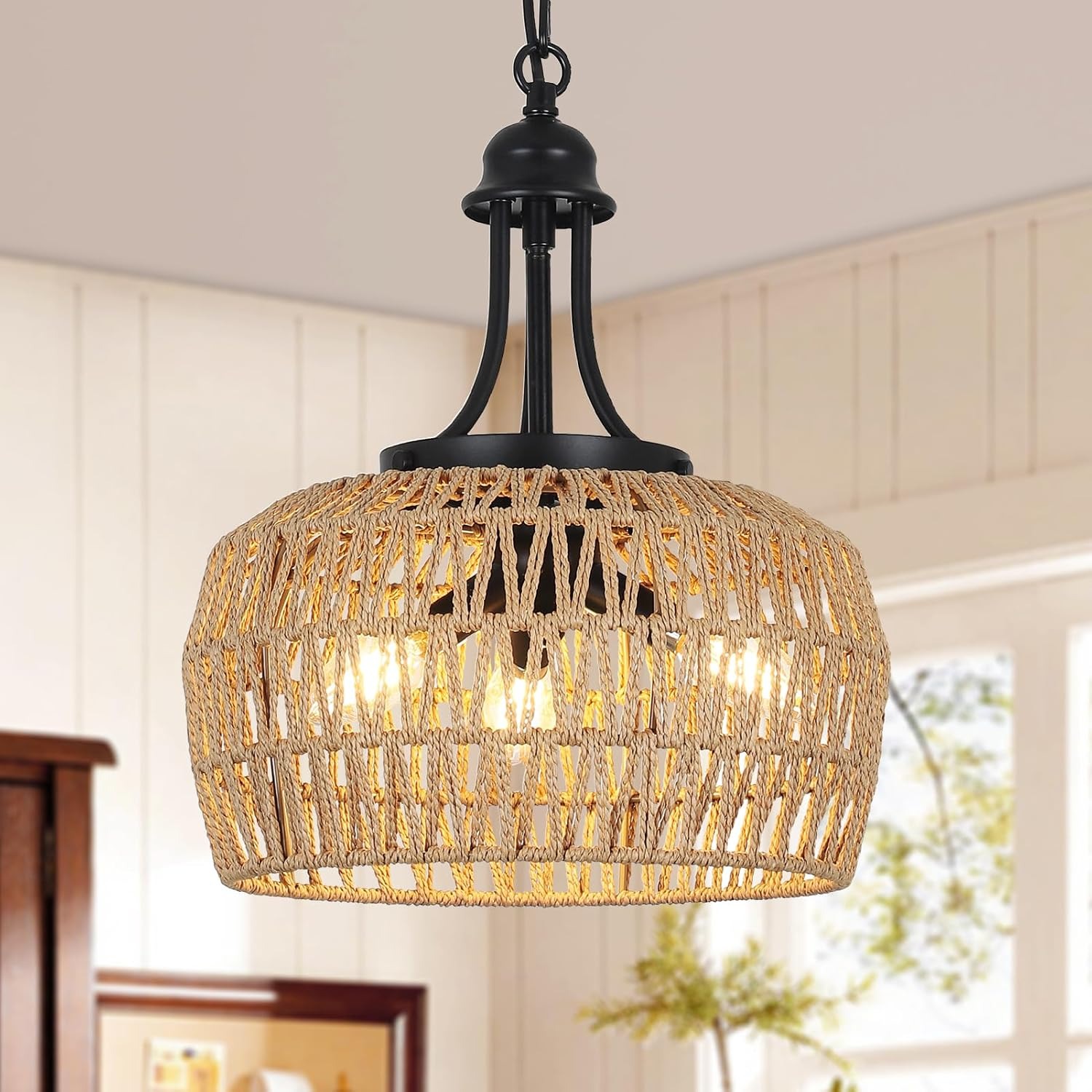
A woven shade changes that. Instead of one bright disc on the ceiling, you get a textured object with light coming through it. The weave breaks the beam into patterns that land on the walls and the table. The room reads as warmer even when the bulb temperature has not changed. That is the whole case for a rattan chandelier in one paragraph.
How a woven rattan chandelier actually works
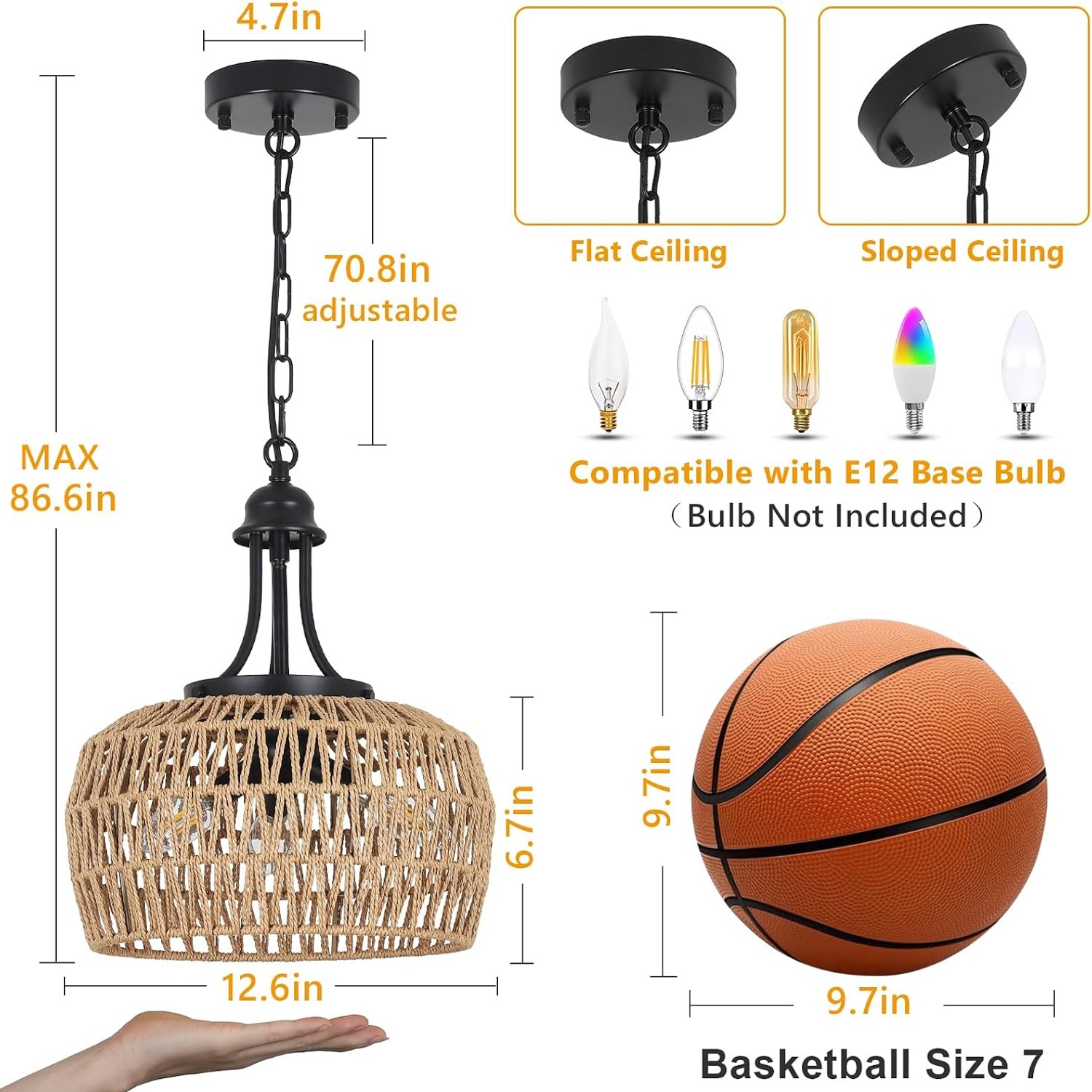
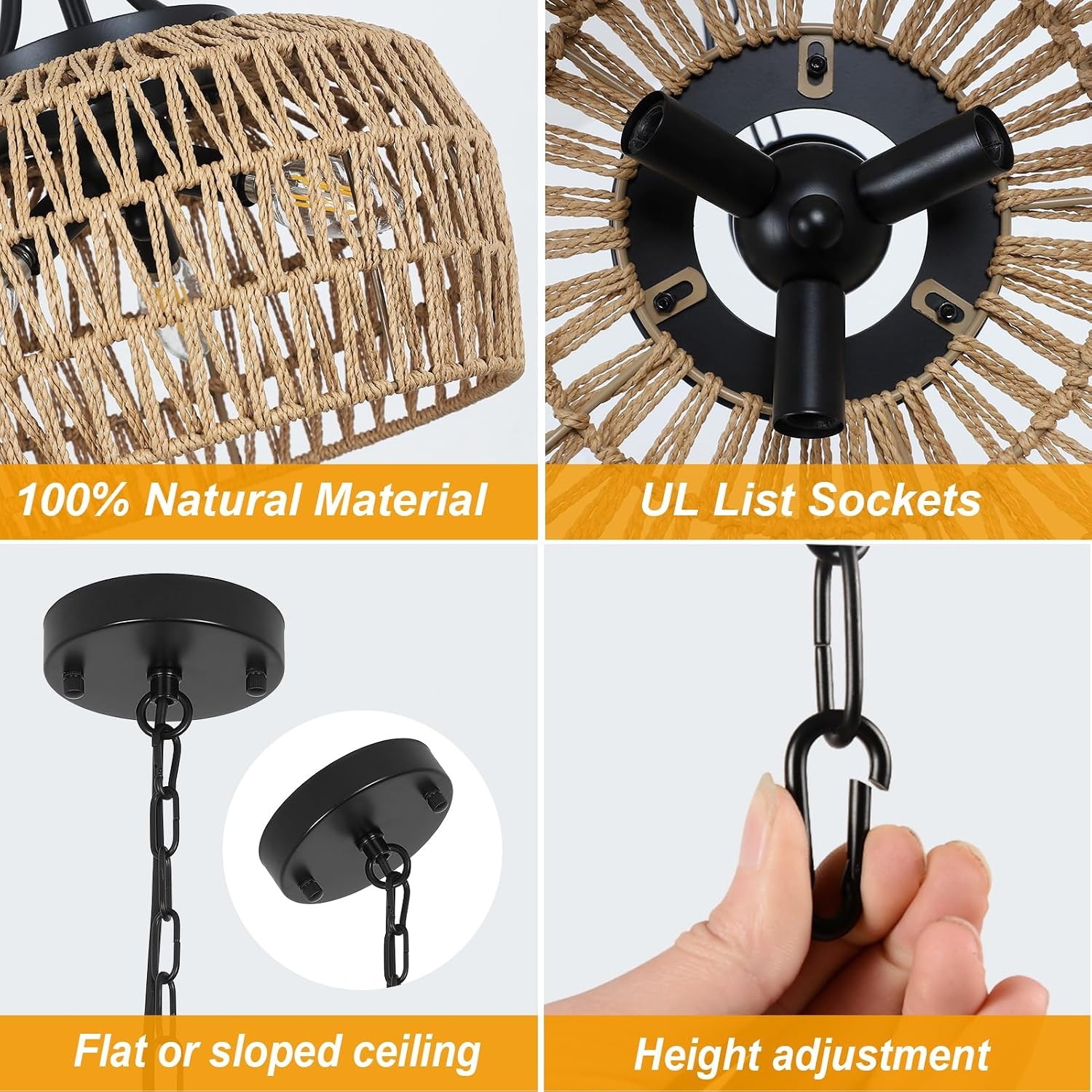
There is less going on inside than you might think, which is a good thing. A metal frame holds three E12 lamp holders. Around that frame sits a hand-woven rattan shade, about 32 cm across on this model. Power comes in through the ceiling, runs to the three sockets, and the bulbs do the rest.
The reason three sockets matter more than one is spread. A single bulb in the middle of a shade creates a hot centre and a dark edge. Three sources sitting apart from each other send light out at different angles, so it crosses through the weave in more directions. Under the fixture you get a broader pool of light. On the walls you get softer patterns rather than one sharp projection.
The shade itself is not just decoration. Open weaving lets a good share of the light escape sideways, which lifts the whole room rather than only the floor under the fitting. Tighter weaving pushes more light down. This one is listed as a downlight, so expect the strongest light on whatever is directly below it, with a pleasant glow spilling out around the sides.
Output is listed at up to 2000 lumens in warm white, with a 40 watt maximum per socket. In real terms, that means you have room to go bright for a working kitchen or stay low and soft for a dining room. The fixture does not decide that. Your bulbs do.
Who this suits
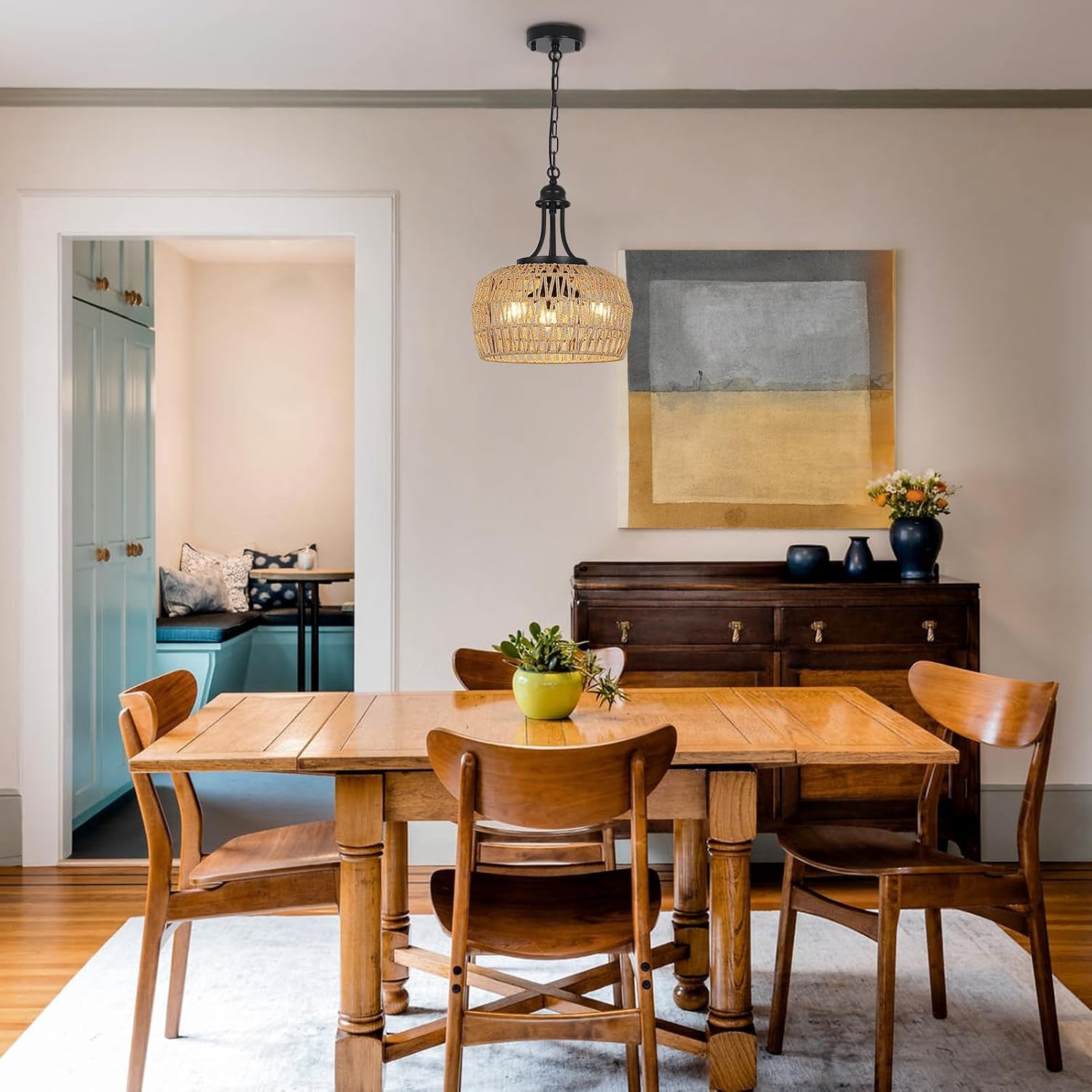
If you have a small to medium dining table, a kitchen island, a hallway, a bedroom or a nursery, the scale works. A 32 cm shade sits comfortably in those spaces without dominating them. It is a sensible pick if you have been hunting for the best small dining chandelier and keep finding fittings that are far too wide.
It also suits people with lower ceilings, because of the adjustable drop. Run it short and it behaves like a semi flush mount fitting, clearing heads in a hallway or over a landing. Let the drop out and it hangs the way a pendant should over a table.
Where it does not suit: bathrooms, laundries, covered porches and anywhere steam gathers. The fitting is indoor only and not water resistant. Natural rattan and damp air are a bad long-term match, and no amount of careful placement fixes that. Pick something rated for damp locations in those rooms.
It is also worth saying that this is a hardwired fitting. There is no plug. If you are renting and cannot alter the wiring, this is not the one for you.
How to choose the right size and drop
Start with the table or the space underneath. A rough rule for dining is that the shade should be about half to two thirds the width of the table. For a table around 80 to 100 cm wide, a 32 cm shade sits nicely. Over a wider table, two of these in a row often looks better than one undersized fitting stranded in the middle.
For drop height over a table, aim for the bottom of the shade to sit roughly 75 to 90 cm above the tabletop. Low enough to feel intimate, high enough that people can see each other. In a hallway or walkway, the bottom of the fitting should clear 2.1 m from the floor at minimum so nobody clips it.
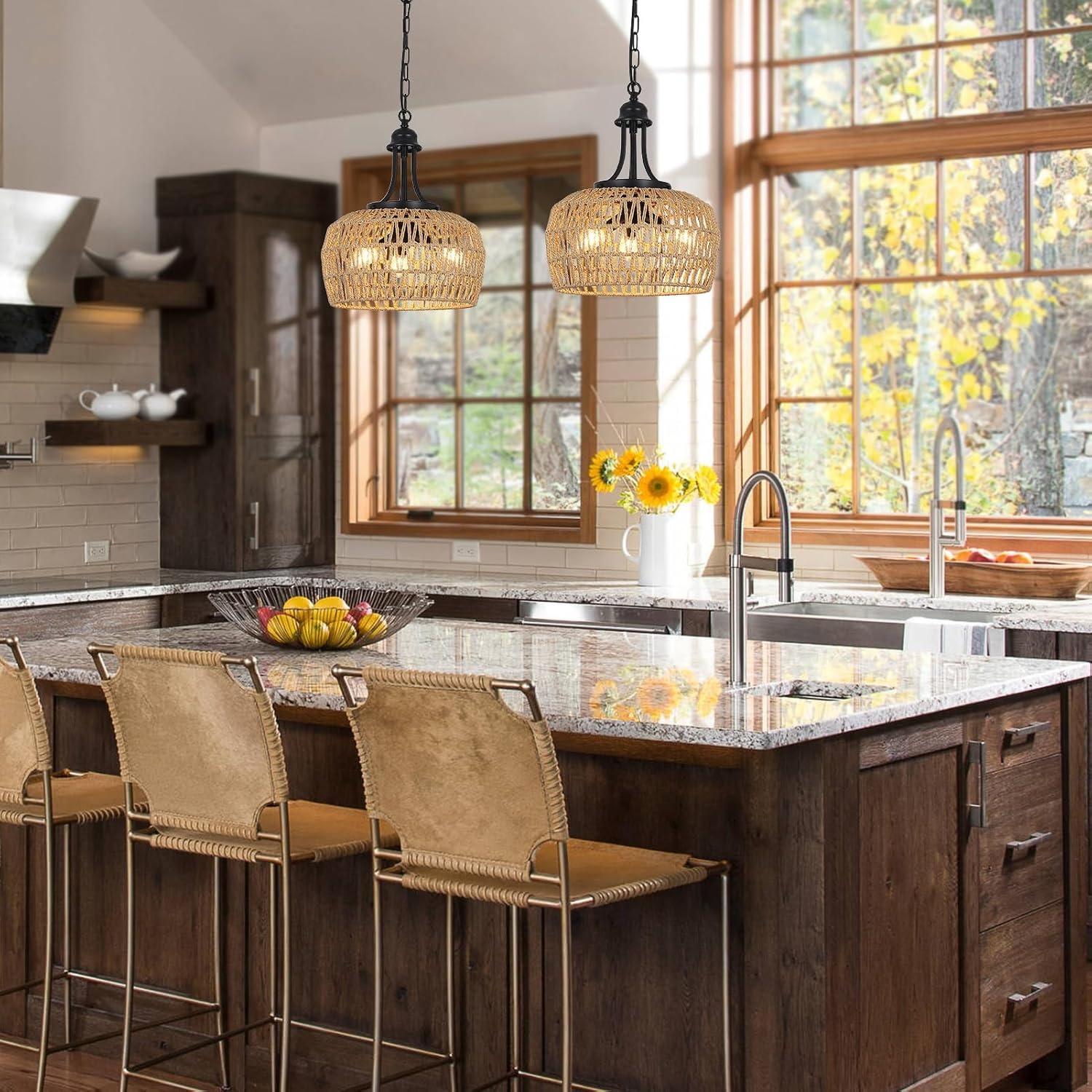
Over a kitchen island, think about what you do underneath. If you prep food there, hang it a touch higher and go brighter with the bulbs. If it is mostly a breakfast bar, drop it lower and go warmer.
If you are hanging more than one, space the centres about 60 to 75 cm apart for a shade this size. Measure and mark on the ceiling with pencil before anyone drills anything.
Picking bulbs
This is where most people either make or break the result, so it is worth a minute. The fitting takes three E12 bulbs, up to 40 watts each. Bulbs are not included.
For warmth, look at colour temperature. Around 2700K gives you a soft, yellowish light that suits dining and bedrooms. 3000K is slightly crisper and works in kitchens. Anything above 4000K will feel cold and will fight the natural rattan rather than complement it.
For brightness, three LEDs at roughly 400 to 600 lumens each covers a typical dining area. If the room is large or the ceiling is high, go higher. If it is a bedroom, go lower.
If you want flexibility, buy dimmable LED bulbs and have a compatible dimmer fitted. Being able to take the light right down in the evening is the single best upgrade you can make to a dining fixture. Just make sure the dimmer is rated for LED loads, since older dimmers designed for incandescent bulbs often flicker with modern LEDs.
Filament-style LED bulbs are a nice touch here. The visible filament looks good through an open weave, and they run cool.
Installation notes
The fitting is hardwired and listed at 110 volts AC. In most places that means a licensed electrician should connect it. Power off at the breaker, not just the wall switch, before anything starts.
At 1.81 kg it is light, which makes the job easier. A standard ceiling box will take that weight without extra bracing in most homes, but your electrician will confirm based on what is actually up there. Plasterboard ceilings with no joist behind the box sometimes need a brace regardless of weight.
Set the drop before final tightening. It is far easier to adjust the chain or rod while the fixture is loose than to go back up a ladder later. Stand back and look at it from a seated position too, since that is how you will see it most of the time in a dining room.
Living with it and keeping it clean
Rattan collects dust. That is the one maintenance task and it is not a big one. Every month or two, kill the power and run a soft dry brush or a vacuum brush attachment over the weave on low suction. Work with the direction of the weave rather than against it.
Metal parts get a barely damp cloth and an immediate dry. That is it. Do not soak the shade, do not use solvents or bleach, and skip anything abrasive. If a mark will not lift with a slightly damp cloth, leave it. Natural materials carry a bit of character and trying to scrub it out usually does more harm.
Keep it away from steam and sustained humidity. If your kitchen cooks hard with poor extraction, think about how much steam actually reaches the ceiling before you mount it there.
The short version
This is a compact hand-woven rattan chandelier with three E12 sockets, an adjustable drop and a 32 cm round shade. It weighs 1.81 kg, runs at 110 volts AC, takes bulbs up to 40 watts each, and lists warm white output to 2000 lumens. Bulbs are not included and it needs hardwiring.
It is indoor only and not water resistant, so keep it out of wet rooms. It suits dining rooms, kitchen islands, hallways and bedrooms, and the semi flush option makes it workable with lower ceilings. backs it with a 2 year warranty.
Buy good warm dimmable bulbs, get the drop height right, and dust it now and then. Do those three things and it will look as good in five years as it does on day one.