
The complete guide
How to Choose a Black Crystal Semi Flush Ceiling Light
The problem with low ceilings
Most people who want a chandelier do not have the ceiling for one. Standard rooms sit around 2.4 metres, and once you hang a fixture on a chain you are suddenly dealing with something at eye level. In a hallway that is worse. People carry laundry baskets through hallways. They walk through with a toddler on their shoulders. A pendant in that spot is a problem waiting to happen.
The usual fallback is a plain dome light. It is safe, it works, and it is completely forgettable. You end up with a ceiling that does nothing for the room.
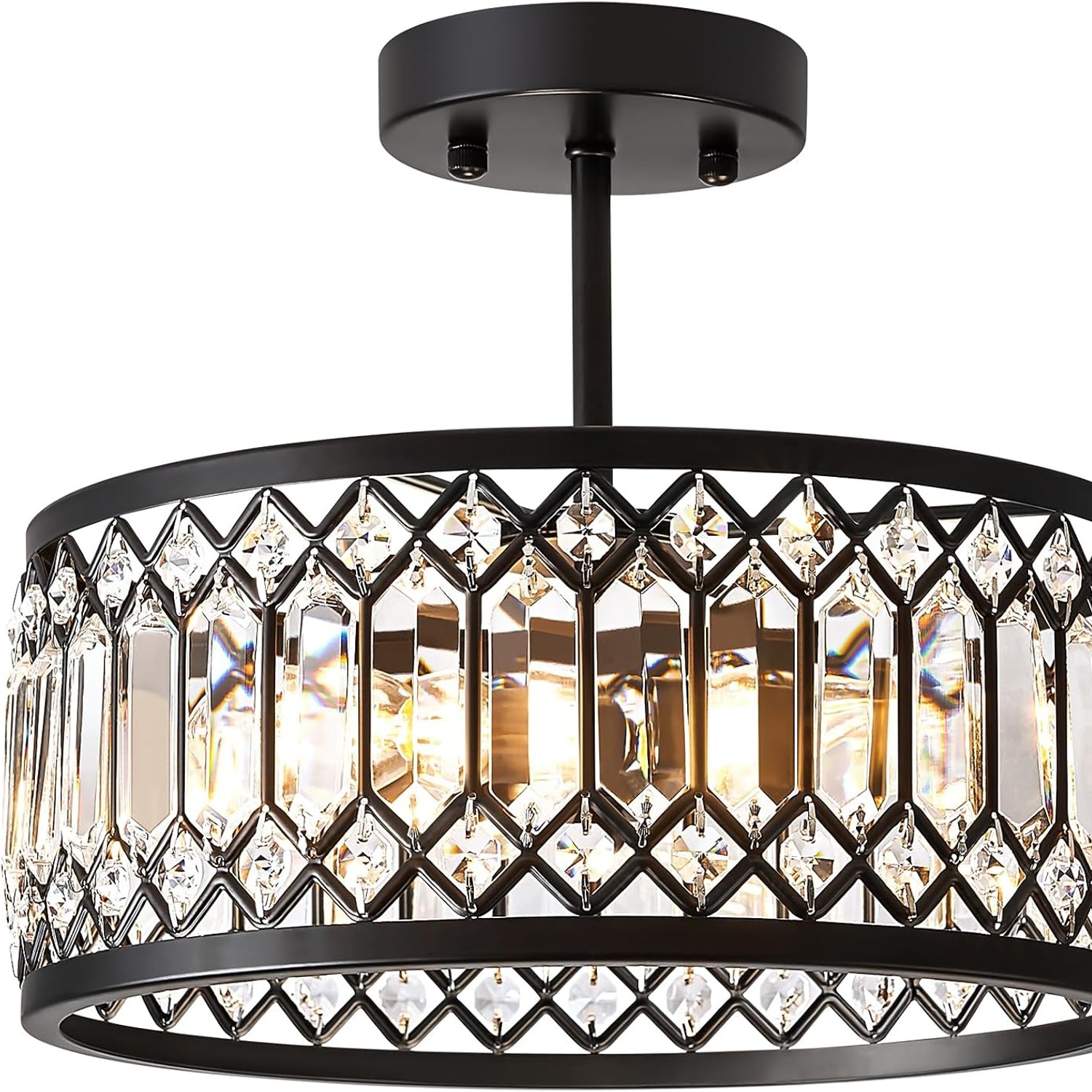
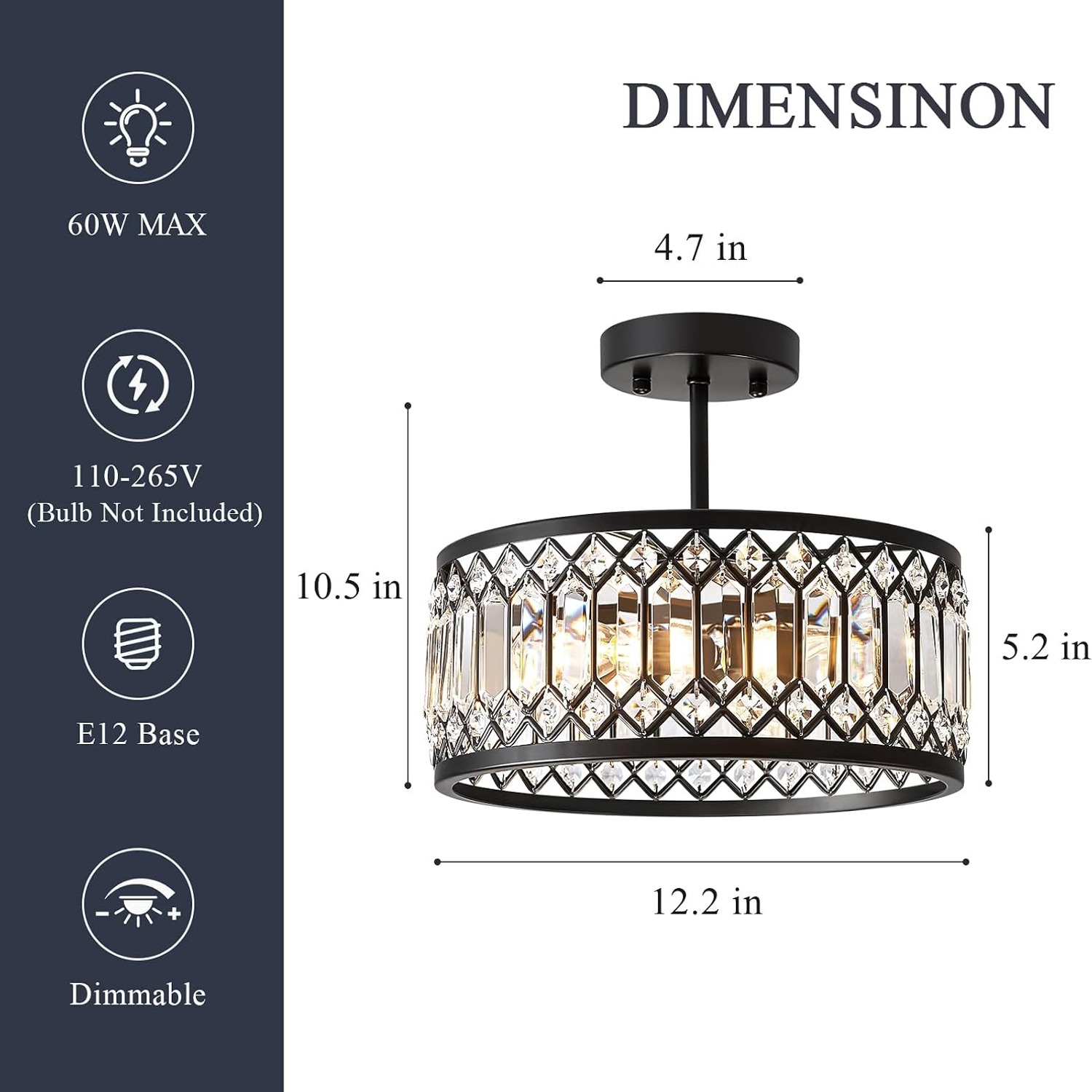
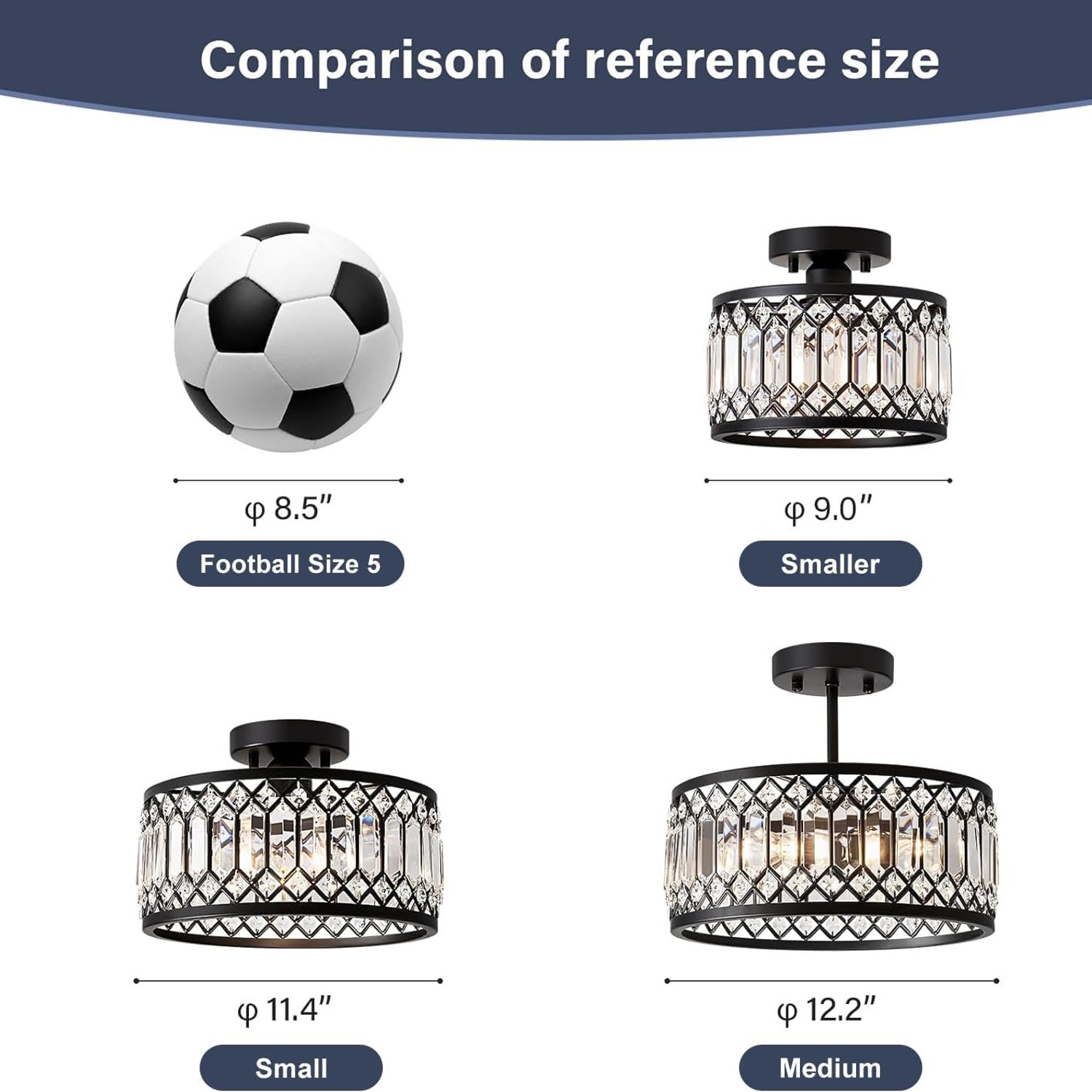
A semi flush mount sits in between. It keeps the fixture tight against the ceiling, but it still has shape and detail. This particular one stands 25.9 cm tall and spans 30 cm across, so it hugs the ceiling while giving you crystal and a black metal frame to look at. That is the whole point of the category. You get decoration without the drop.
How a crystal semi flush actually works
The mechanics are simple. A metal canopy screws to the ceiling box and covers the wiring. Below that sits the body of the fixture, which here holds three E12 candelabra sockets. Crystal pieces are mounted around and over those sockets, and the bottom stays open so light travels straight down.
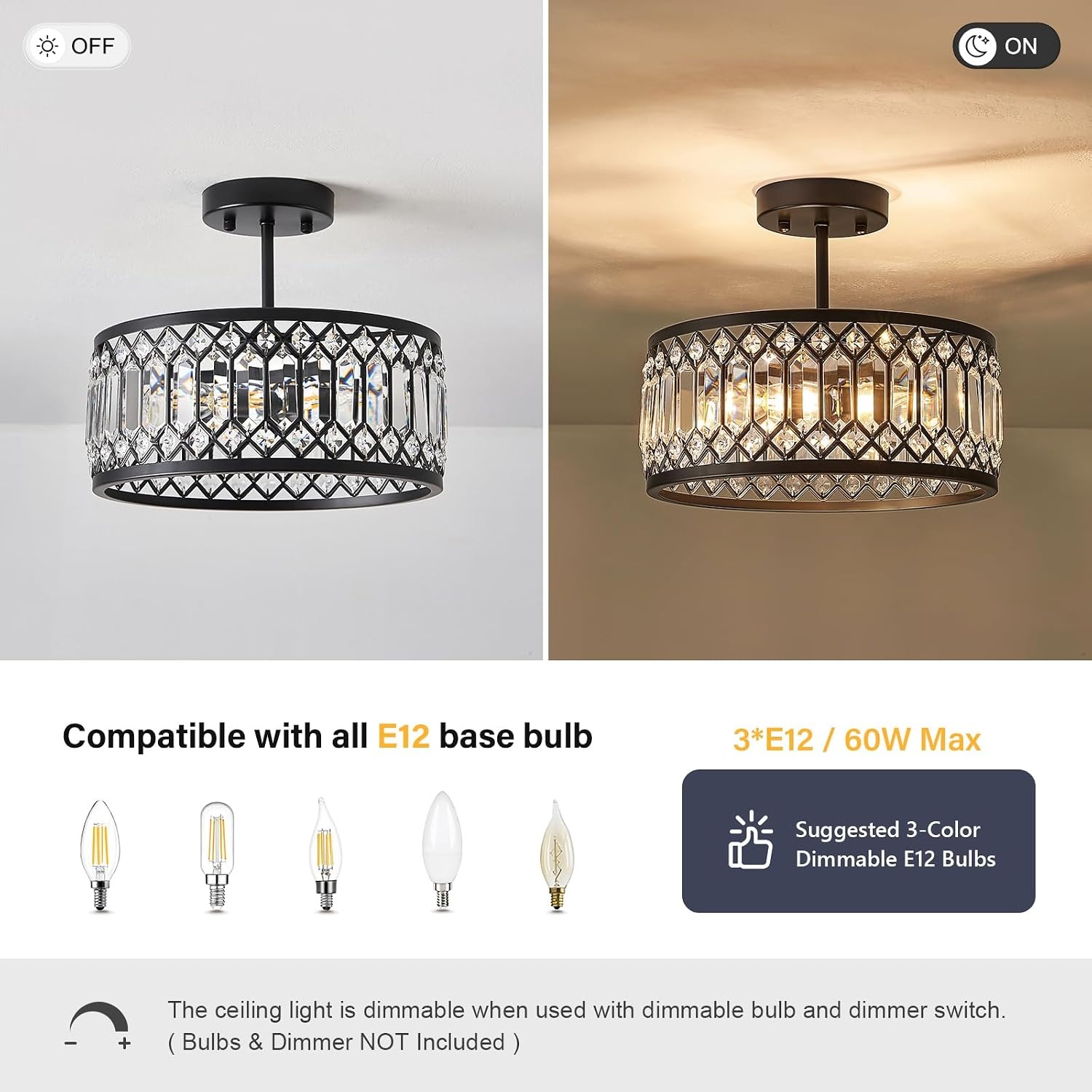
The crystal is doing two jobs. First, it looks like something when the light is off, which is more than half the time. Second, when bulbs are lit, the crystal refracts and scatters the beam. You get bright points of light on the ceiling and soft patterns on nearby walls. The effect is strongest with clear filament bulbs and weakest with frosted ones, which is a useful lever when you are setting the mood of a room.
The black lacquered frame is a deliberate contrast. Against a white ceiling it gives the fixture a defined outline instead of letting it blur into the paint. In rooms with black hardware, dark window frames or matte black taps, it ties in without effort. That contrast is what makes a black crystal ceiling light read as modern rather than traditional, even though crystal is an old idea.
Bulbs are your real decision
This fixture ships without bulbs, and that is genuinely better than the alternative. Supplied bulbs are usually the cheapest available and the first thing people throw out.
You need three E12 candelabra base bulbs, each 60 watts maximum. E12 is the small screw base. If you grab a standard household bulb off the shelf it will not thread in, so check the base code printed on the box.
Beyond that, think about colour temperature. Warm white, somewhere around 2700K, gives a soft amber light that suits bedrooms, dining rooms and entries. Neutral white around 3500K to 4000K is brighter and more practical for kitchens and laundries. Cool white above 4000K works in a utility space but usually feels harsh under crystal, because the sparkle starts to look clinical.
Shape matters too. Flame-tip candelabra bulbs lean traditional. Clear globe filament bulbs lean modern and throw the sharpest patterns through the crystal. Frosted bulbs are the gentlest on the eye, which is worth considering in a room where you will be looking up at the fixture from a bed or a sofa.
The maximum light output listed is 2700 lumens. You rarely need all of it. Three 400 to 600 lumen LEDs will light a bedroom or hallway comfortably without feeling like a shop display.
Dimming, switches and wiring
Dimming is possible, but it is a two-part job. You need dimmable bulbs and a dimmer switch that works with them. Neither comes in the box. If you put non-dimmable LEDs on a dimmer, they will flicker, buzz, or simply refuse to go low. If you want dimming, buy the bulbs and the switch together and check they are listed as compatible.
The fixture is hardwired and runs at 120 volts AC. If you live somewhere on a 220 to 240 volt supply, do not guess. Have an electrician confirm compatibility before you order or install. Wiring rules differ by country and getting this wrong is not a minor mistake.
One more constraint worth repeating. This fixture is built for flat ceilings. It will not sit correctly on a sloped or vaulted surface, and there is no adapter mentioned in the product details. If your ceiling angles, look at a fixture designed for that specifically.
Where it suits best
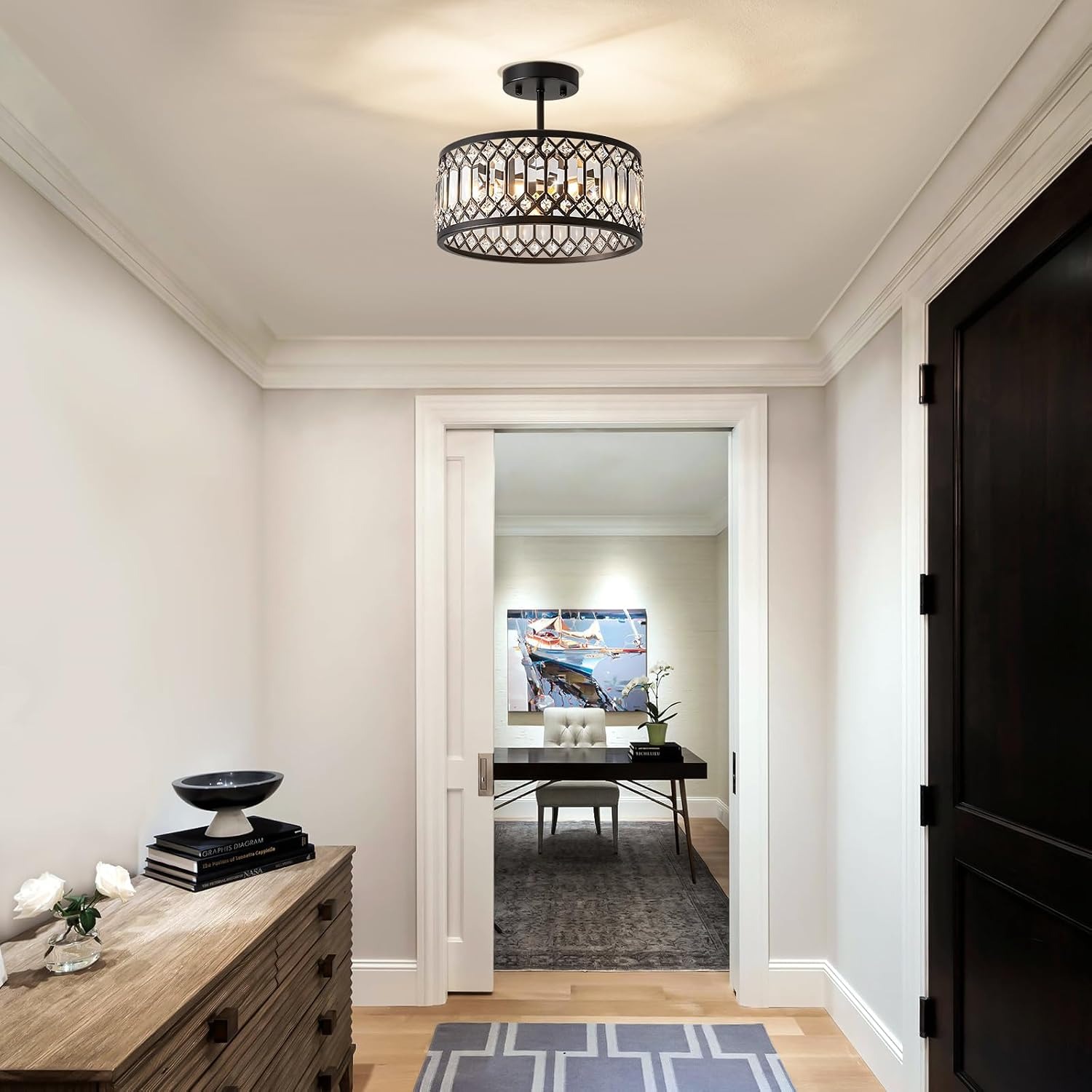
Hallways and entries are the obvious fit. These are high-traffic spaces where a hanging fixture is a nuisance, and they are also the first thing visitors see. A fixture with some detail does real work there.
Bedrooms are the second use case. Three candelabra bulbs on a dimmer give you bright light for getting dressed and a low glow for evenings. Many people still add a bedside lamp for reading, which is fine, since ceiling light is rarely the right angle for a book.
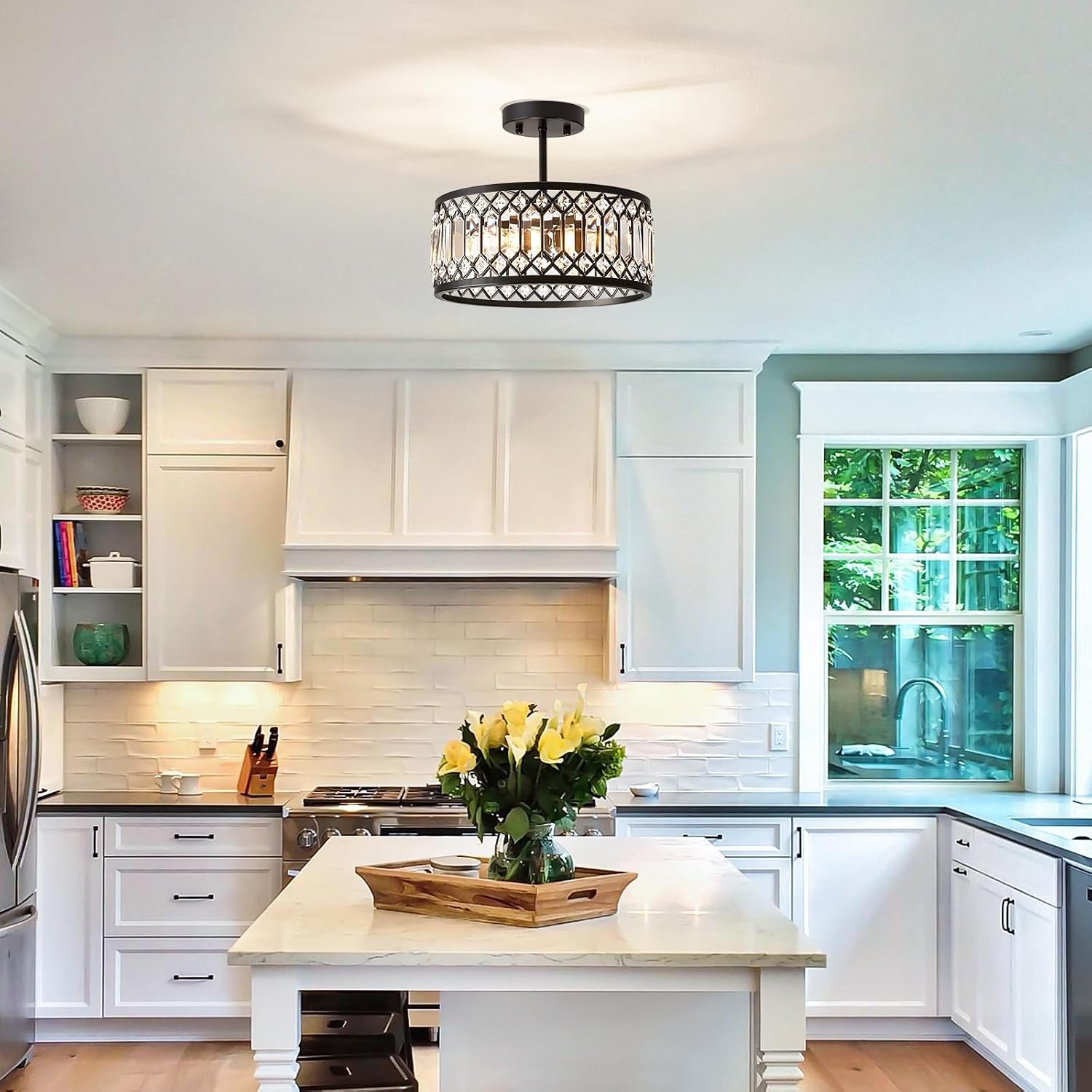
Small dining rooms work well because the crystal is genuinely at its best over a table. A kitchen is practical if you pick cooler bulbs, though do expect to wipe the crystal more often because of airborne grease. Walk-in closets, laundry rooms and stairway landings round out the list. In each case the reason is the same, which is limited headroom paired with a wish for something better than a dome.
Where it does not belong is outdoors or anywhere exposed to water. The fixture is indoor only and not water resistant. Bathrooms are a grey area that depends on your local wiring zones, so check the rules where you live.
Sizing and clearance
At 30 cm wide this is a compact fixture. In a hallway or a closet it is right at home. Over a dining table it suits a four to six seat setup, though a larger room may call for a wider fixture or a second light source.
The 25.9 cm height is the number that matters most. Measure from your ceiling to the top of any door swing, tall furniture, or ceiling fan path nearby. With 2.4 metre ceilings you will have well over two metres of clearance underneath, which is plenty for walking traffic.
Weight is 2.42 kg. That is modest, but your installer should still confirm the ceiling box is secure and rated for a fixture before mounting.
Looking after it
Crystal only sparkles when it is clean. Dust settles fast on horizontal surfaces, and a dusty crystal shade loses the pattern effect entirely.
Turn the fixture off at the wall and let the bulbs cool before you touch anything. Dust with a dry microfibre cloth every month or two. For fingerprints or light grime, dampen the cloth slightly with water, wipe, then dry immediately. Skip solvents, bleach and anything abrasive, which can mark the lacquered black finish. Never spray liquid directly at the fixture, especially near the sockets.
Bulb changes are easy thanks to the open bottom. Kill the power, let the old bulb cool, unscrew, replace. Keep a spare set of E12 bulbs in the cupboard so a dead bulb does not become a month-long annoyance.
The short version
If you have a flat ceiling, limited headroom and a room that deserves better than a plain dome, this works. You get a 12 inch crystal flush mount with three E12 sockets, a black lacquered metal frame, and the sparkle of crystal in a package that sits tight against the ceiling.
Buy the bulbs separately and treat that as a feature. Warm LEDs for bedrooms and dining, neutral for kitchens, clear filament if you want the strongest light patterns. Add a dimmer only if your bulbs are dimmable.
Check your voltage, confirm your ceiling is flat, and get an electrician if hardwiring is not your thing. Do those three things and it is a straightforward upgrade to a room that was probably being let down by its ceiling.