
The complete guide
How to Choose a 6-Light Brushed Gold Chandelier
The problem with one light in the middle of the ceiling
Walk into most dining rooms and you will find a single fixture dead centre, doing its best. It throws light down in a narrow cone. The middle of the table is bright. The edges are not. People sitting opposite each other get shadows under their eyes, and the corners of the room disappear after dark.
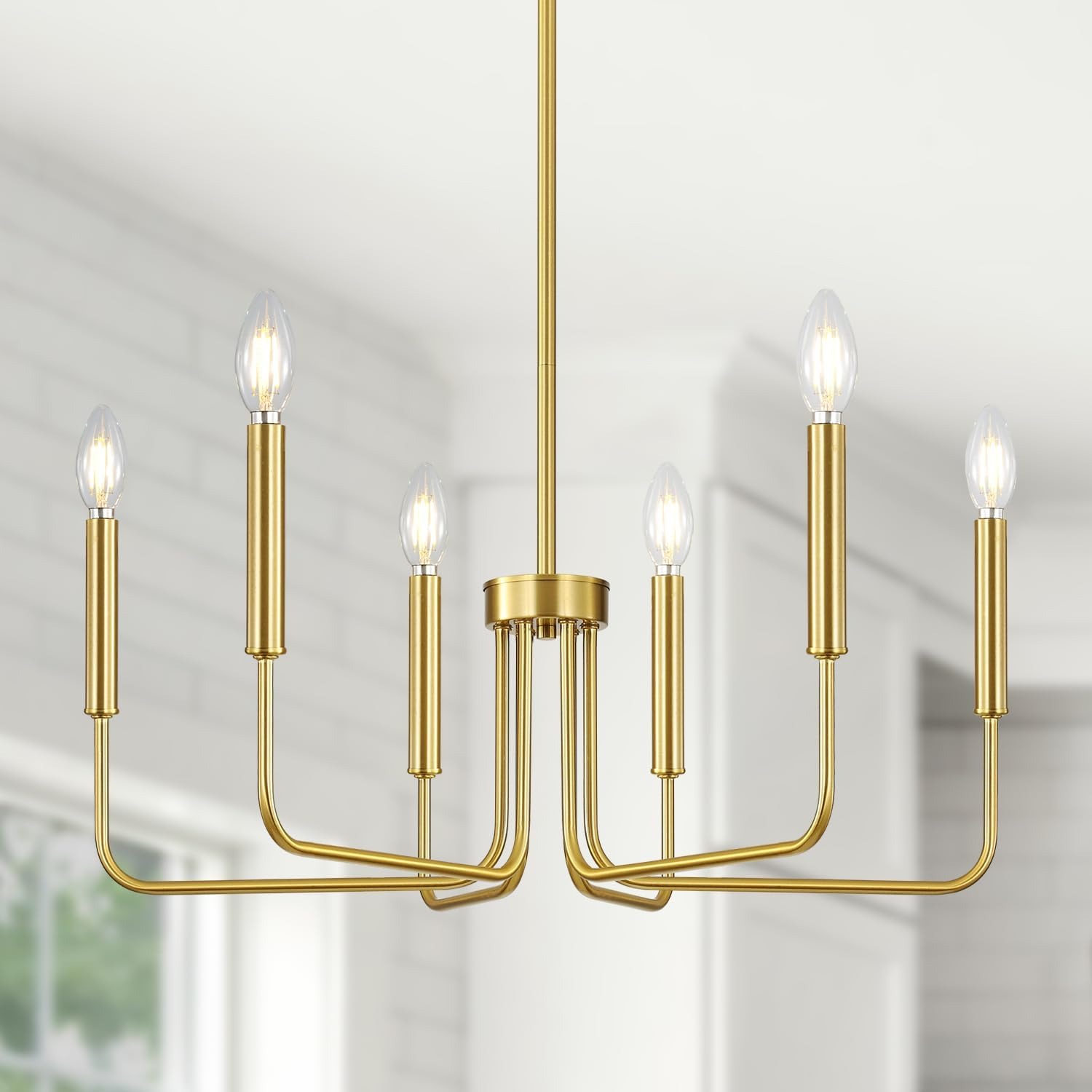
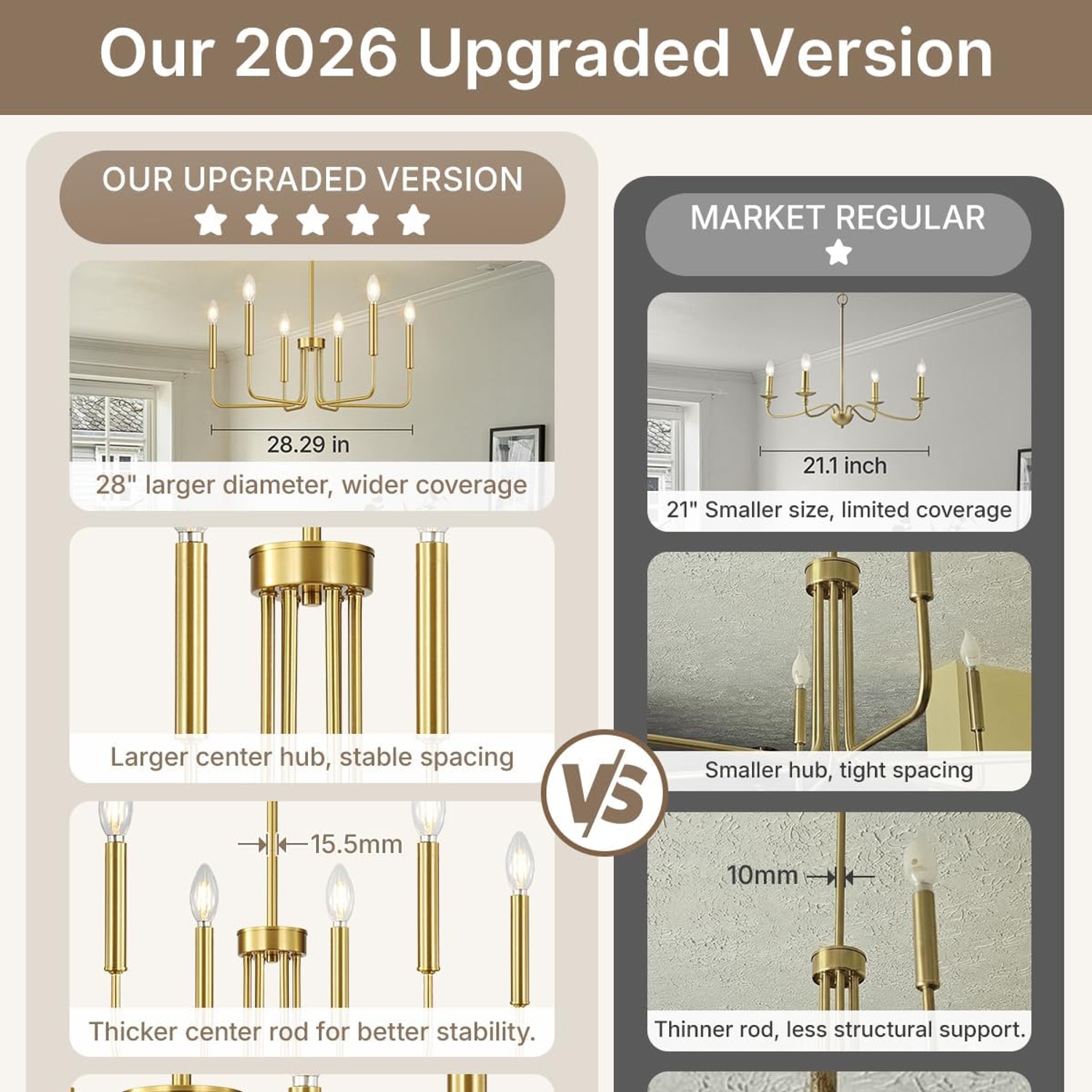
A chandelier with six arms solves that in a simple, physical way. Six light sources spread across a 71.9 cm circle means light arrives from several angles instead of one. Shadows soften. The table feels evenly lit end to end. The room stops looking like a space with a lamp in it and starts looking like a room that was designed.
That is really the whole argument for a multi-light fixture. Not that it is fancier, though it usually is, but that it distributes light better across a surface you actually use.
How this chandelier works
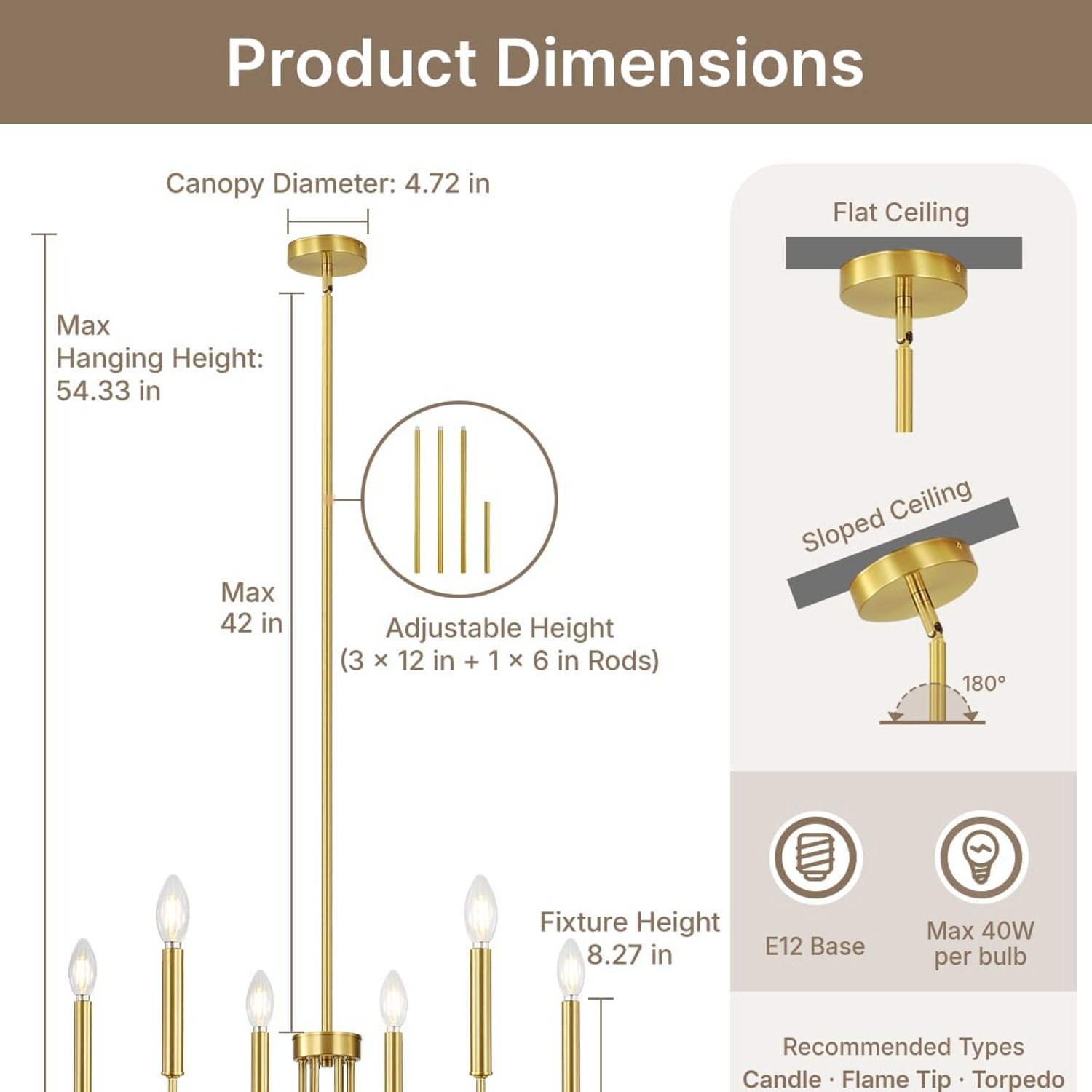
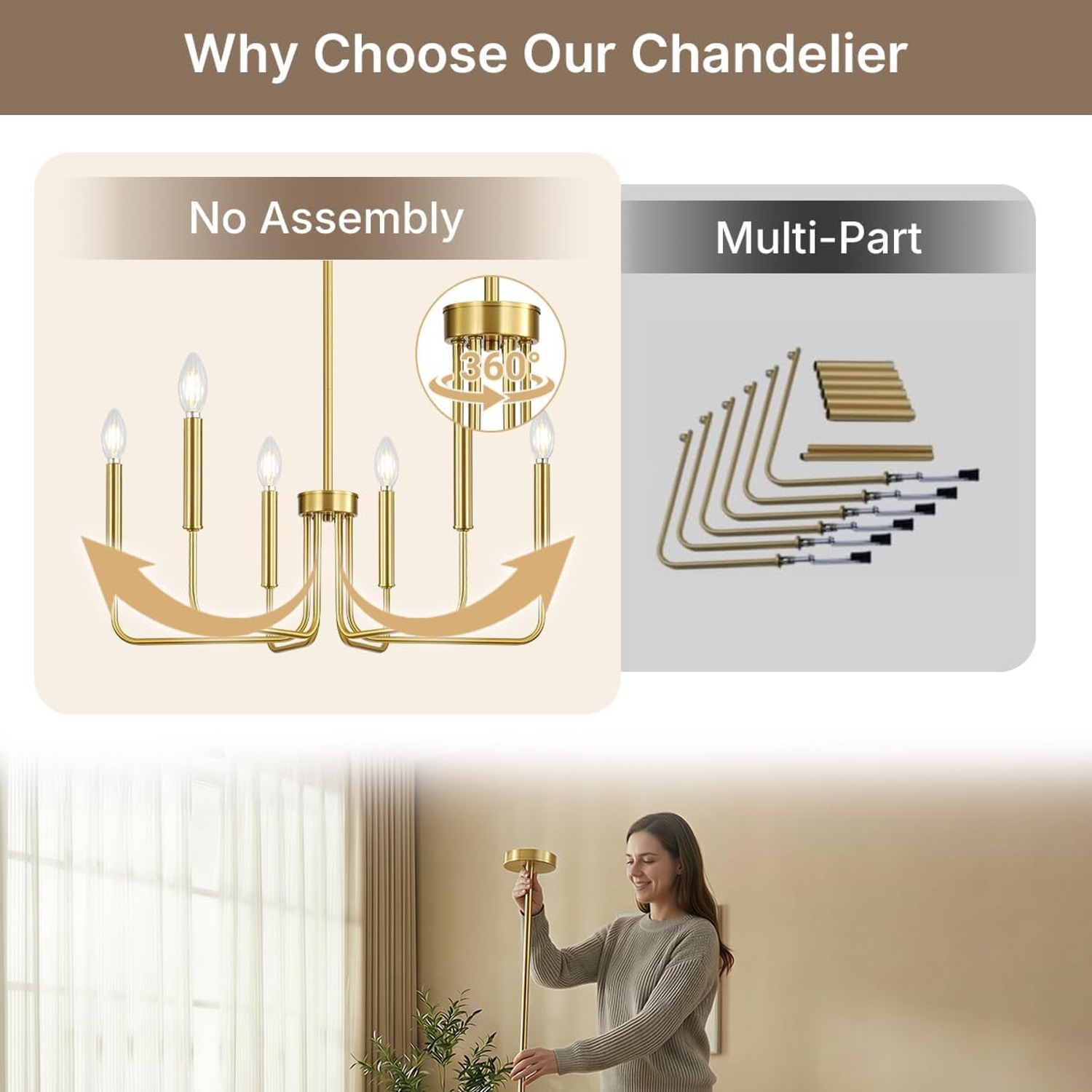
The body is metal with a brushed gold finish, built as one piece so the arms do not need assembling on a ladder. Each of the six arms ends in an E12 candelabra socket rated to 40 watts.
Bulbs are not included, which is normal for this kind of fixture and genuinely useful. You pick the look. LED candle bulbs keep running costs low and barely warm the room. Filament-style LEDs give you a visible glowing coil, which suits the farmhouse side of the design. If you want to dim, you need dimmable bulbs and a compatible dimmer switch, and you will need to buy both.
The listed maximum light output is 4800 lumens. That is the ceiling, not the guarantee. Six low-output candle bulbs will give you something gentle and atmospheric. Six brighter ones will light a working kitchen island. It is worth thinking about which job you need before you buy bulbs.
Installation offers two useful features. Adjustable rods let you set the drop, and a 180 degree swivel joint at the top compensates for sloped or vaulted ceilings so the fixture still hangs level. At 3.1 kg the whole thing is light, which keeps the load on a standard ceiling box sensible and makes the lift easier when you are holding it over your head.
Who it suits
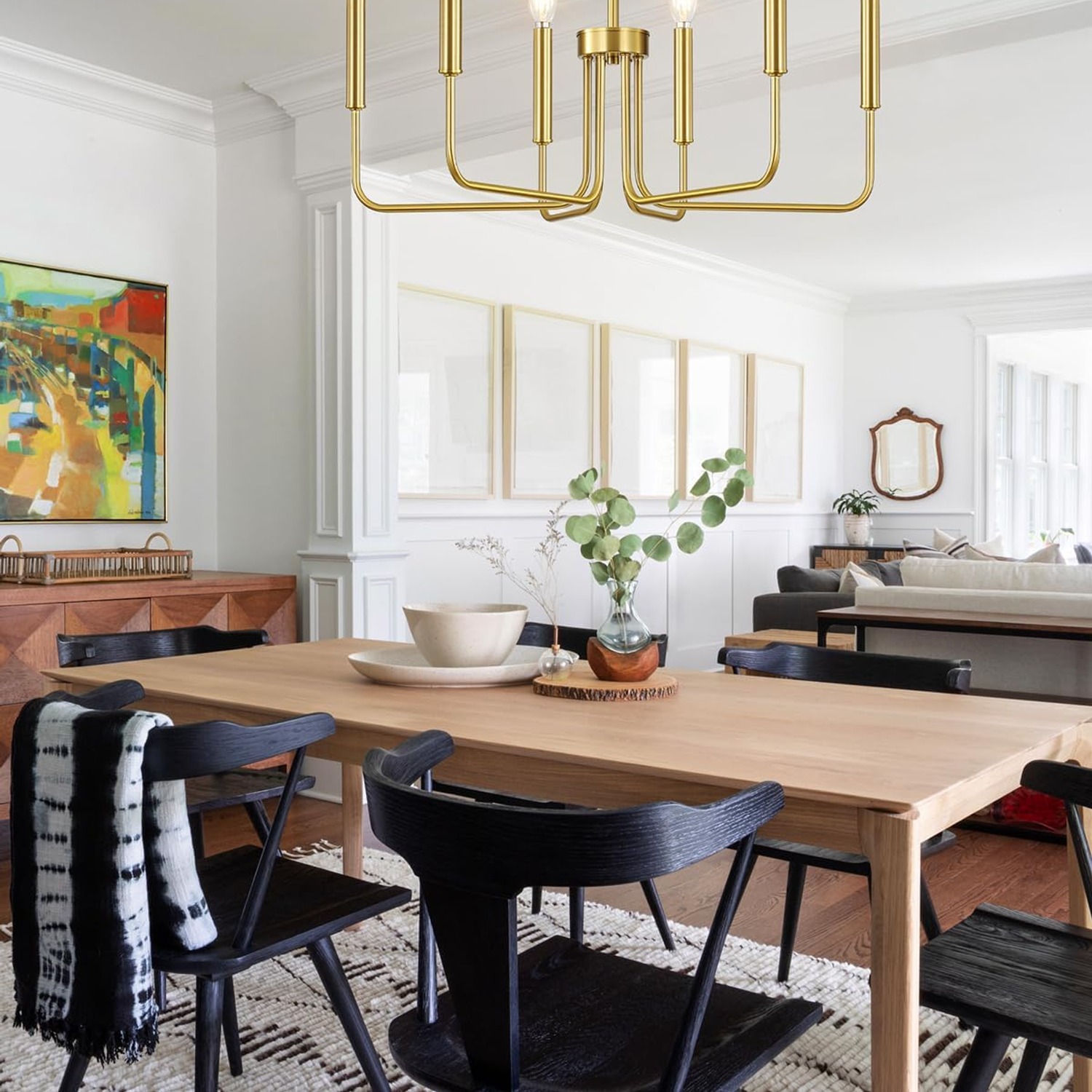
This works best in rooms where a wide fixture has room to breathe. A dining table is the obvious one. A kitchen island is another, particularly if the island is long enough to carry a 28 inch circle without crowding the overhead cabinets. Entryways with a bit of ceiling height are a good fit, since a chandelier at the door sets the tone for the rest of the house.
Living rooms work if the ceiling is high enough that nobody walks into it. Bedrooms can work beautifully over the foot of the bed or centred in a larger room, though a small bedroom will feel tight with a fixture this wide.
Where it does not belong is anywhere damp. The fixture is listed as indoor only and not water resistant. That rules out bathrooms with open showers, laundries that get steamy and any outdoor or semi-outdoor spot. If you want something similar in a wet area, you need a fixture specifically rated for it.
Style-wise, the theme covers farmhouse, industrial and modern. That sounds like fence-sitting, but with a brushed gold candle-arm fixture it is accurate. Put it over a reclaimed wood table and it reads rustic. Put it in a white room with flat-panel cabinets and it reads contemporary. The flame-shaped arm profile is the detail that bridges the two.
How to choose the right size and height
Width first. A fixture about 71.9 cm across wants a table of around 90 cm wide or more to look balanced. A rough rule many people use is to make the chandelier roughly half to two thirds the width of the table. Narrower than that and the fixture starts to look oversized.
Height next, and this matters more than people expect. Over a dining table, aim for 75 to 90 cm between the tabletop and the bottom of the fixture. That keeps the light where the food is without putting metalwork in the middle of a conversation. In an entryway or a room where people walk underneath, keep at least 210 cm of clear headroom, and more if anyone in the house is tall.
If your ceiling is sloped, measure at the lowest point of the chandelier's position, not at the peak. The swivel joint will keep the body straight, but the drop still needs to be checked against the real clearance.
For low ceilings, use the semi flush configuration and the shortest rod. For high ceilings, add rod length until the fixture sits in the visual middle of the space rather than floating near the roof.
Picking bulbs
Six bulbs is a meaningful decision, because they set colour, brightness and running cost all at once.
Warm white, usually around 2700K, suits dining and living spaces. It flatters skin tones and food, and it pairs naturally with a gold finish. Neutral white around 3000K to 3500K is a reasonable compromise if the chandelier sits near a kitchen with cooler downlights. Anything cooler than that tends to fight the warmth of the brushed gold.
Stay within the 40 watt per socket limit. With LEDs that is almost never an issue, since most E12 LED candles draw a few watts while producing the equivalent light of a 40 watt incandescent. If you do run older incandescent or halogen bulbs, remember they get hot and they use far more power across six sockets.
Buy all six bulbs the same, from the same batch where you can. Mixed colour temperatures across one fixture is one of the most noticeable mistakes in home lighting, and it is easy to avoid.
Installing it without drama
This is a hard-wired fixture, so in many places a licensed electrician is legally required. Even where it is not, it is money well spent. The electrical side is the part that carries risk.
Before anyone gets on a ladder, work out the drop height and set the rods on the ground. Adjusting a chandelier while holding it overhead is miserable. Lay out all the hardware, read the instruction manual, and keep the small parts in a container so nothing rolls under the table.
Check that your ceiling box is rated to support the fixture. At 3.1 kg this one is light, but old boxes vary in condition and a quick check is worth the time.
Fit the bulbs last, once the fixture is mounted and level. Then step back and look at it from the far side of the room before deciding you are finished. Chandeliers that are a few centimetres off level are obvious from a distance and invisible up close.
Looking after it
Maintenance is mostly dusting. Turn the power off at the wall and let the bulbs cool first. A dry microfibre cloth or a soft duster handles ordinary dust on the arms and body.
For marks, use a cloth barely dampened with water and dry straight away. Skip abrasive pads, bleach and solvent cleaners. A brushed metal finish can be dulled permanently by the wrong product, and once it is dull there is no fixing it.
Once or twice a year, check that the mounting screws are still tight and that each bulb is seated firmly. Loose bulbs are behind most flickering, and a quick quarter turn usually sorts it.
The short version
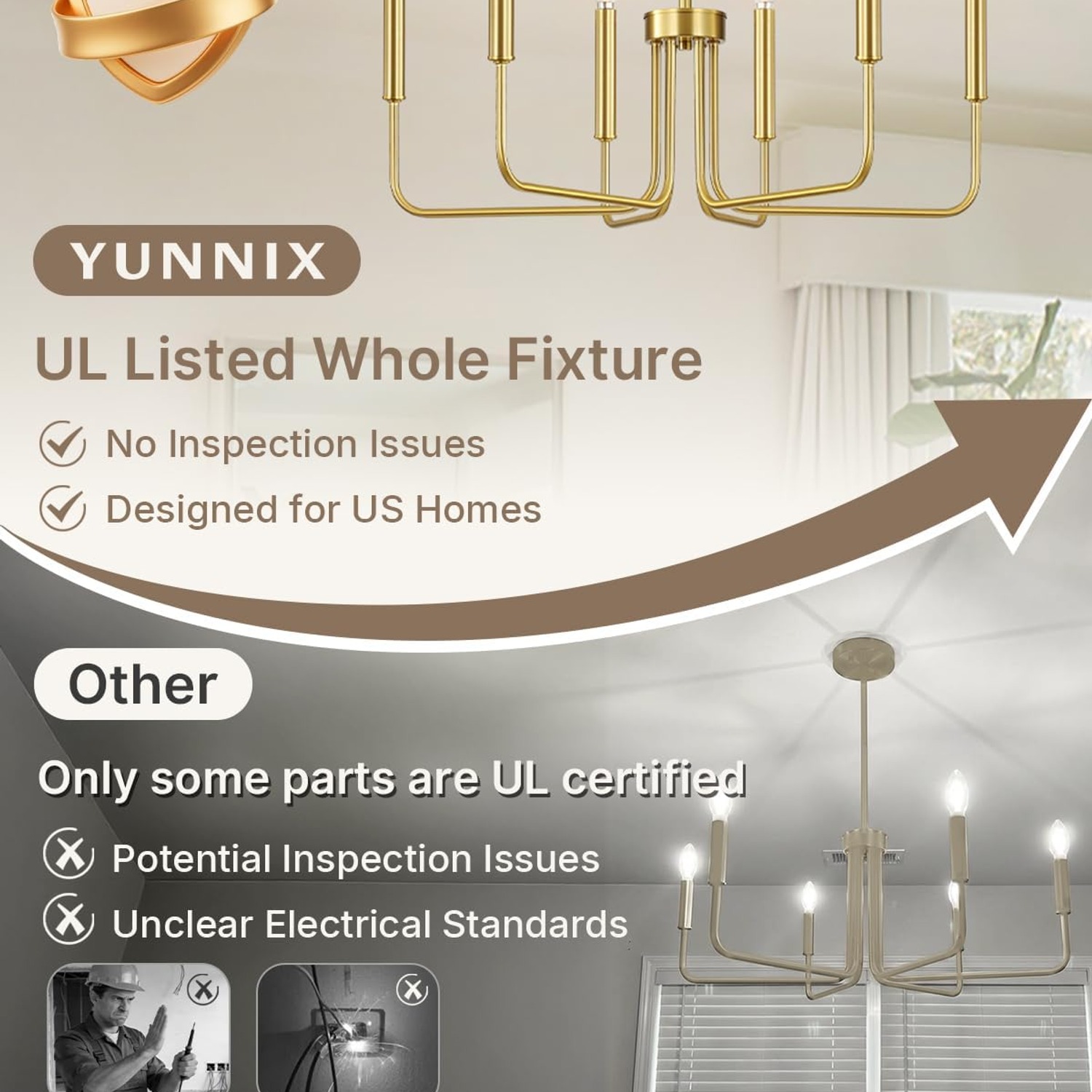
This is a 71.9 cm wide, six-arm chandelier in brushed gold metal, weighing 3.1 kg, with E12 sockets rated to 40 watts each and a listed maximum of 4800 lumens at 120 volts. Adjustable rods and a 180 degree swivel joint let you set the drop and hang it level on flat or sloped ceilings. It is UL listed as a whole fixture, indoor only, not water resistant, and comes with mounting hardware and a manual but no bulbs. The manufacturer warranty is two years.
If you have a dining table, island or entryway that deserves better than a single downlight, and you like the warmth gold brings to a room, this one is worth a look. Measure your clearance, buy six matching warm white bulbs, and let an electrician handle the wiring.