

The complete guide
How to Choose a Crystal Chandelier for Your Dining Room or Living Space
The problem with most ceiling lights
Most rooms get one light in the middle of the ceiling, and most of those lights are forgettable. A flat disc, a frosted dome, something builder-grade that nobody chose. It does the job of making the room not dark, and that is where its ambition ends.
The trouble shows up at dinner. Flat overhead light makes food look dull and faces look tired. There is no focal point, so the eye has nothing to land on. You can add lamps and candles, but you are working around the ceiling light rather than with it.
A crystal chandelier solves two problems at once. It gives you a real light source over the table, and it gives the room a centre. The crystal does something a plain shade cannot, which is split the light into points and scatter them across the ceiling. That is the sparkle people notice without being able to name.
How a crystal chandelier actually works
The mechanics are simple. Light leaves the bulb, hits a faceted piece of crystal, and comes out the other side bent and split. Some of it reflects off the surface. The result is that one bulb produces many small bright spots instead of one even wash.
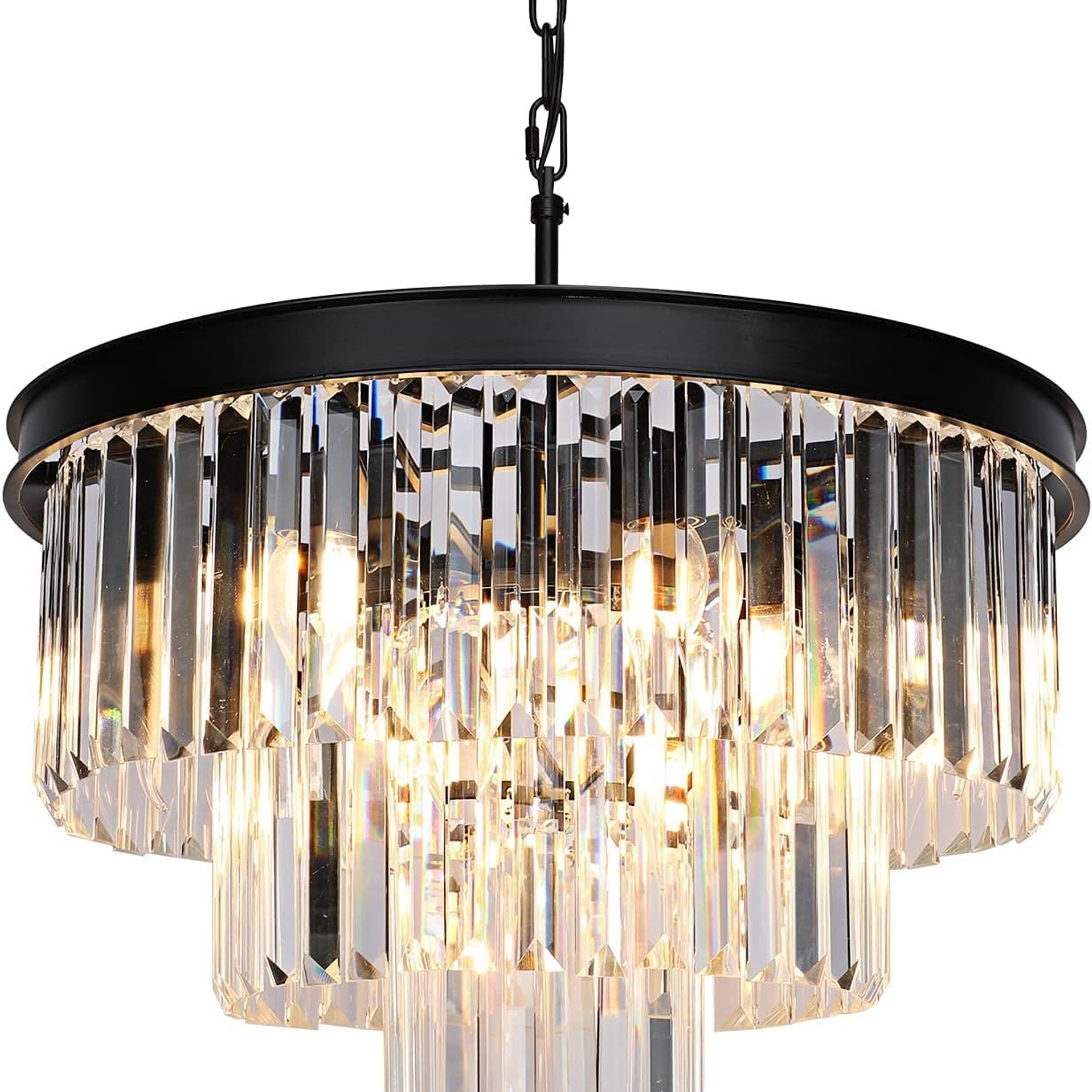
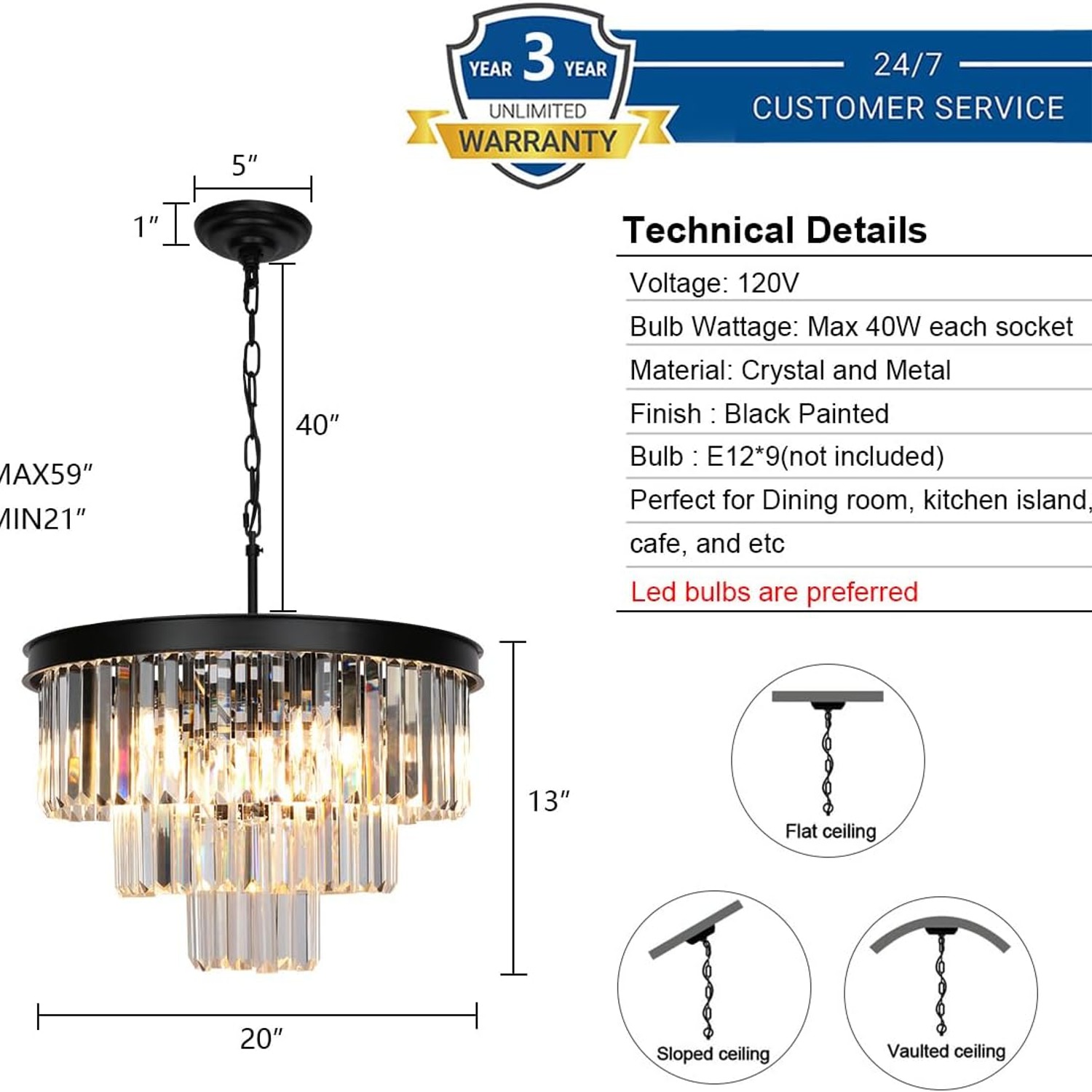
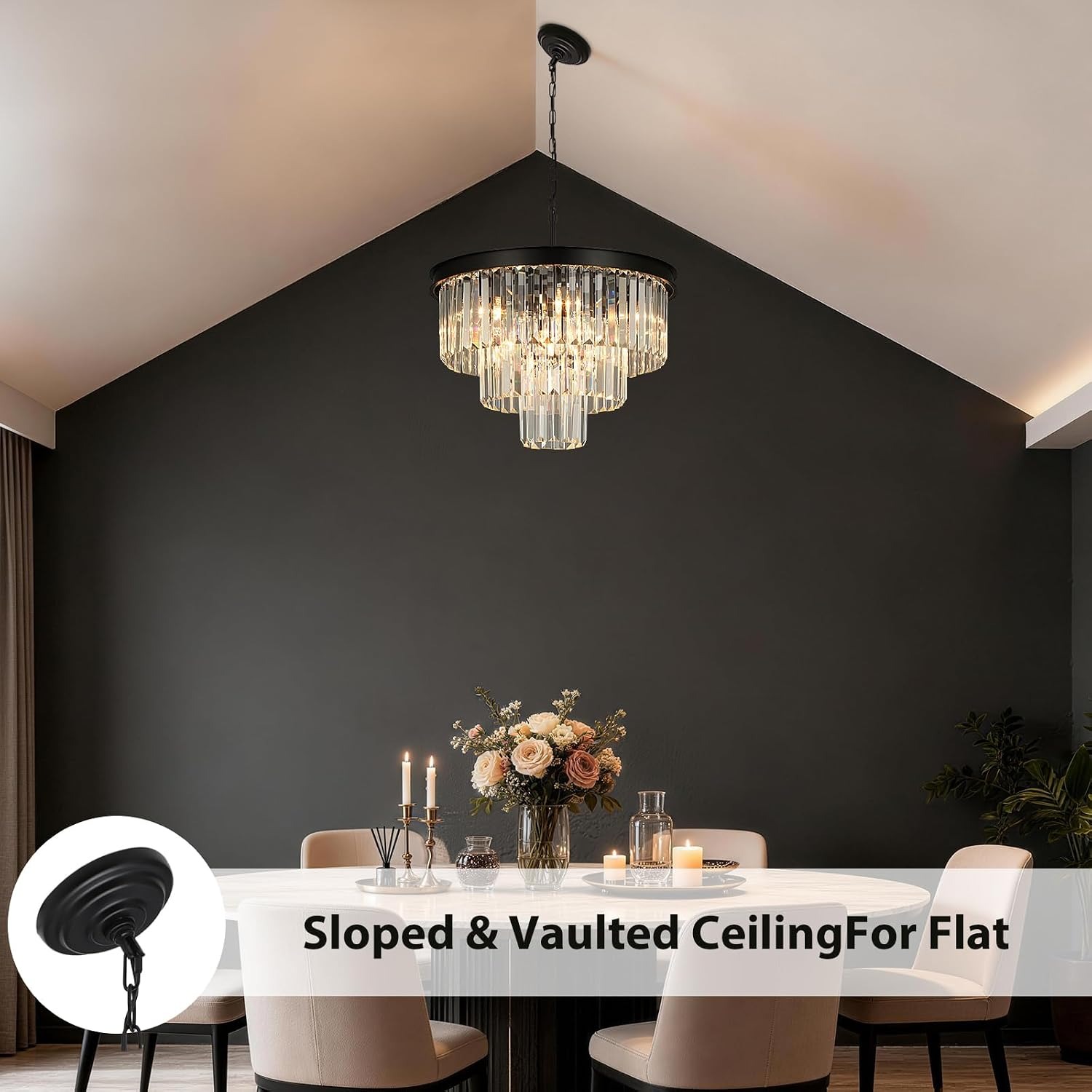
Stack that across nine bulbs and three tiers, and you get a lot of visual activity from a fixture that is only 20 inches across. The three-tier arrangement matters here. Crystal set at different heights catches light from different angles, so the effect has depth rather than reading as a flat ring.
The black frame is doing work too. Against clear crystal, a dark painted finish gives a hard outline that stops the fixture looking like a wedding cake. It is the difference between traditional and modern, and it is why a black crystal chandelier sits comfortably in a room with plain walls and simple furniture.
Bulb choice changes everything. Clear bulbs with a visible filament throw the sharpest sparkle, because the light source is a small bright point. Frosted bulbs give a softer, more even glow with much less patterning on the ceiling. Neither is wrong. Decide whether you want drama or calm, then buy accordingly.
Who this kind of fixture suits
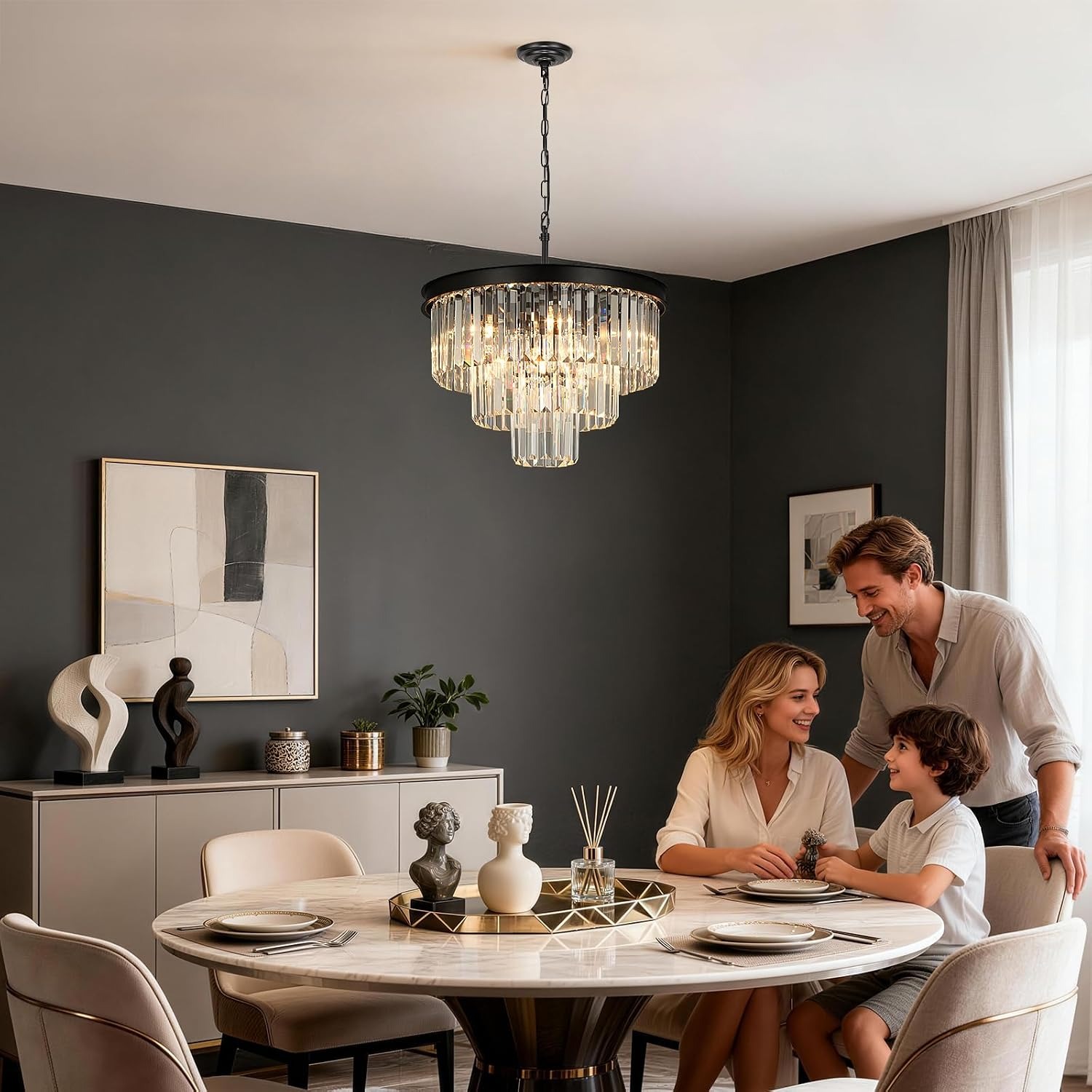
It suits anyone with a defined centre in the room. A round or square dining table, a square island, a seating area with a rug anchoring it. The fixture is round, so it works best when the thing underneath is roughly round or square too.
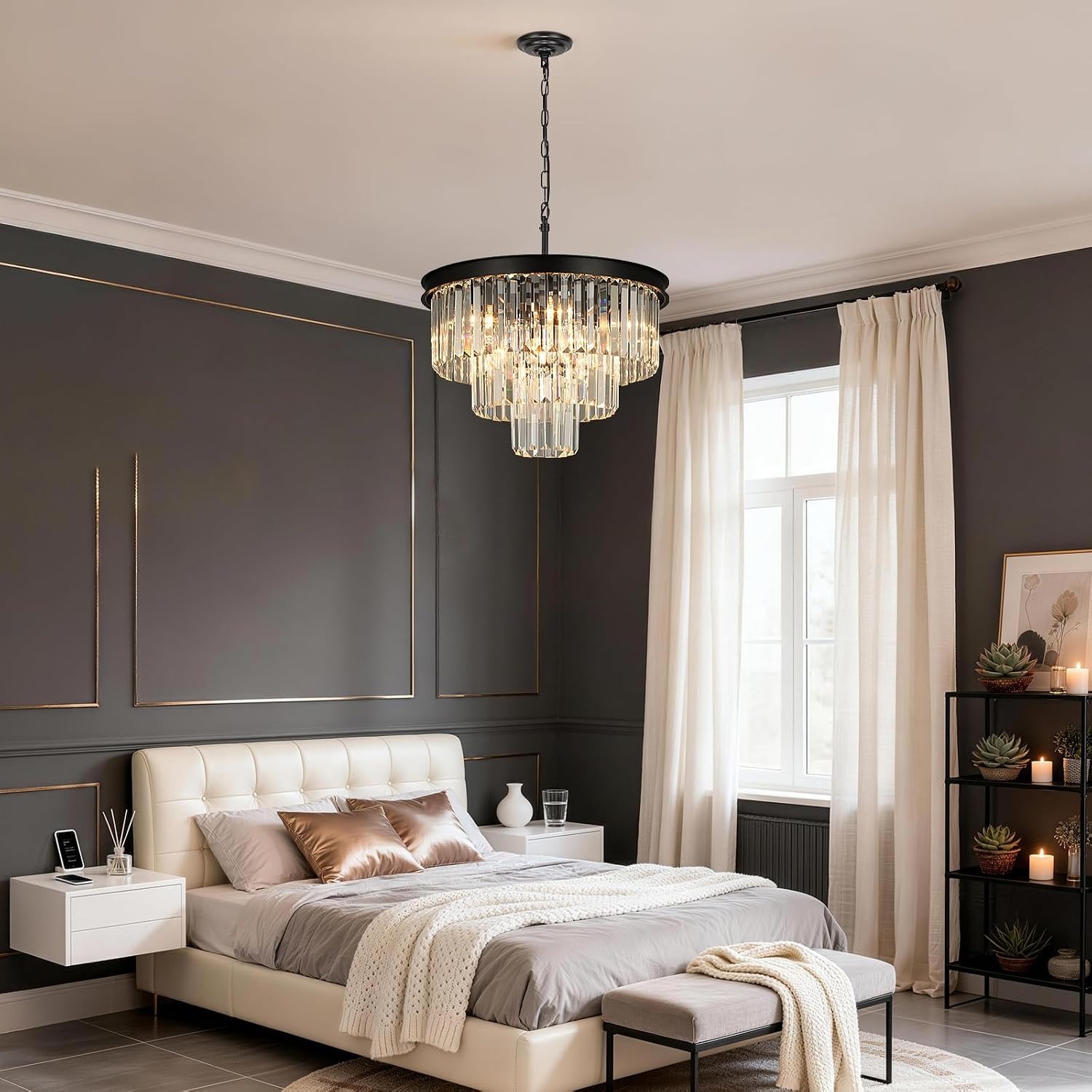
It suits people who want the light fitting to be part of the decorating, not just the wiring. If you have kept the walls neutral and the furniture plain, a crystal fixture gives the room its one piece of visual interest.
It suits people willing to pick their own bulbs. Nine empty E12 sockets can feel like homework, but it is actually freedom. You control brightness, warmth, and whether the thing sparkles or glows.
It is less suited to a long narrow dining room, where a linear fixture or a pair of pendants usually looks better. It is not suited to bathrooms with open showers, covered outdoor areas, or anywhere steam and damp collect, because the fixture is rated for indoor use only and has no water resistance. And it is a poor choice for a room with a very low ceiling unless you shorten the chain right down and are happy with a tight drop.
Getting the size right
Size is where most people go wrong, and it is easy to get right with a tape measure.
For a dining table, the usual guide is to pick a fixture roughly half to two-thirds the width of the table. A 20 inch round fixture sits comfortably over a table around 90 to 120 cm wide. On a much larger table it will look lost. On a small two-seater it will dominate.
For a room rather than a table, add the room's length and width in feet and treat that number as a rough diameter in inches. A 12 by 14 foot room gives you 26, which suggests something a little larger than 20 inches, though a 20 inch fixture still reads fine if you are after a lighter touch.
Then there is drop. Over a table, aim for roughly 75 to 90 cm between the tabletop and the bottom of the fixture. Sit down and check nobody is looking through crystal to talk to the person opposite. In an open walkway, keep the bottom at least 210 cm from the floor so nobody walks into it. The adjustable chain is what gives you room to tune this, and the full listed height of 127 cm is with that chain extended.
Light levels and bulbs
The listed maximum is 3600 lumens across 360 watts, which is a lot of light for a medium room. You will almost certainly not run it at maximum.
Nine LED bulbs at 400 lumens each would hit that number while drawing a fraction of the power. More likely you will want something gentler. Nine bulbs at 200 to 250 lumens each gives you around 1800 to 2250 lumens, which is plenty over a dining table and much more comfortable to sit under.
Colour temperature is the other dial. The maker lists 4000 Kelvin, which is a neutral white. For dining, many people prefer going warmer, around 2700K, because warm light flatters food and skin. Cooler light suits a kitchen or a home office better. You choose when you choose the bulbs.
If you want dimming, remember it takes two things. Dimmable bulbs and a compatible dimmer switch. Fitting dimmable bulbs on a plain on-off switch does nothing. Fitting standard bulbs on a dimmer can cause flicker and buzz. Neither bulbs nor dimmers come with the fixture.
Installation, honestly
This is a 9.98 kg fixture with nine wired sockets. That puts it in a different category from a lightweight pendant.
Two things need checking before you start. First, that your ceiling box is rated to carry the weight, which often means a fixture-rated or fan-rated box rather than a basic one. Second, that the wiring at the ceiling is in good condition and set up for the load.
It comes with an instruction manual and the hanging hardware. The physical install is not complicated, but it is a two-person job. One person holds the weight while the other makes the connections. Trying to do both alone is how crystal gets broken.
In many countries, hard-wired ceiling fixtures legally require a licensed electrician. Even where a competent DIY install is permitted, hiring someone is worth it here, especially if you are adding a dimmer at the same time.
Keeping it looking good
Crystal collects dust. That is the only real maintenance issue, and it creeps up slowly, so most people do not notice until the sparkle has faded by half.
A dry microfibre cloth every few weeks keeps it bright. Switch the power off and let the bulbs cool first. For fingerprints on the crystal, dampen the cloth slightly with water and dry straight away. Avoid solvents, ammonia sprays, and abrasive creams, all of which can damage a painted black finish and leave it patchy.
Never spray liquid at the fixture. Water near live sockets is a bad idea, and overspray tends to leave marks on the frame.
Once or twice a year, check the chain links, the canopy screws, and the crystal hangers. Heavy fixtures can work loose slightly, especially in rooms where doors slam or there is traffic vibration outside.
The short version
This is a 20 inch round, three-tier crystal chandelier on a black painted frame, with nine E12 sockets and an adjustable chain. It weighs 9.98 kg, runs on 120 volts, and is rated to 360 watts and 3600 lumens with a listed colour temperature of 4000 Kelvin. Bulbs are not included.
Measure your table or your room before you order. Plan the drop from a seated position. Pick bulbs that match the mood you want rather than defaulting to the brightest ones on the shelf. Get help with the install, because of the weight.
Do those four things and you get a fixture that lights the table properly and gives the room something to look at. Indoor use only, and keep it away from damp.