

The complete guide
How to Choose a Brass Gold Chandelier for Your Dining Room or Entry
The ceiling is usually the problem
Most rooms that feel cold are not short on furniture. They are short on decent light. One flat fitting in the middle of a ceiling throws the same even wash everywhere, which is fine for finding a dropped fork and terrible for making a room feel like somewhere you want to linger.
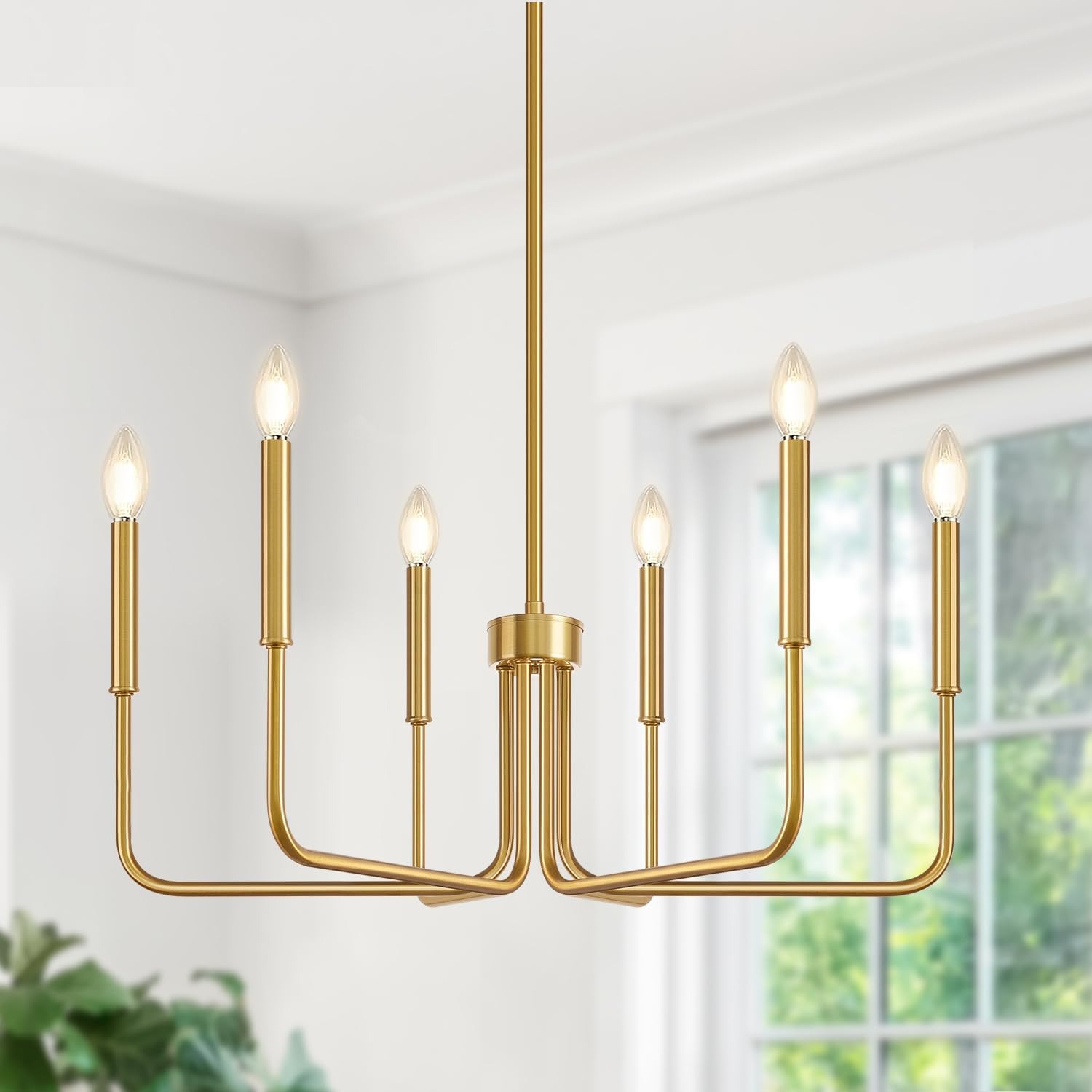
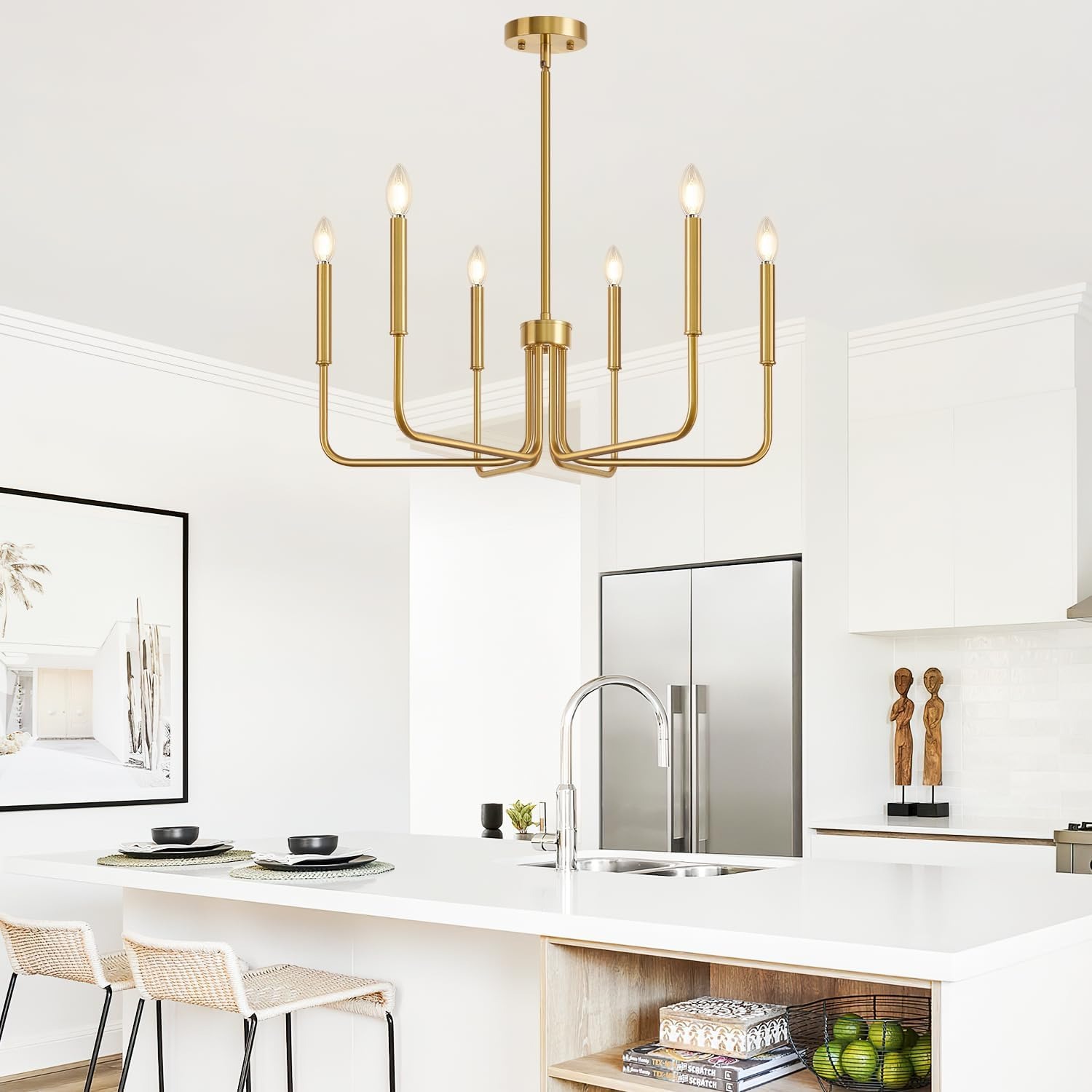
A six-arm chandelier changes that straight away. The light comes from six separate points, so it falls across a table in overlapping pools instead of one broad sheet. Shadows come back. Faces look better. The brass gold metal catches a bit of the glow and gives you a warm point to look at, which is something a flush dome never does.
That is really the job of a brass gold chandelier. Not to blind the room, but to give it a centre.
What this fixture actually is
This is a six-light ceiling-mounted chandelier, model L220028P6. The frame is metal with a polished brass gold finish, and glass is listed as the shade material. Six candle-style arms carry six E12 candelabra sockets. The maker's description records an LED light source, warm white light colour, 60 watts, 110 volts, and a maximum output of 6000 lumens.
It measures 69.85 cm across and 124.46 cm at full height, and weighs 2.77 kg. The box includes mounting hardware and an instruction manual.
The style is described as farmhouse with a rustic theme. In plain terms, it is simple and a bit old-fashioned rather than sharp and modern. That makes it easy to live with. It sits well with wood tables, painted boards, woven rugs and anything with a bit of age to it.
It is for indoor use only and it is not water resistant. That rules out covered porches, open patios, and spots directly over a bath or shower.
The height question, and why rods beat chains
The most common mistake with a chandelier is hanging it wrong. Too high and it floats, disconnected from the table. Too low and everyone ducks.
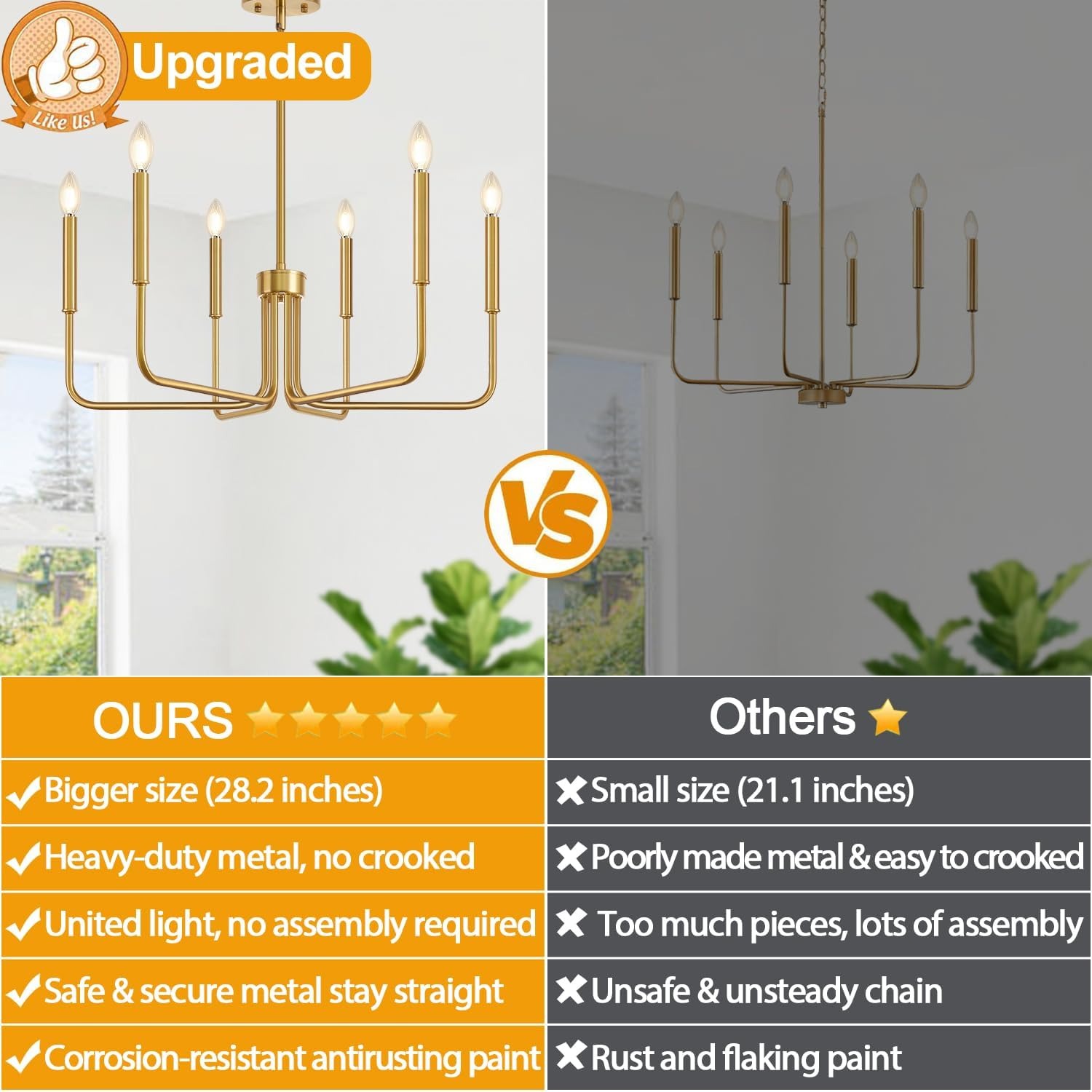
This fixture uses splicing rods instead of a chain, which gives you two advantages. The first is adjustment. You can set the drop to suit your ceiling, from a semi flush position close to the ceiling down to a proper hanging fixture. The second is steadiness. A chain lets a fixture swing when a door slams or an air conditioner kicks in. Rods hold it still.
For a dining table, the usual guide is somewhere around 75 to 90 cm of clear space between the tabletop and the bottom of the chandelier. On a standard ceiling that puts the fixture at a comfortable eye-friendly height. On a high ceiling you can go a little lower so the light does not feel marooned.
For an entry hall, the key number is headroom. Nothing below about 2.1 metres from the floor in any spot people walk through. An adjustable height chandelier makes both of those easy to hit, because you are not stuck with a fixed drop.
It also works on sloped ceilings, which solves a real headache. If you have a pitched living room or a stairwell ceiling that angles away, many fixtures simply hang crooked. This one is designed to handle the angle.
Choosing bulbs, which matters more than people think
Six E12 sockets means you decide the character of the light. That is more control than it sounds.
For a dining room, warm bulbs in the 2700K range give you that amber, candlelit feeling that makes food look good and conversation slow down. Go for lower output per bulb, because six of them add up fast. A dining room chandelier that is too bright feels like a cafeteria.
For an entryway chandelier or a kitchen island, you can push brighter and slightly cooler. You need to see what you are doing. Still, keep it on the warm side of neutral so it matches the rest of the house.
A few practical notes. Buy all six bulbs at once from the same batch, because mismatched colour temperatures across a single fixture look wrong immediately. If you want dimming, you need dimmable bulbs and a compatible dimmer switch, and neither is included here, so buy them as a matched pair. And stay at or under the stated wattage limit per socket.
If you want the candle look without the bare-bulb glare, vintage-style filament LED candelabra bulbs are the usual answer. They give you the shape and the warmth at a fraction of the heat of real filament bulbs.
Who this suits
This works for anyone who wants a room to feel settled rather than styled. It is a good fit over a dining table that seats six to eight, over a long kitchen island, in an entry hall with a reasonable ceiling, or in a living room that currently has a boring central fitting.
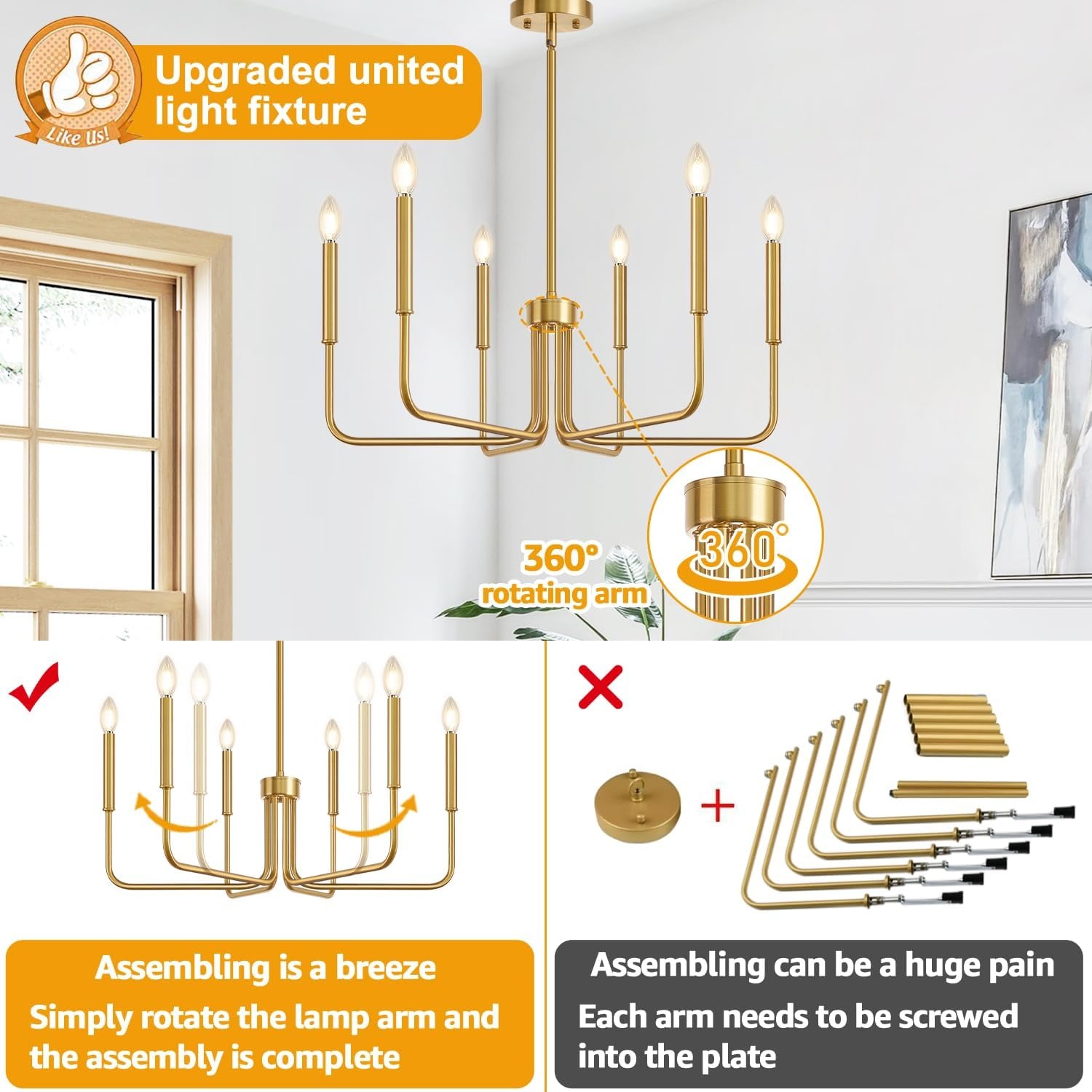
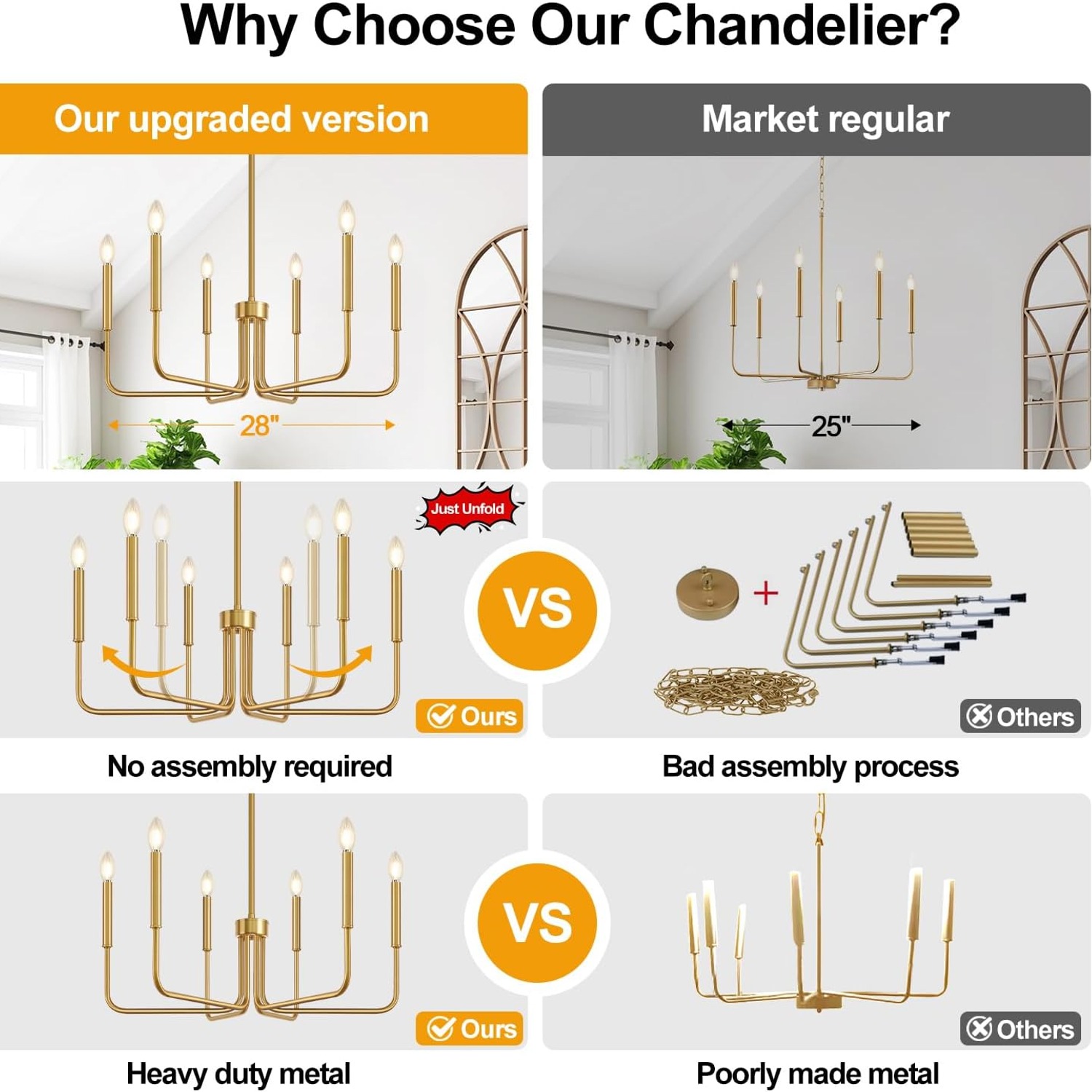
It also suits people who are nervous about installation. The arms arrive pre-attached. You unfold them, set the rods, and wire it in. There is no fiddly assembly of a dozen small parts on the kitchen floor, which is the step where most people lose an afternoon and their temper.
It is less suited to very small rooms. At nearly 70 cm wide, it needs space around it. If your dining table is narrow or your hallway is tight, something smaller will look better. Measure the table first. The chandelier should generally be noticeably narrower than the table it sits above.
Installation, honestly
The fixture is light at 2.77 kg, so the physical mounting is not a struggle. The electrical side still needs respect.
Kill the power at the breaker, not just at the wall switch, and test the wires before you touch anything. Check that your ceiling box is rated to support a hanging fixture. If you are replacing an older, heavier fitting, the box is almost certainly adequate, but it is worth a look.
Work out your drop before you mount. It is far easier to set the rod length on the ground than to redo it while standing on a ladder holding a chandelier. If you are putting it over a table that is already in place, have someone hold the fixture at your chosen height while you sit down and check the sightline across the table.
In many countries, ceiling wiring is work for a licensed electrician. If that applies where you live, or if you simply are not confident, get a professional in. It is a short job for them.
Looking after it
Not much to do here. Switch off, let the bulbs cool, and dust the arms and frame with a dry soft cloth or a microfibre duster. If something has marked the metal, a barely damp cloth works, followed by drying straight away. Standing moisture and metal finishes do not get along.
Stay away from abrasive pads, scouring cream, bleach and solvent sprays. A polished finish can be dulled permanently by the wrong cleaner, and once it is dull you cannot bring it back.
The finish is described as rust resistant, which helps in a kitchen where cooking steam rises. Still, give it an occasional dust if it hangs near a stove, since grease and dust together are harder to shift than dust alone.
Once or twice a year, check the bulbs are seated, the arms sit level and the mounting hardware is snug. That is the whole maintenance routine.
The short version
If your dining room or hall feels flat, the fixture overhead is usually why. A six-arm brass gold chandelier spreads the light, adds warmth and gives the room something to look at.
This one measures 69.85 cm wide and up to 124.46 cm high, weighs 2.77 kg, takes six E12 bulbs, and arrives with its arms already attached. Splicing rods let you set the drop on flat or sloped ceilings, and the polished brass gold finish suits farmhouse and rustic rooms without shouting.
Measure your table, check your ceiling height, pick warm bulbs, and let an electrician handle the wiring if your rules require it. Done properly, it is the kind of fixture you stop noticing and simply enjoy.