

The complete guide
Buying a Firework Crystal Chandelier, What Actually Matters
The problem with a plain ceiling
Most rooms get their light from one source, usually a flat fitting stuck to the ceiling. It does the job. It also flattens everything. The corners look the same as the middle, nothing casts a shadow worth looking at, and the room feels like a space rather than a place.
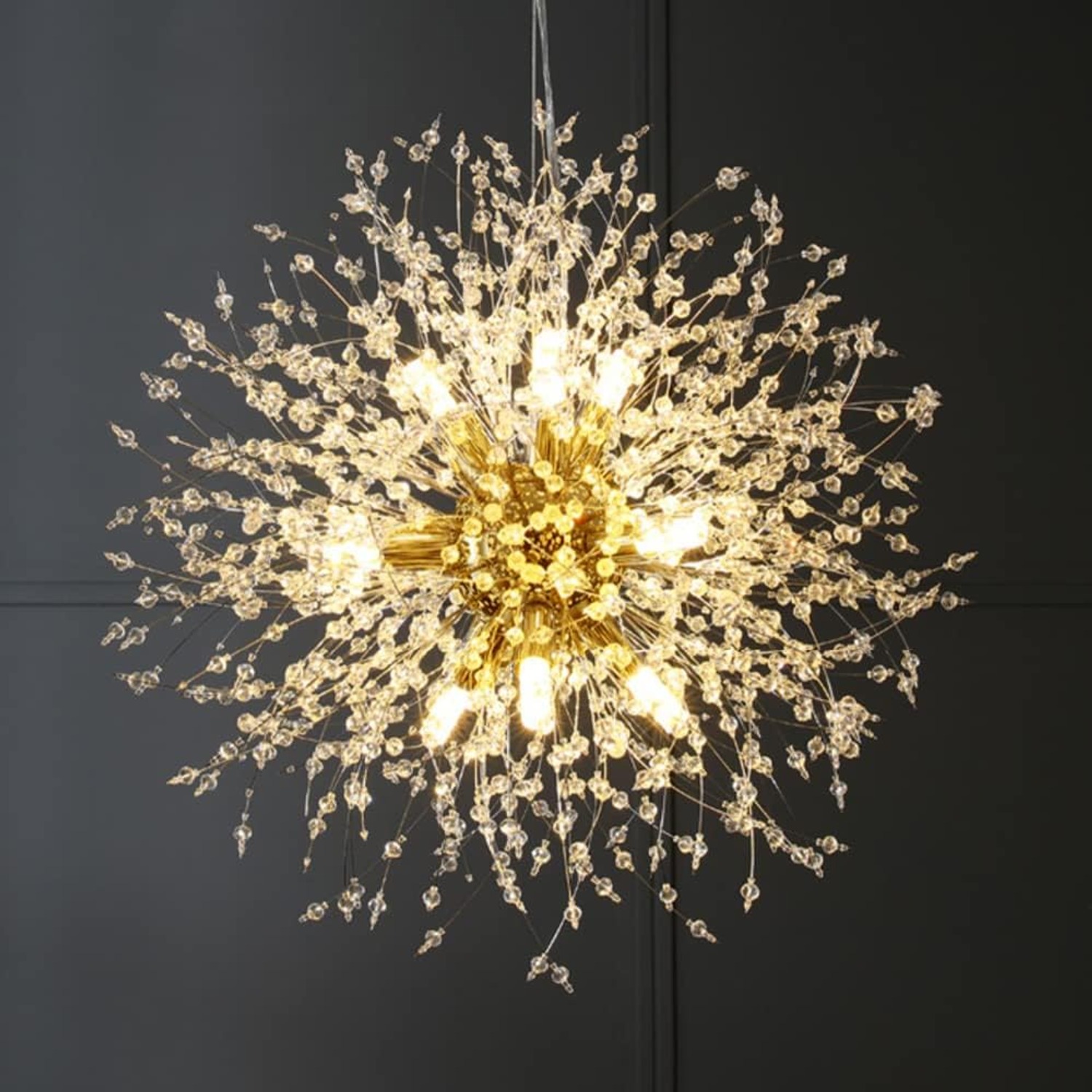
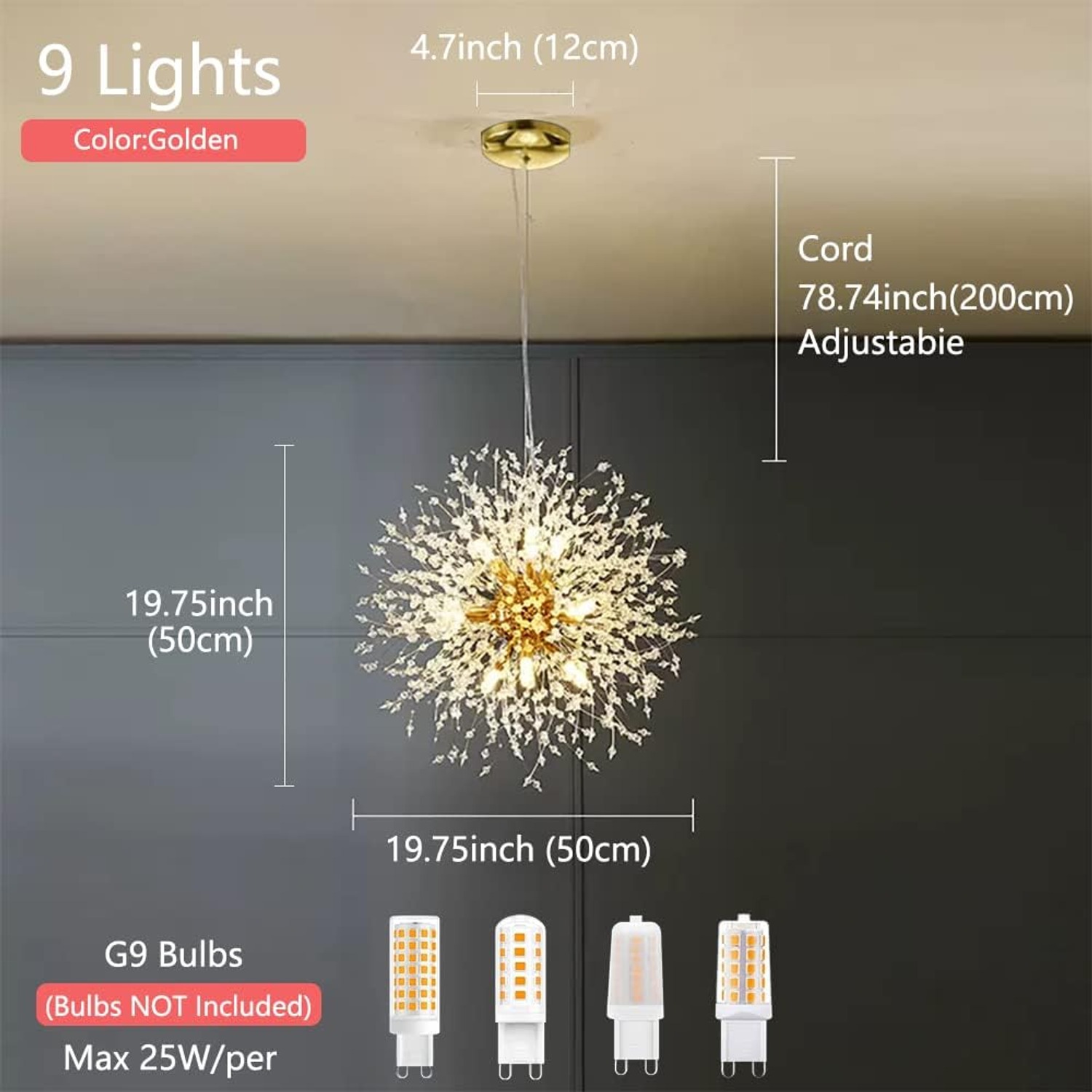
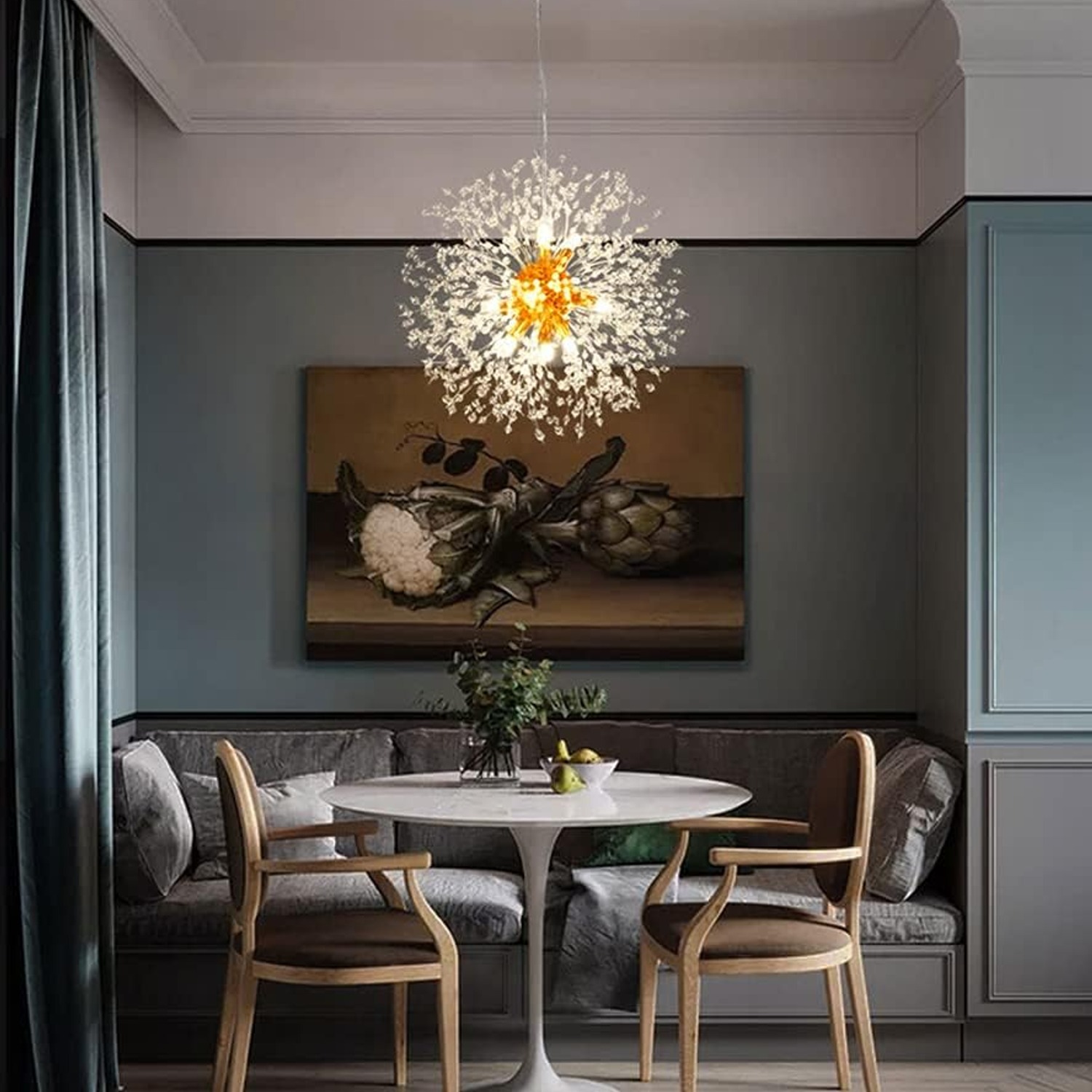
A chandelier solves that by putting light at several points instead of one, and by giving you something to look at while it works. This firework crystal chandelier is a nine-light version of that idea. Nine gold-tone arms come out of a central hub in a round burst, and each one ends in a crystal bead cluster with a lamp behind it. The shape is about 50 cm across, so it reads clearly from across a room without swallowing a small dining space.
The crystal is doing real work here, not just sitting there as decoration. Light hitting those beads breaks up and scatters, which is why a crystal fixture throws small bright points onto walls and ceilings while a plain shade just pools light downward. That scatter is the whole reason people go looking for the best modern crystal light fixture instead of another flush mount.
How it works
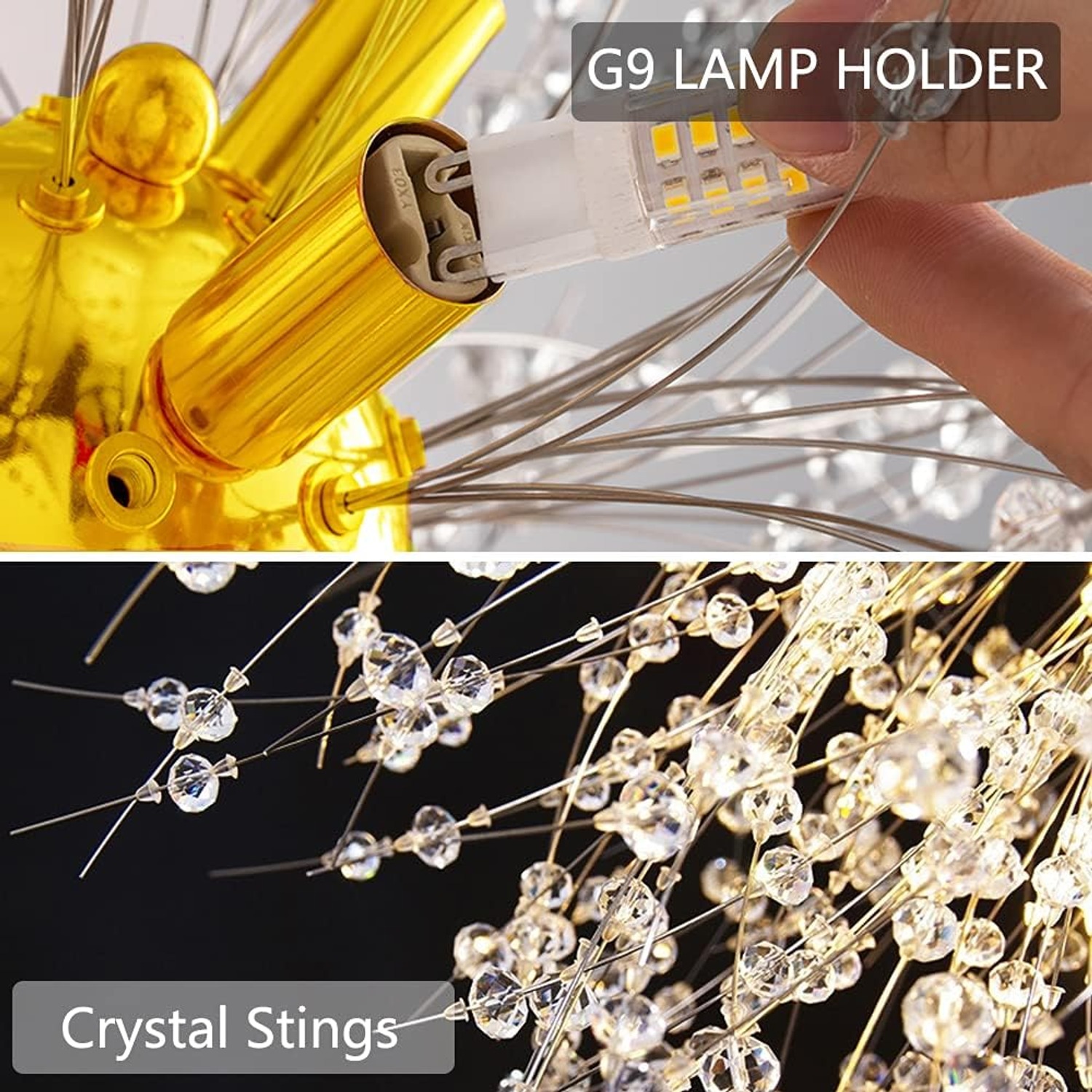
Nine G9 sockets sit at the arm tips. G9 is a small two-pin lamp base, common and easy to buy, and both LED and halogen versions fit. The stated maximum is 25 watts per lamp, which is your ceiling for safety, and the maker's description quotes a maximum output of 3600 lumens in warm white across the whole fixture.
Bulbs are not included. That sounds like a catch, but it is actually useful. You choose the colour temperature and the brightness yourself rather than inheriting whatever a factory decided. Warm lamps around 2700K to 3000K suit the gold finish and the warm white description. Cooler lamps will look sharper, which some people want in a kitchen and almost nobody wants in a bedroom.
It runs at 120 volts, so check that against your local supply before you order. The fixture is corded electric and hard-wired, mounted as a suspended ceiling fitting. The cable length is adjustable, which is the detail that makes it work in more than one kind of room.
Dimming is possible, with two conditions. You need dimmable lamps, and you need a compatible dimmer switch. Neither comes in the box. Get this combination right and the fixture goes from bright working light to quiet evening light with one slider. Get it wrong and you will hear a buzz or see a flicker, which is almost always a lamp and dimmer mismatch rather than a fault in the fixture.
Who it suits
The listed room types are bedroom, dining room, entryway, kitchen and laundry room, and the shape backs that up. A round, open burst looks good when you see it from several angles, so it earns its place in a stairwell, a hallway or an entry where people walk around it rather than past it.
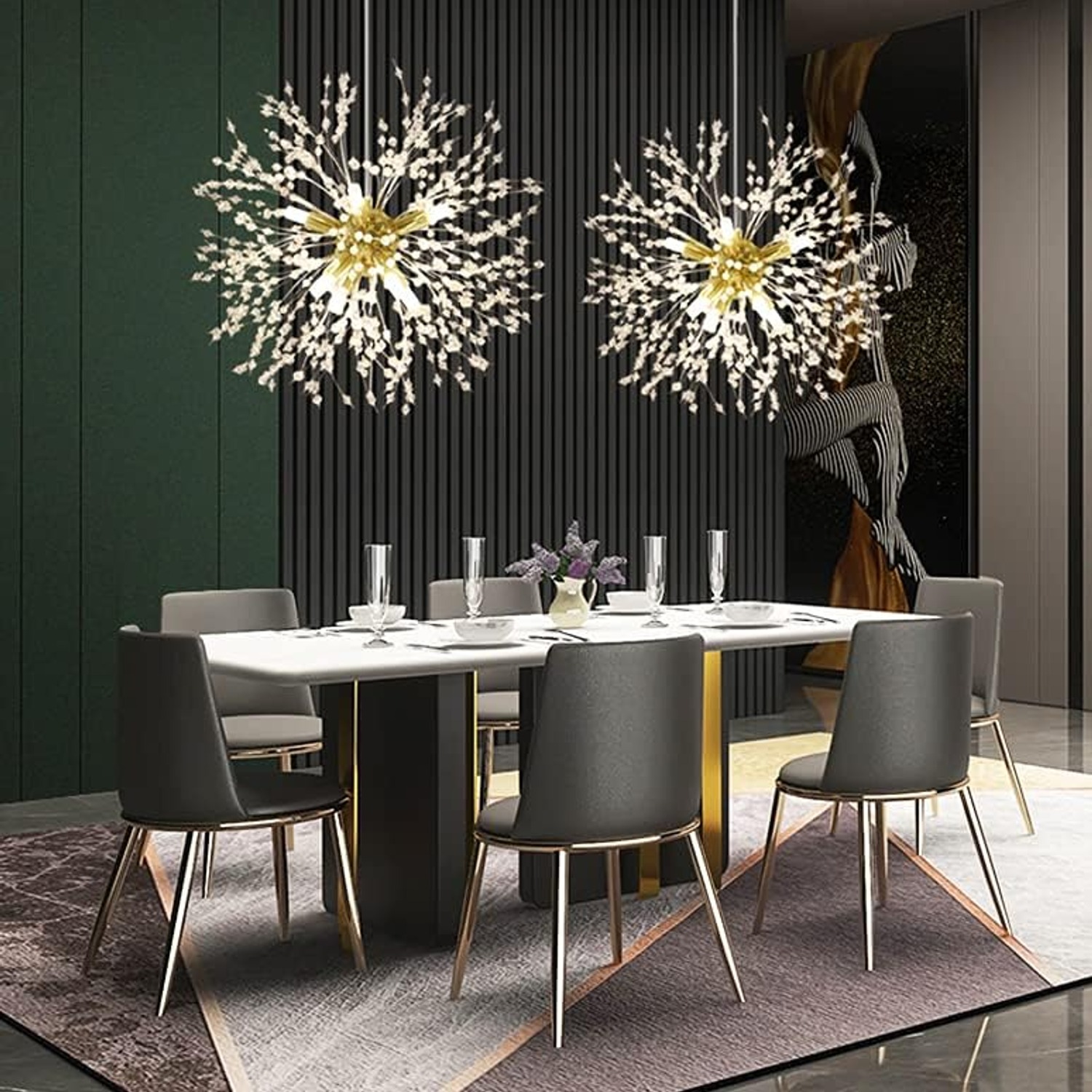
Over a dining table it does its best work. Nine small light points above a table give you sparkle on glassware and a bit of shine on cutlery, which a single diffused fitting never manages. If you are hunting for the best chandelier for small dining room, a 50 cm diameter is a sensible size to aim at. Much wider and it starts to crowd the table edges.
In a bedroom it needs a little more thought. Check your ceiling height and where the bed sits. You want it clear of anyone standing up on the mattress, and you want dimmable lamps so it is not harsh at midnight. People often shortlist the best crystal chandelier for bedroom and then forget the dimmer, which is the part that makes it liveable.
It is indoor only and not water resistant. That rules out covered patios, open porches and anywhere near a shower.
How to choose and hang it
Start with the drop. Over a dining table, the common rule is to leave about 75 to 90 cm between the tabletop and the lowest point of the fixture. That keeps sightlines clear across the table while still feeling like the light belongs to the table. In a hallway or an open walkway, you want the lowest point comfortably above the tallest head in the house, with room to spare for someone carrying a box.
Next, the ceiling. The product details list it as compatible with sloped ceilings, which is genuinely handy. A suspension cable lets the body hang level even when the ceiling above it is at an angle, so attic rooms and converted lofts are back on the table. If you want the best sloped ceiling chandelier for an awkward room, cable suspension is the feature to look for.
Then the ceiling box itself. At 2.05 kg the fixture is light for its size, so most sound ceiling boxes will handle it, but your electrician should confirm the fixing before anything goes up. That is a five-minute check that saves a lot of trouble.
Finally, the lamps. Buy all nine at once and from the same batch if you can. Mixing brands or colour temperatures across nine sockets shows up immediately on a fixture like this, because you see every lamp at the same time. If you want the best G9 chandelier result, consistency matters more than brand names.
Installing it without drama
Turn the power off at the circuit breaker, not just the wall switch. Then confirm it is dead at the fitting. Mains wiring work should be done by a licensed electrician, and in many places that is a legal requirement rather than advice.
Assembly order helps. Get the main body fixed and wired first, then fit the crystal strings, then put the lamps in last. Working the other way around means you are handling crystal while reaching overhead, which is how beads get knocked loose. Unpack over a rug or a towel so nothing bounces if it slips.
Check the parts list against what is in the box before you start. If something is missing or marked, photograph it in the packaging and get in touch before assembly rather than after.
Keeping it looking good
Crystal shows dust faster than almost anything else in a room, so a quick dust every few weeks does more than a deep clean twice a year. Switch off at the breaker and let the lamps cool. Use a soft dry cloth or a clean soft brush, and work from the top arms down.
For fingerprints or cooking haze, a cloth lightly dampened with water is enough. Dry it straight away. Keep water away from the sockets and the ceiling canopy, and skip household sprays, solvents and abrasive pads, which can dull a plated finish over time. The fixture is listed as not water resistant, and that applies to cleaning as much as to location.
When a lamp fails, replace it with the same type and colour temperature as the others. One cooler lamp among eight warm ones is obvious on a nine-light fixture.
The short version
This is a nine-light gold-tone chandelier with crystal bead tips, about 50 cm across, weighing 2.05 kg. It takes nine G9 lamps up to 25 watts each at 120 volts, with a listed maximum output of 3600 lumens in warm white. Bulbs are not included. It dims with dimmable lamps and a compatible dimmer switch, mounts as a suspended ceiling fitting, and is listed as sloped-ceiling compatible. Indoor use only.
If you have a dining room, entry or bedroom that feels flat under one ceiling light, this is a straightforward way to fix it. Decide the drop before installation day, buy nine matching lamps, and have an electrician make the connection. Those three steps cover almost everything that goes wrong with a chandelier.