
The complete guide
How To Choose A Wagon Wheel Chandelier For A Big Room
The problem with lighting a big room
Most homes are lit for a room that no longer exists. Ceiling fixtures were designed for small boxes with low ceilings, and then people knocked out walls, built extensions and put in vaulted roofs. The light fitting stayed the same size.
You can spot the result quickly. The middle of the room is bright and slightly harsh. The corners are dim. People end up adding floor lamps and table lamps to fill the gaps, which works, but it also means five switches and a lot of clutter.
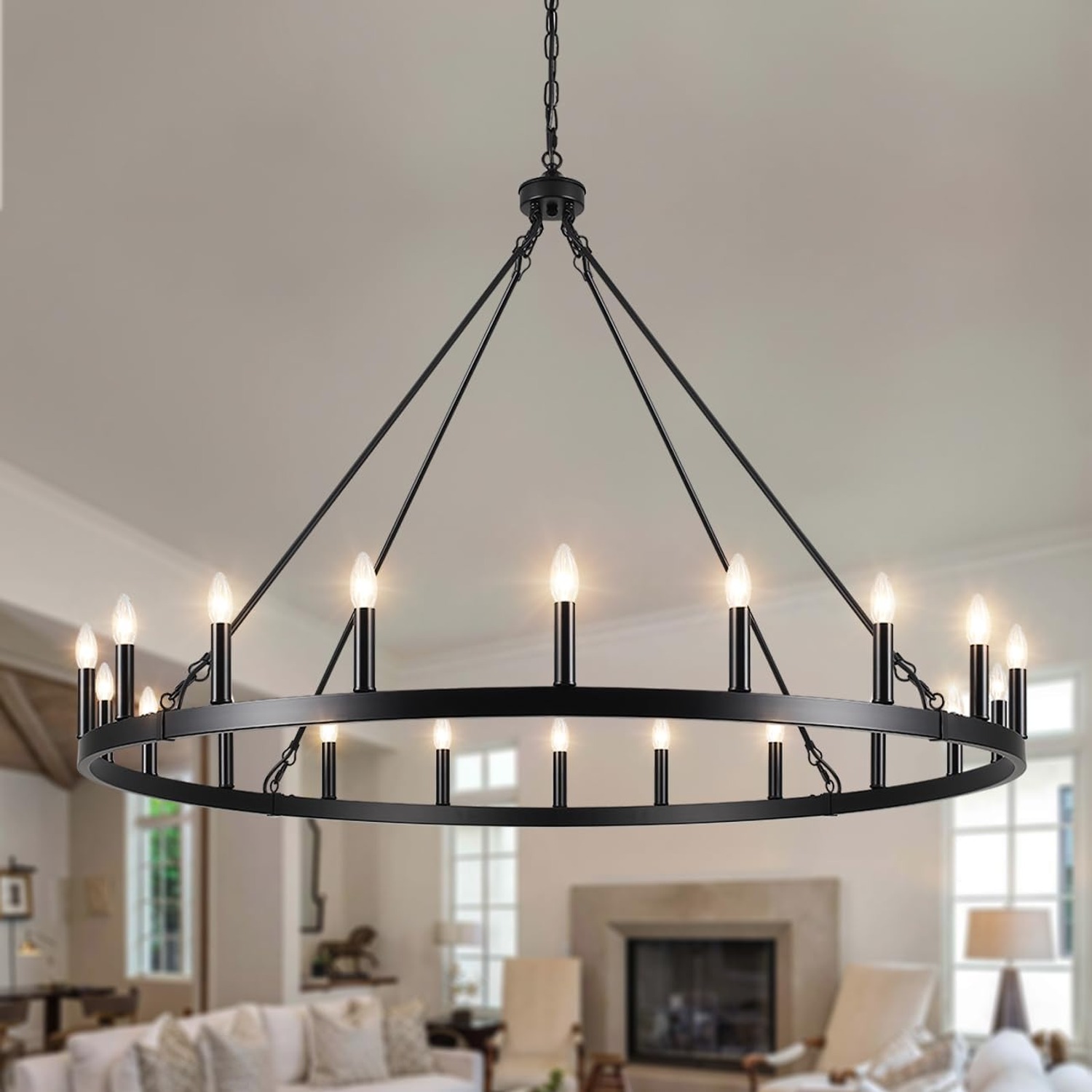
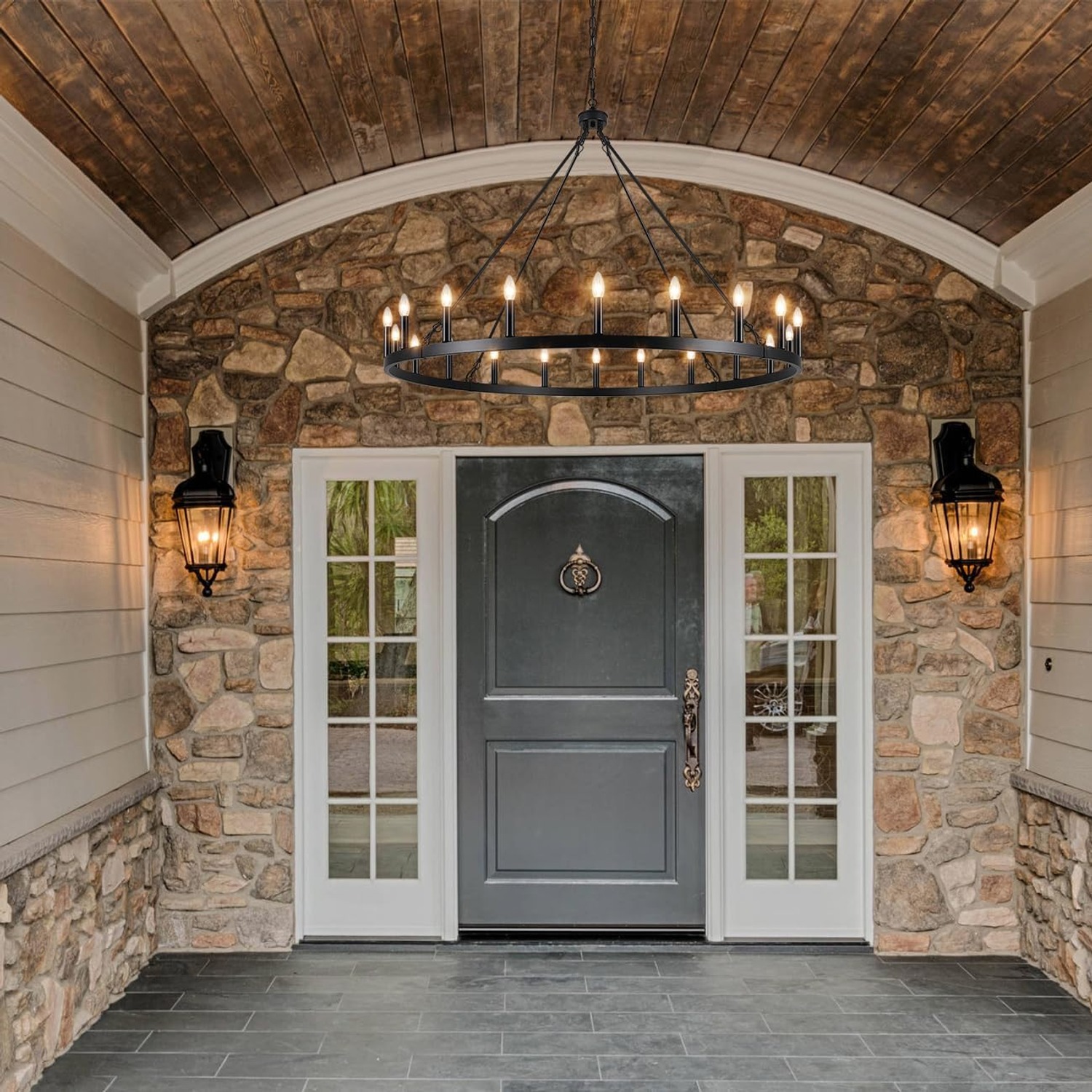
A large chandelier solves this differently. Rather than making one point brighter, it spreads the source out. A 47 inch wagon wheel chandelier puts twenty small lights around a ring nearly a metre wide, so the light leaves the fixture from twenty positions instead of one. Shadows soften. The corners stop looking abandoned. You need fewer lamps.
How a wagon wheel chandelier actually works
The shape is borrowed from an old cart wheel. There is a large outer ring, spokes or support chains running to a centre hub, and lamp holders set around the rim. On this model the holders are candle-style, which is the detail that keeps the look warm instead of purely industrial.
Because the frame is open, you see through it. That matters when a fixture is this wide. A solid drum shade at 92.5 cm across would block the view and dominate the room. An open iron ring hangs there without cutting the space in half.
The frame is iron metal with a lacquered finish, which is a practical choice for something that will sit above head height for years and collect dust. Lacquer gives you a surface you can wipe clean without scrubbing at bare metal.
Light output depends on what you put in it. The fixture takes twenty E12 bulbs at up to 60 watts each, which is where the 1200 watt total and the 10,800 lumen maximum figures come from. Nobody realistically loads twenty 60 watt incandescent bulbs into a dining room light anymore. Most people fit LED candle bulbs, which gives plenty of light at a fraction of the power and a lot less heat.
Who this suits
This is a fixture for rooms with volume. Dining rooms with a long table. Open living areas. Two-storey entryways. Stairwells where the ceiling opens up above the landing. Kitchens with high ceilings and an island.
It is a good fit if your home leans farmhouse, rustic, country or industrial. Black iron, wood, exposed brick, linen, shaker cabinetry: all of that sits comfortably under a wagon wheel frame.
It is also workable in more modern rooms if you choose bulbs carefully. Plain opal LED candles read as contemporary. Exposed Edison filaments push it firmly vintage. The frame is neutral enough to go either way.
Who it does not suit: small rooms with standard ceilings. If you have a 2.4 metre ceiling and a modest dining nook, a fixture this wide will feel like it is pressing down on the table. Measure before you fall in love with it.
Getting the size and height right
Two numbers decide whether this works: the width of your table or space, and your ceiling height.
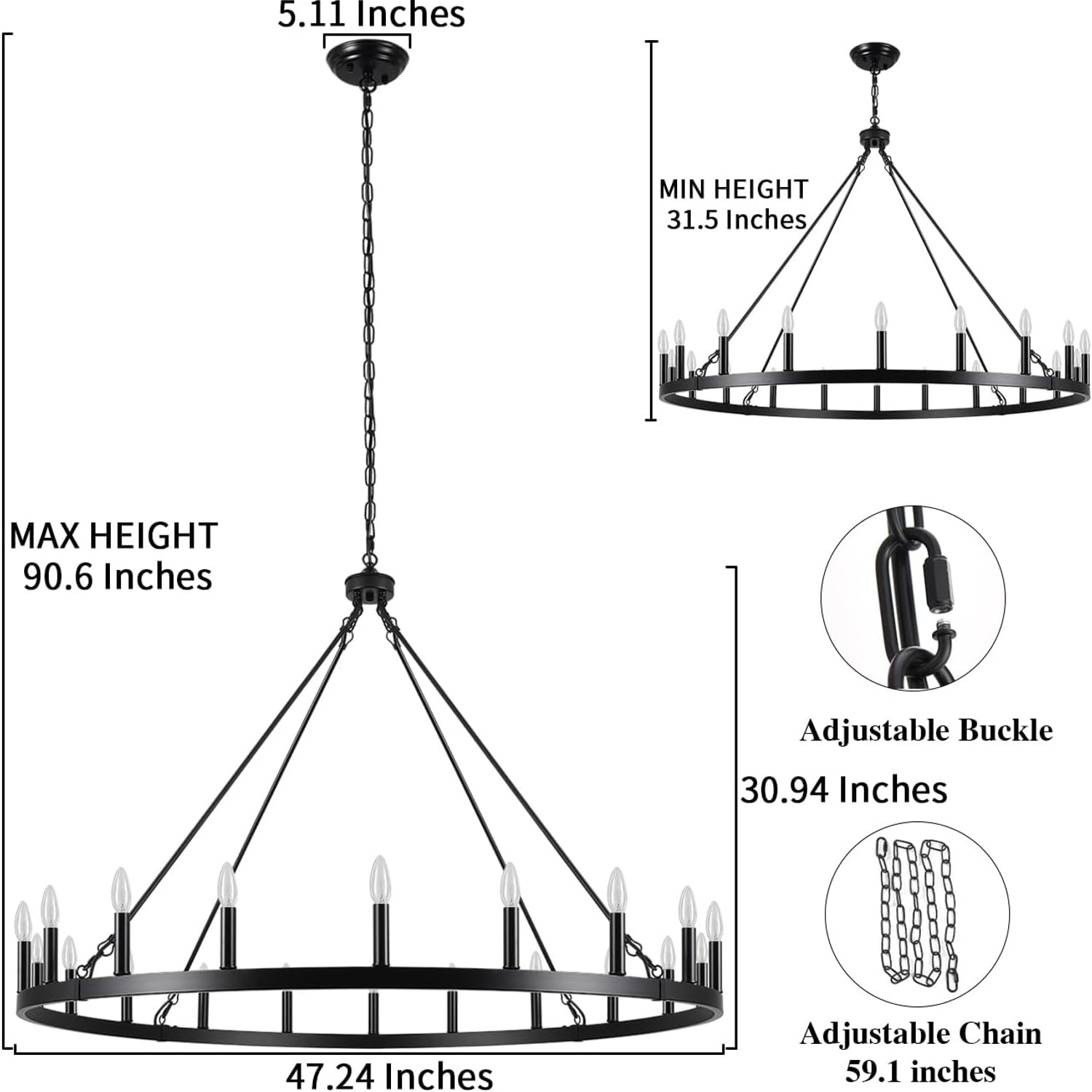
For a dining table, a common guide is that the fixture should be roughly half to two-thirds the width of the table. A 92.5 cm chandelier suits a table around 140 to 180 cm wide. Narrower than that and it will overhang awkwardly.
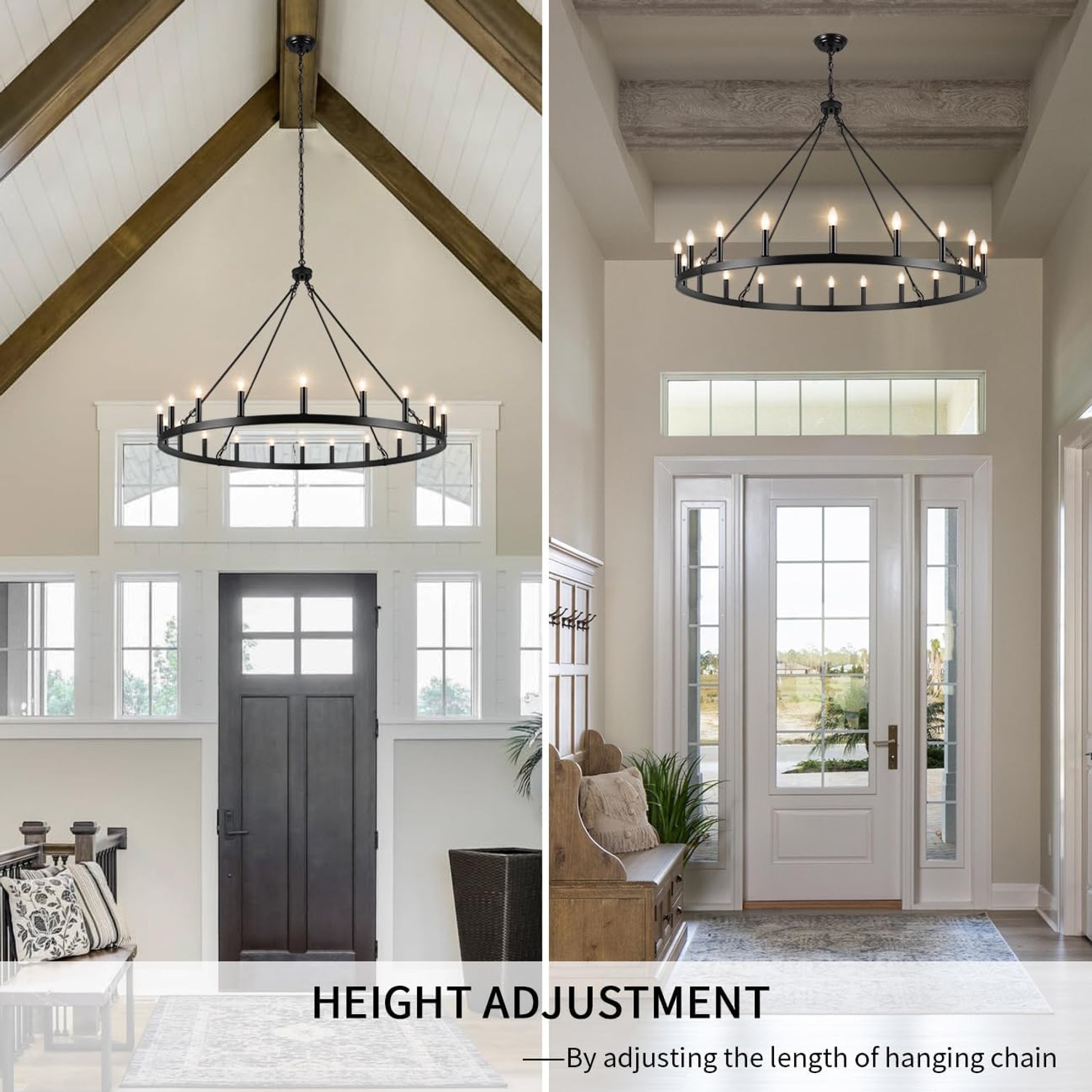
For height, aim for about 75 to 90 cm of clear space between the tabletop and the bottom of the fixture. That keeps the bulbs out of your eye line when seated and stops anyone cracking their head when they stand up. In an entryway or stairwell with no furniture below, hang it higher, with at least 2.1 metres of clearance to the floor.
The supplied chain is 59.1 inches and links can be removed, so you have real room to adjust. Work out your target drop before you climb the ladder, because taking links out mid-install while holding 6.26 kg above your head is miserable.
Sloped and vaulted ceilings
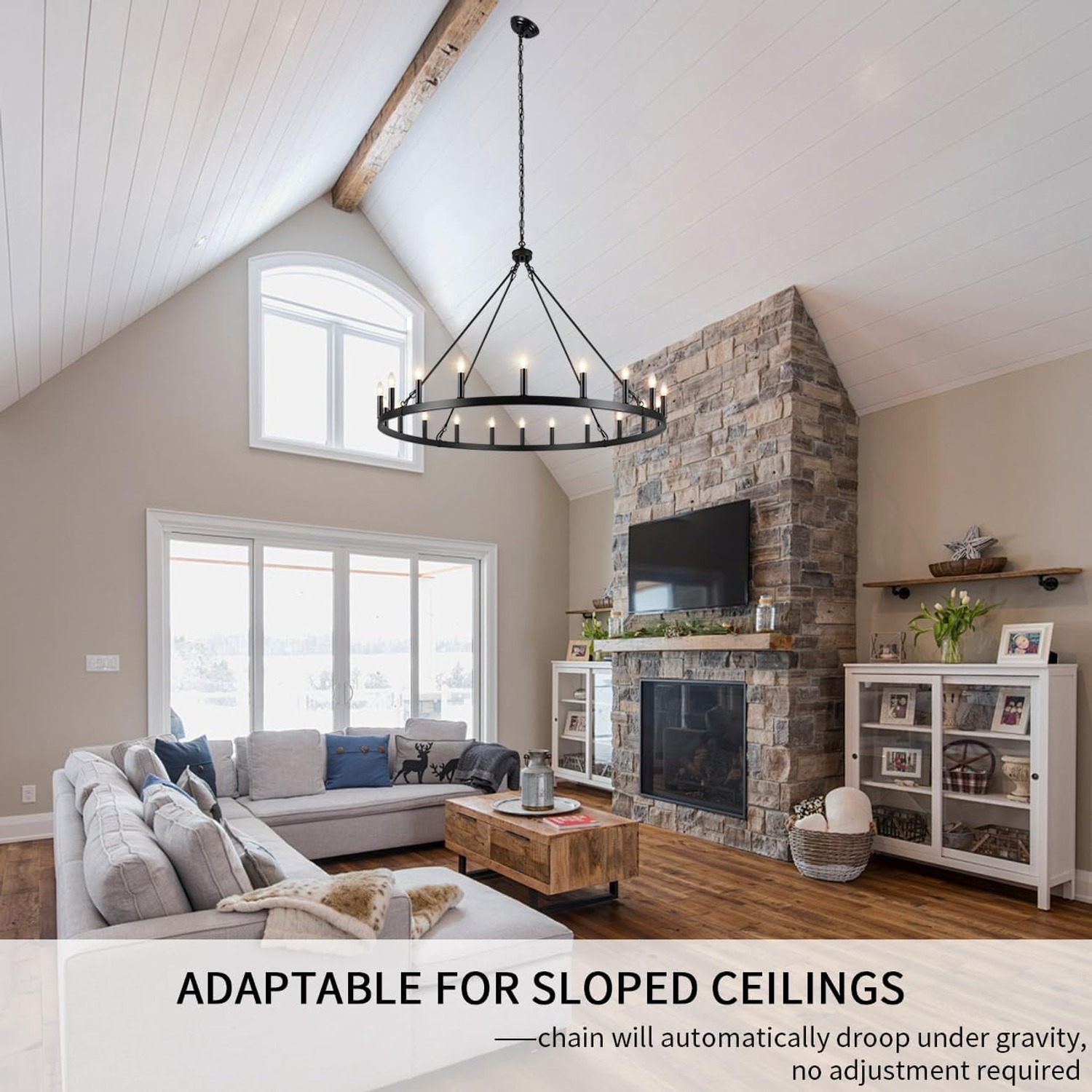
This is where a lot of large fixtures fall down. A rigid ceiling plate on a sloped ceiling leaves an ugly gap on one side and puts the whole fixture at an angle.
The ceiling plate on this one is designed to flex so it sits properly against flat, sloped and arched ceilings. That makes it a genuine option for a vaulted living room or an open stairwell, both of which are exactly the kinds of spaces that need a big light in the first place.
If your ceiling is particularly steep, measure the pitch and check the mounting instructions before you start. A quick five-minute check saves a wasted afternoon.
Bulbs and dimming
The bulb choice changes the character of this light more than anything else.
Warm white LED, around 2700K, gives a soft, candlelit feel that suits dining. Neutral white, around 3500K to 4000K, is crisper and works better in a kitchen or a working entryway. Cool white above 5000K will make a farmhouse chandelier look clinical, so most people avoid it here.
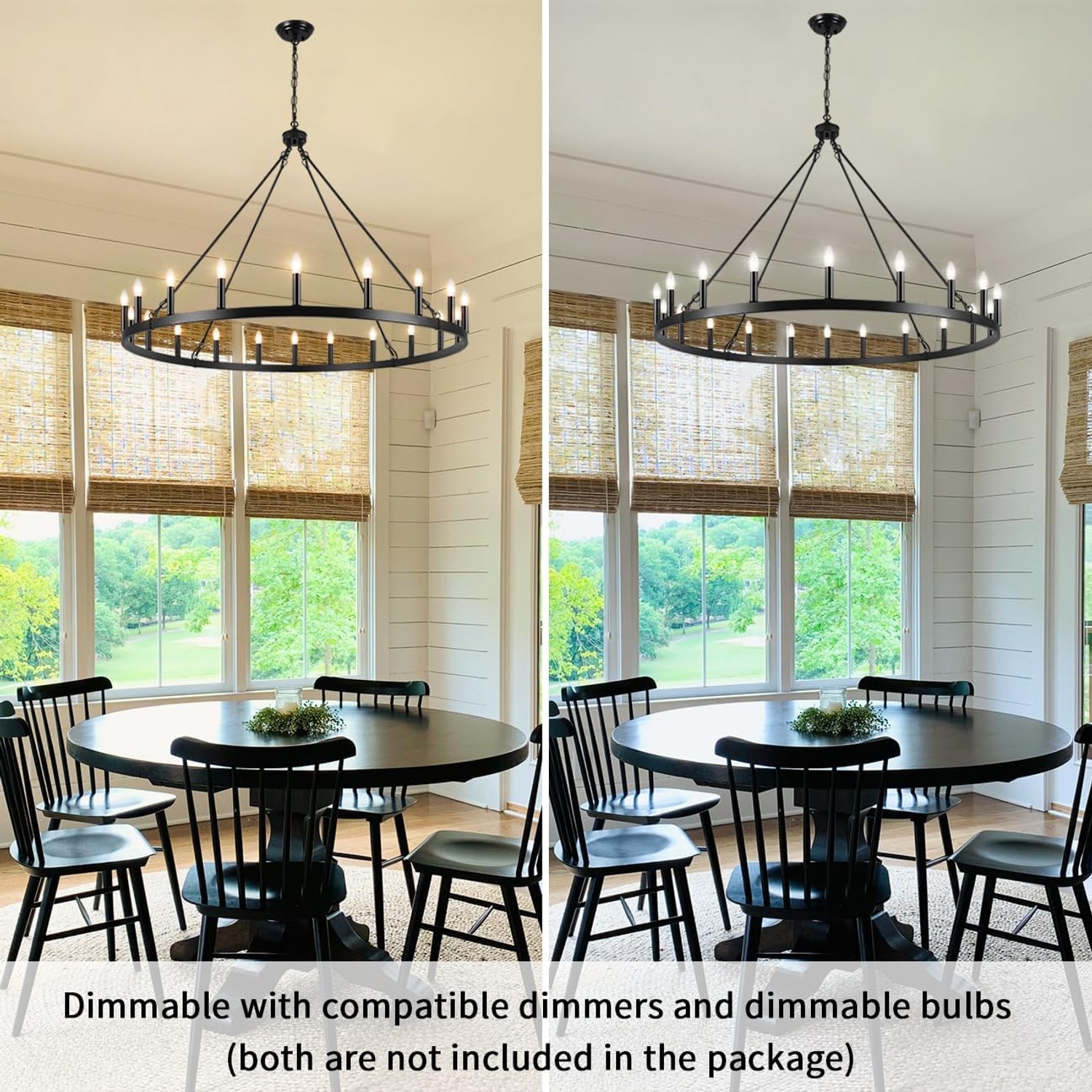
Dimming is worth setting up. The fixture is fully dimmable, but only if you install a compatible dimmer switch and buy dimmable bulbs. Both are sold separately. Get this wrong and you will hear a hum or see flicker at low settings. Buy the bulbs and the dimmer as a matched pair, check the dimmer's minimum load rating against your total LED wattage, and it will behave.
Twenty bulbs is a lot to buy in one go. Buy them together, from the same brand and batch, so the colour matches across the ring.
Installation, honestly
This is a hard-wired fixture. There is no plug. It connects into the ceiling box, and the sockets and wires are UL listed.
The box includes mounting hardware, wiring connectors and instructions. Assembly is part of the job, since a 92.5 cm frame does not ship fully built. Lay the parts out on a blanket, check everything against the parts list, and build the frame on the floor before anything goes near the ceiling.
Two people make this much easier. One holds the weight, one makes the connections. At 6.26 kg it is not brutal, but holding it steady overhead while working with both hands is not realistic alone.
If your ceiling box is old, if you are unsure whether it can carry the weight, or if local regulations require licensed work, book an electrician. The fixture cost is the bigger part of the budget here, and an hour of professional labour on top is cheap insurance.
Keeping it looking good
Dust is the enemy of an open metal frame. It settles on the top of the ring and on the arms, and it shows against black.
Switch the power off at the wall and let the bulbs cool first. A long-handled duster handles routine cleaning from the floor. For a proper clean, use a soft dry cloth, and a barely damp one for marks, drying straight after. Keep abrasive pads, bleach and solvent cleaners away from the lacquered finish, and never spray liquid at the sockets.
Replace bulbs as they fail rather than leaving gaps. On a twenty-socket fixture, two dead bulbs on the same side are obvious.
The short version
This is a large, honest fixture for a large room. 92.5 cm across, twenty E12 sockets, iron frame in matte black, adjustable chain, and a ceiling plate that copes with sloped and arched ceilings. Bulbs and dimmer are separate purchases.
Measure your table and your ceiling height first. If the numbers work, it will do more for a big room than any number of lamps.