
The complete guide
How To Choose And Hang An 18-Light Sputnik Chandelier
The problem with one light in the middle of the room
Walk into most dining rooms at night and you can see it straight away. There is a single fitting over the table, it drops a bright circle onto the placemats, and everything past the edge of the table slides into grey. People look tired under it. The corners of the room disappear. You end up switching on a lamp in the corner just to make the space feel liveable.
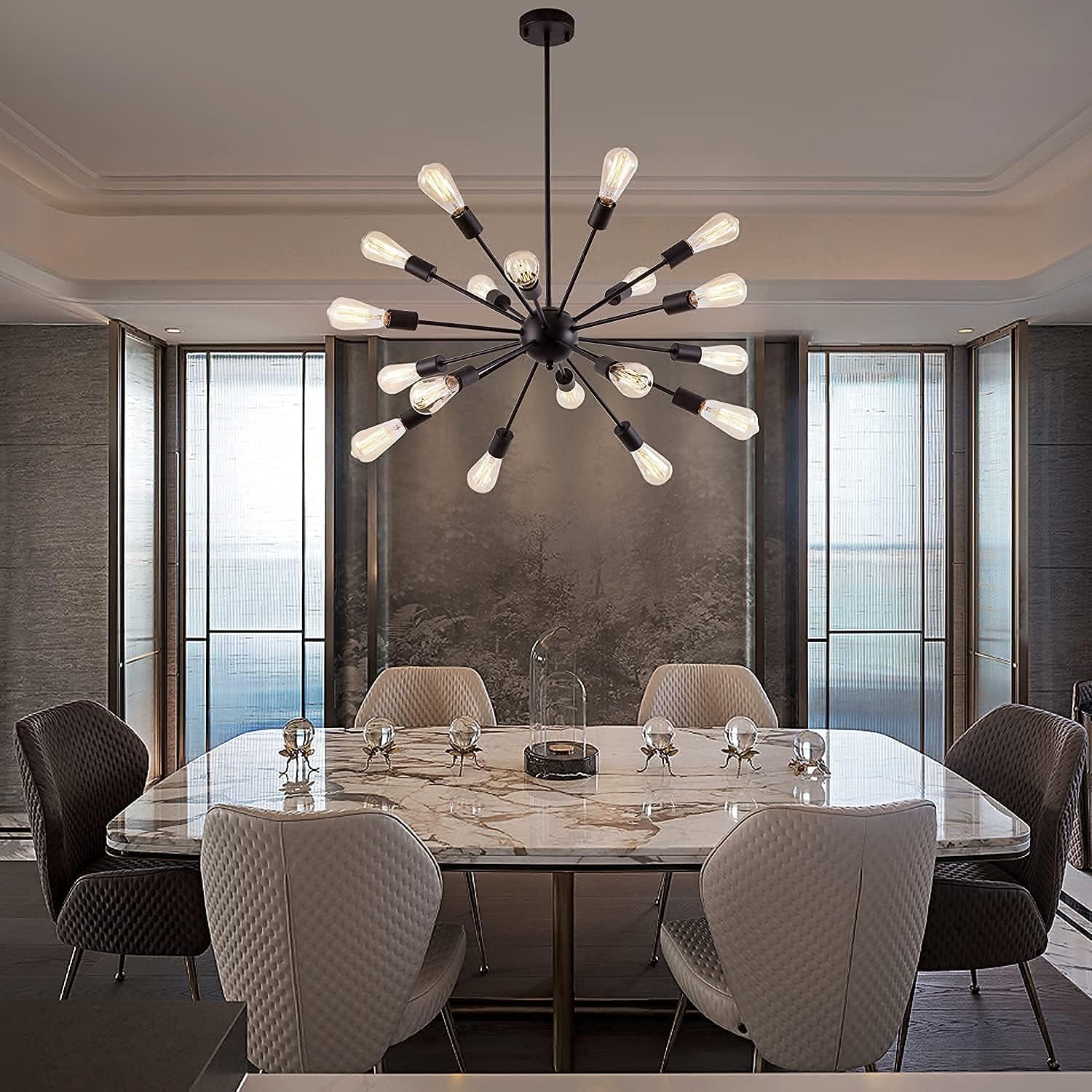
The fix is not a brighter bulb. A brighter bulb in the same spot just makes the contrast worse. What actually helps is spreading the light out, so it comes from several points at once and arrives at faces from more than one direction. That is the real argument for a multi-arm fixture, and it is why an 18 light sputnik light fixture does something a basic pendant cannot.
How a sputnik chandelier works
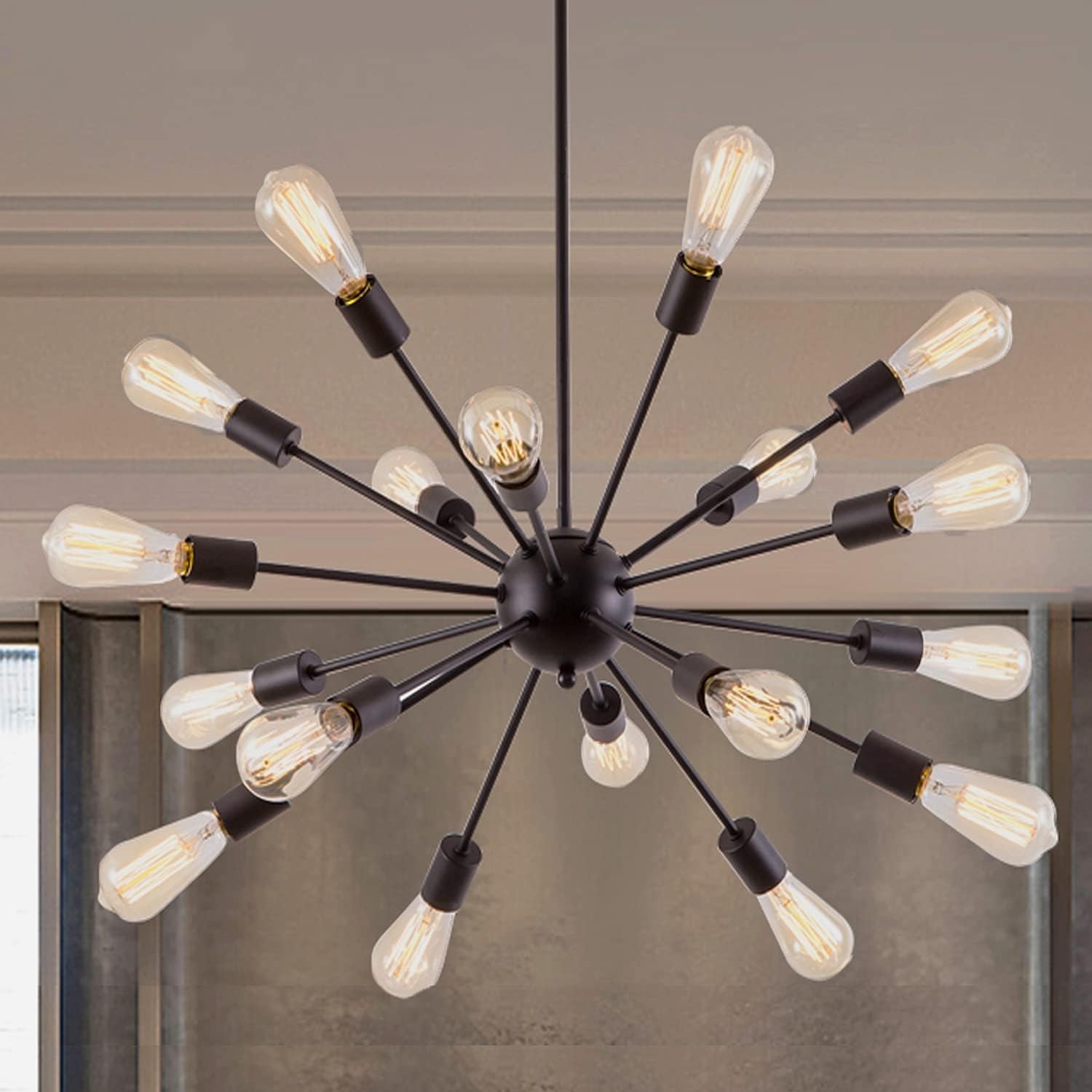
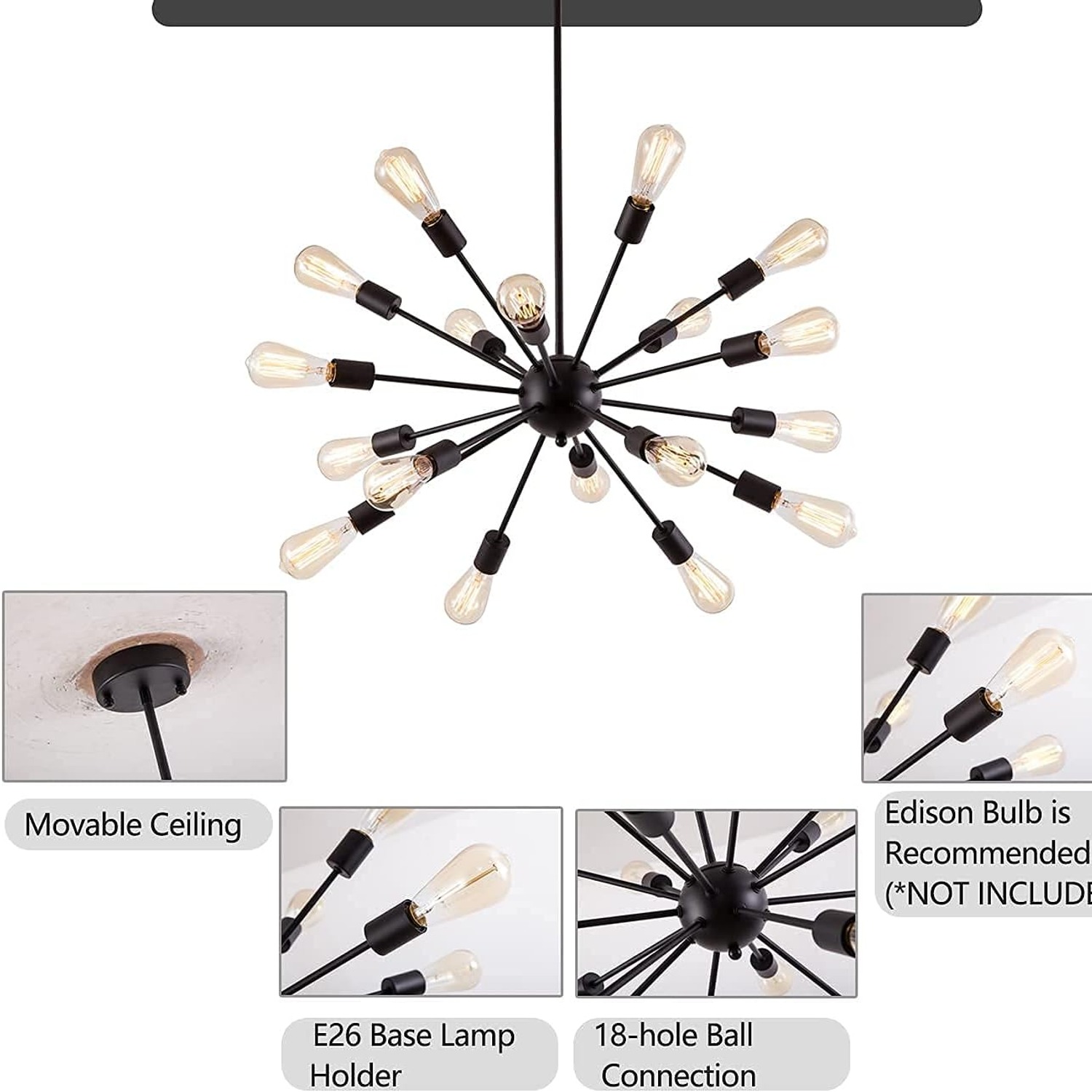
The design is simple. A central hub, straight arms radiating out in every direction, a socket at the end of each arm. There is no shade and no diffuser. The bulbs are the design.
Because the arms point outward at different angles, the light scatters rather than pooling. Some goes up and bounces off the ceiling. Some goes sideways onto the walls. Some comes down onto the table. The result is softer and more even than a single downward beam, even when the total light output is similar.
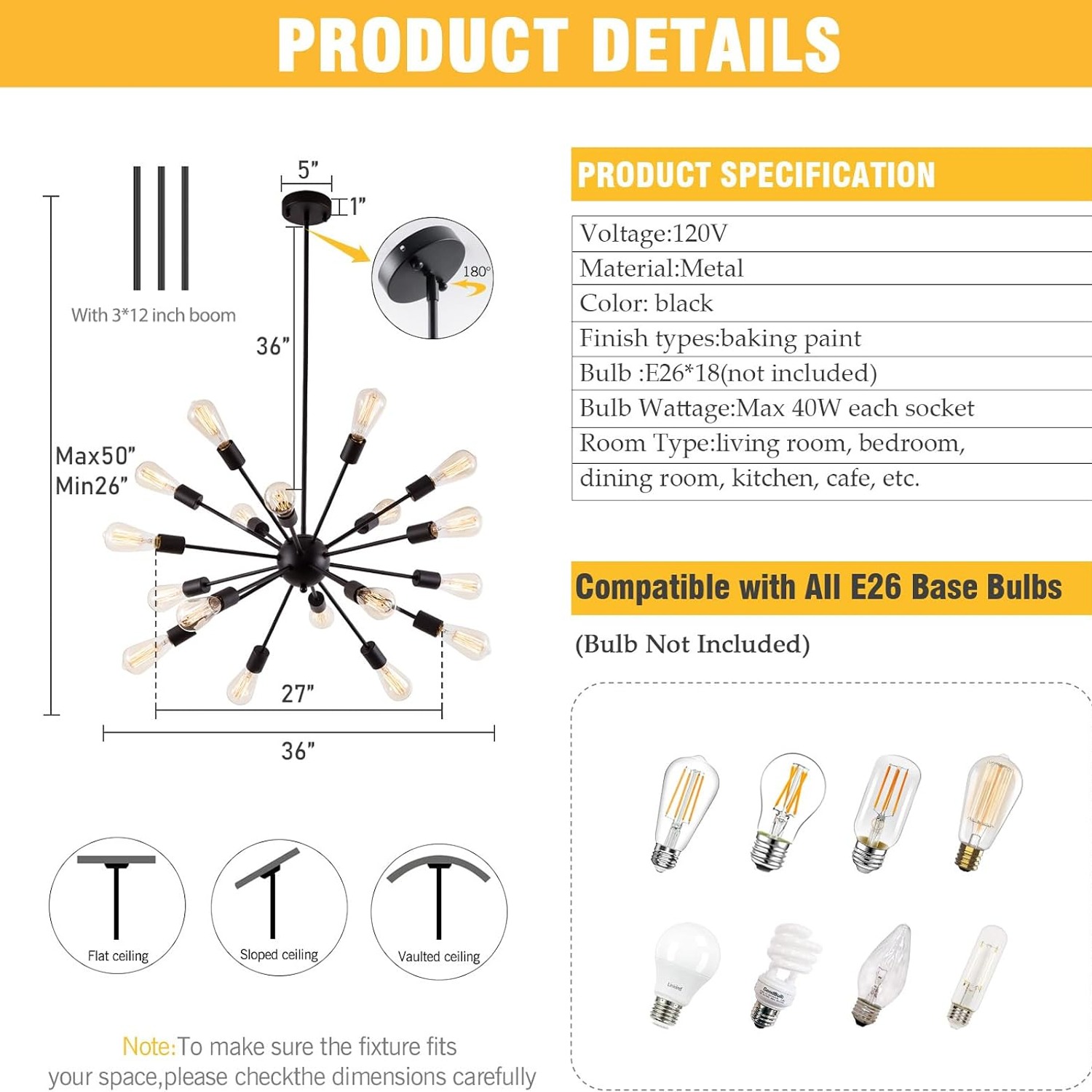
This particular fixture has eighteen arms, each with an E26 socket rated to 40 watts. Listed maximum output is 800 lumens. Bulbs are not given by the maker, which means the character of the light is entirely your call. Clear filament bulbs give that warm amber look that suits the antique styling. Frosted LEDs give a cleaner, cooler light and cost far less to run across eighteen sockets.
The body is metal with a painted black finish. Black does something useful on a fixture like this. It recedes slightly, so your eye lands on the bulbs and the shape rather than on the metal itself. Brass and chrome shout. Black frames.
Who it suits
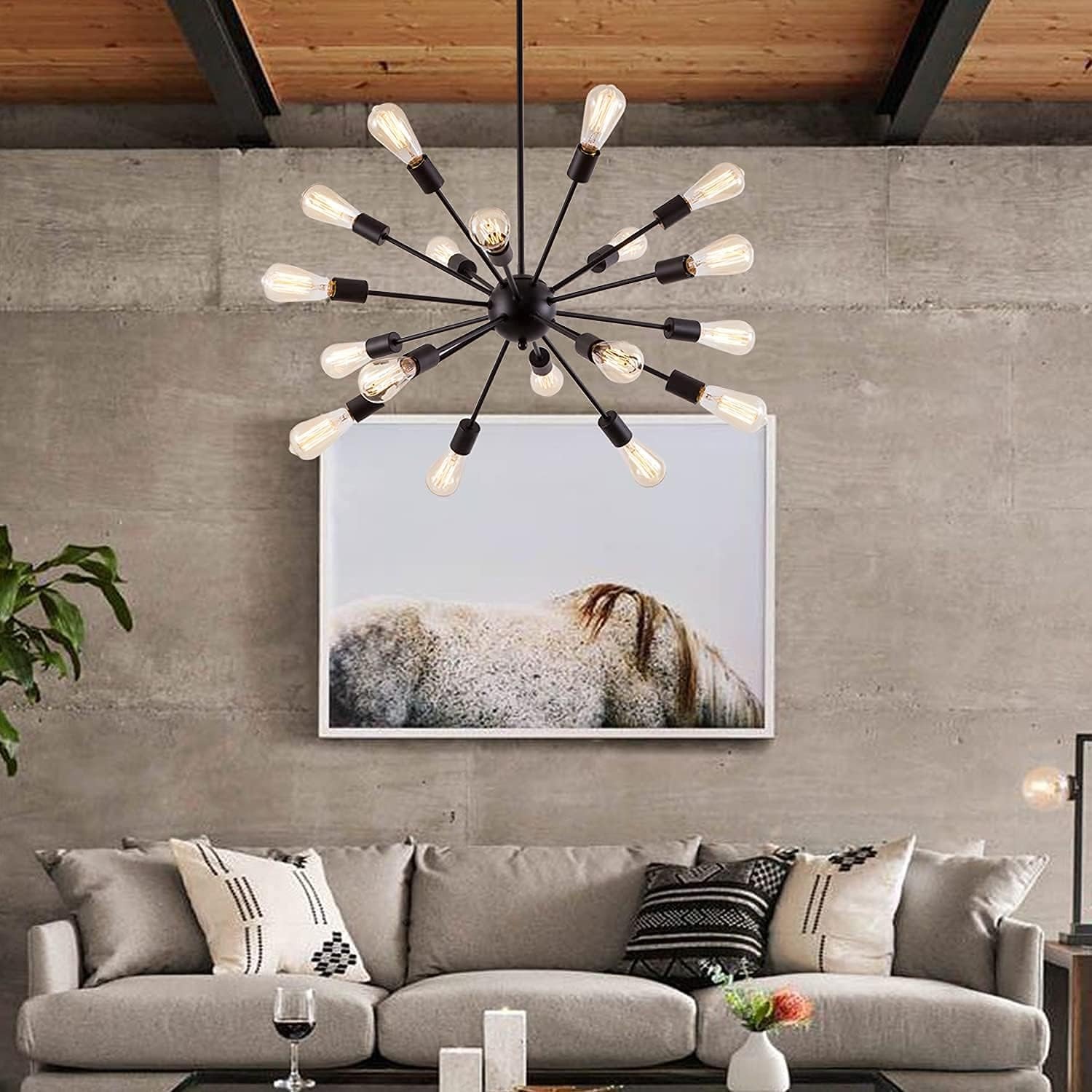
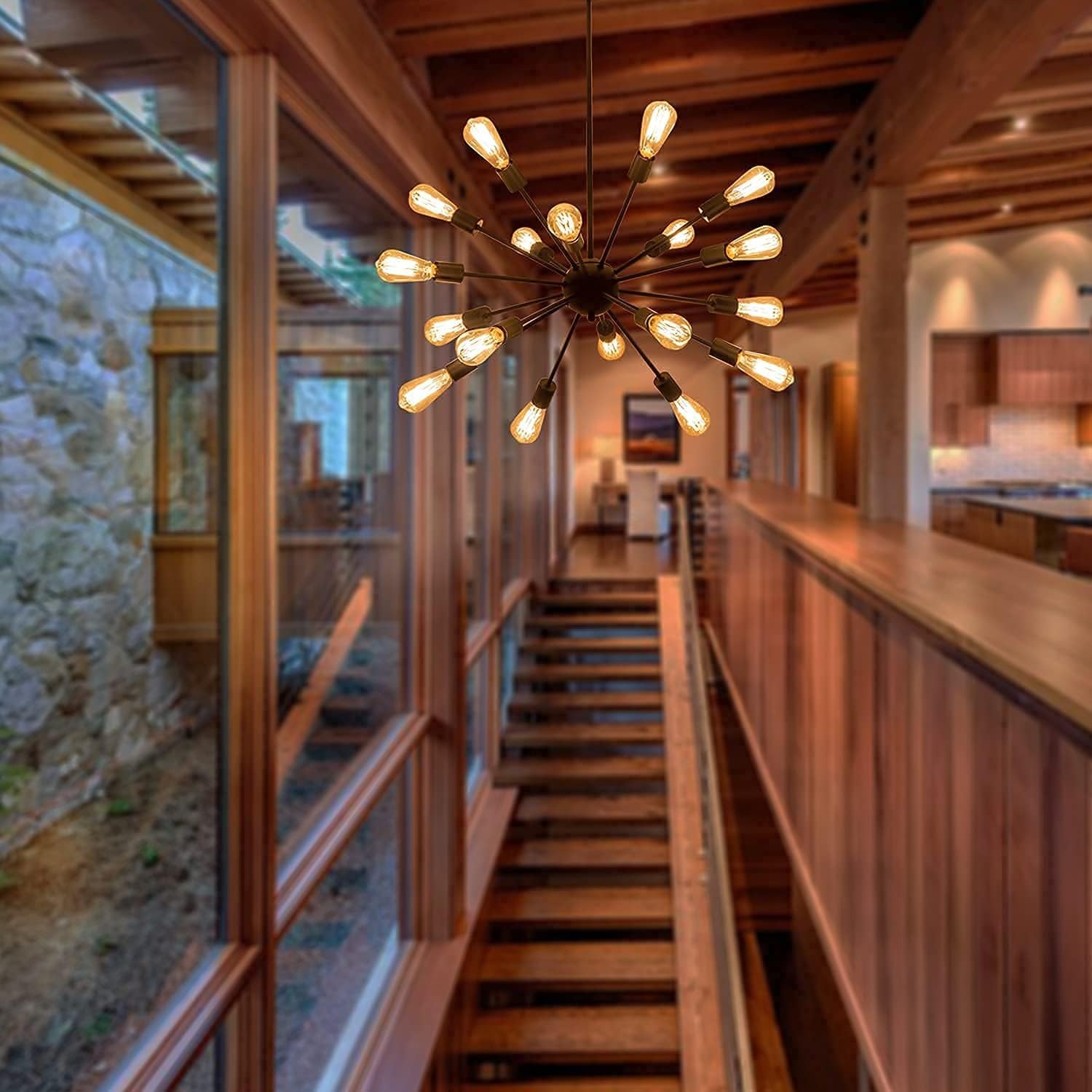
This works best in rooms with some height and some breathing space. The fixture spans 36 inches, so it needs room around it. Over a six foot dining table it looks right. In an entry hall with a stairwell above it, it fills vertical space that a flush fitting leaves empty. In a living room with a ceiling over nine feet, it holds the centre of the room.
It is less suited to a small bedroom with a standard ceiling, or a narrow hallway where three feet of chandelier would feel like an obstacle. If your ceiling is eight feet and the room is modest, a smaller sputnik with six or eight arms gives you the same look without the crowding.
Style-wise, it sits in a useful middle ground. The maker's description calls it farmhouse with an antique theme, and black metal genuinely does pair well with wood, painted cabinetry and exposed beams. But the sputnik shape itself is mid-century modern, so it also works in a clean contemporary room. The bulbs you choose tip it one way or the other.
Getting the height right
This is where people go wrong, and it is easy to get right if you plan it.
The fixture ships with three 10 inch extension rods. Fit all three and the total height is 50 inches. Remove rods and you can bring the drop down to 26 inches. So decide before you install, not while you are up a ladder.
Over a dining table, the usual approach is to leave around 30 to 36 inches between the tabletop and the bottom of the fixture. That keeps the bulbs above the eyeline of people sitting down, so nobody is squinting across the table. Higher ceilings allow a bit more clearance.
In a walkway or entry, the rule is simpler. Nothing should be at head height. Seven feet of clearance from the floor is a sensible minimum, and more in a busy hall.
One other thing to check: your ceiling box. The item weight is listed at 7.15 pounds and shipping weight is 3.24 kg. That is not heavy as chandeliers go, but a ceiling box rated only for a lampholder is not the same as one rated for a fixture. If you are unsure, an electrician can confirm it in minutes.
Choosing bulbs
Eighteen sockets is a lot of bulbs, so this decision matters more than usual.
Buy them all at the same time, all the same model. Mismatched colour temperature across a sputnik is instantly visible and it makes a good fixture look careless. If one bulb fails in two years, you want the packaging so you can match it.
For the warm, lived-in look that suits the farmhouse styling, go for filament-style bulbs around 2200K to 2700K. They glow rather than glare, which is what you want when the bulbs are fully exposed. For a brighter working light in a kitchen, step up to 3000K.
Watch the wattage. Forty watts is the ceiling per socket. LED bulbs will come in well under that while still putting out useful light, which keeps heat down around eighteen painted metal sockets. That is worth doing.
If you want to dim, buy dimmable bulbs and pair them with a compatible dimmer switch.
Installation, honestly
The box includes instructions, installation gloves and the mounting hardware, and one person can manage it. The gloves are there for a reason. Fingerprints show on fresh painted metal and they are annoying to remove later.
The sequence is straightforward. Power off at the breaker, not just the wall switch. Mount the bracket to the ceiling box. Thread the rods to your chosen length. Attach the arms to the hub. Connect the wiring, raise the fixture, secure the canopy. Fit the bulbs last, once everything is tight.
If any of that sounds like more than you want to take on, hire a licensed electrician. Working overhead with mains wiring is not the place to learn. The cost of a short call-out is small next to the cost of getting it wrong.
One firm limit: this is an indoor fixture. It carries no water resistance rating and should not go on a covered porch, in a bathroom, or anywhere that gets steam or damp.
Keeping it looking good
Open sockets collect dust. That is the trade-off for a shadeless design, and it is not a big deal if you stay on top of it.
Turn the power off, let the bulbs cool, then run a dry microfibre cloth or a soft long-handled duster over the arms every few weeks. For a mark on the paint, a barely damp cloth works, dried off straight away. Skip abrasive pads, bleach and solvents entirely, because they will cut through the painted finish.
Never spray cleaner near the sockets. Spray the cloth instead.
Once or twice a year, check the bulbs are finger-tight and the canopy screws have not loosened. Fixtures with multiple arms can shift slightly over time, especially near a door that gets slammed.
The short version
An 18 light sputnik light fixture solves the flat, one-point lighting problem that makes dining rooms feel unfinished. The 36 inch span and adjustable 26 to 50 inch drop make it a statement piece, so measure your room before you commit. Bulbs are not included, which is good news if you care about the look, so buy eighteen matching E26 bulbs at 40 watts or less, ideally warm LEDs. Fit it indoors only, hang it high enough to clear heads, dust it now and then, and it will carry a room for years. The manufacturer lists a limited 3 year warranty.