
The complete guide
How to Choose a Black Candle Chandelier for Your Dining Room
The problem with one light in the middle of the ceiling
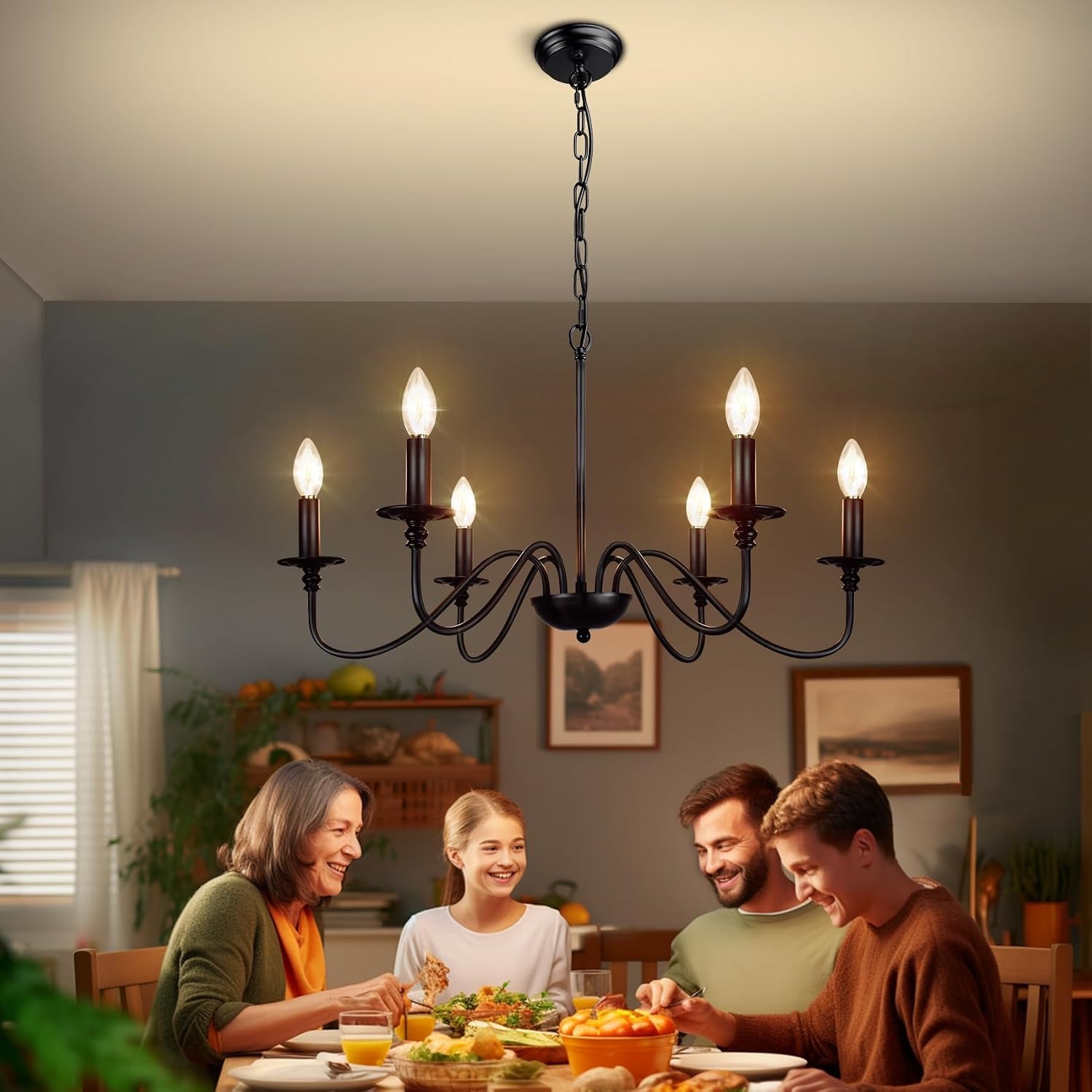
Walk into most dining rooms at night and you will see the same thing. One fitting, dead centre, pushing light straight down. The table is bright, the plates look fine, and everything else fades. People's faces are lit from above, which is rarely flattering. The corners go dark. The room feels smaller than it is.
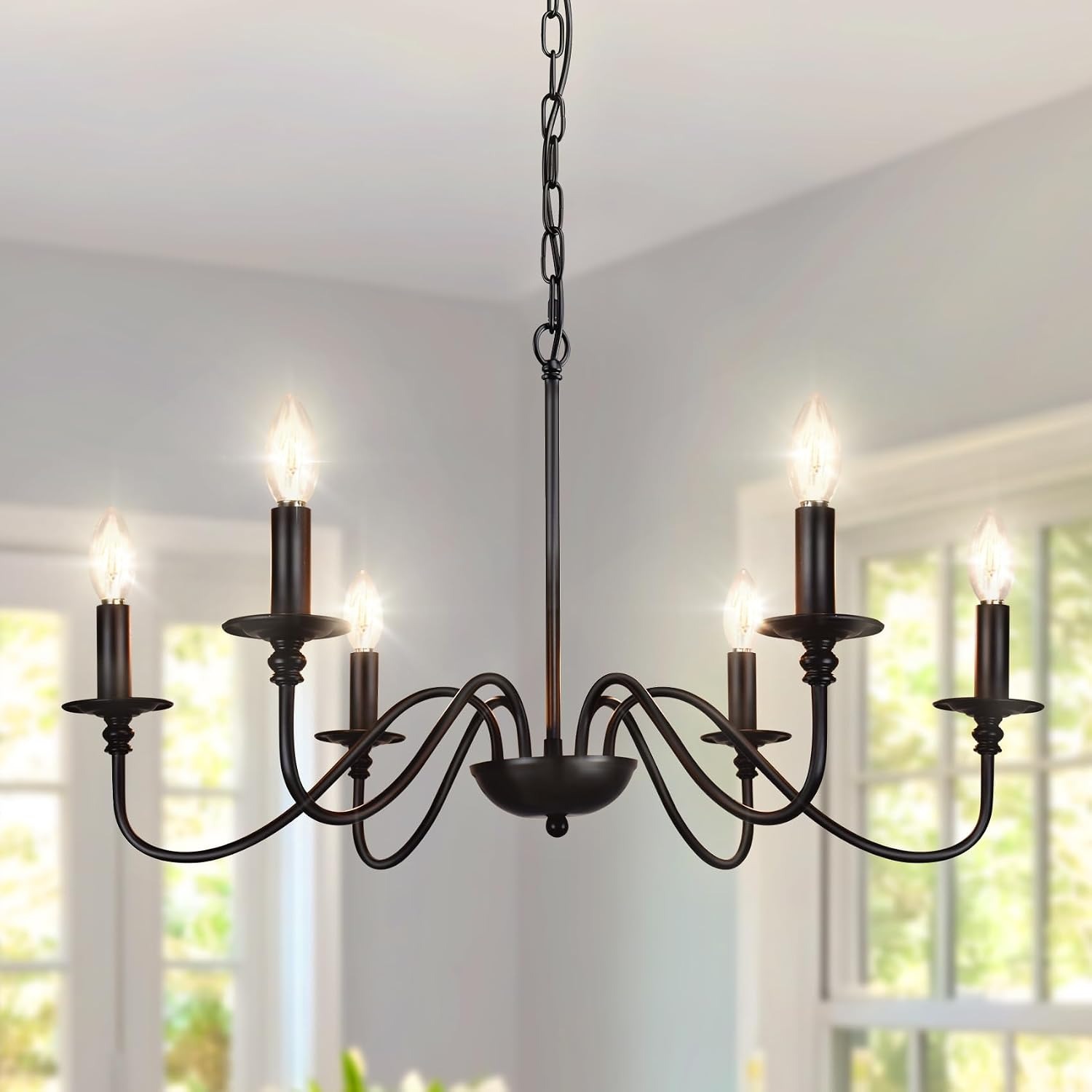
A multi-arm chandelier fixes this almost by accident. Instead of one source, there are six, spaced around a circle roughly 70 cm wide. The light leaves from six points instead of one, so it crosses over itself and fills in the shadows. Nothing clever is happening. It is just geometry. But the difference at the table is obvious the first evening you use it.
That is the main reason candle-style chandeliers have survived so long. The shape dates back to real candles arranged on a ring, and it worked then for exactly the reason it works now.
What this fixture actually is
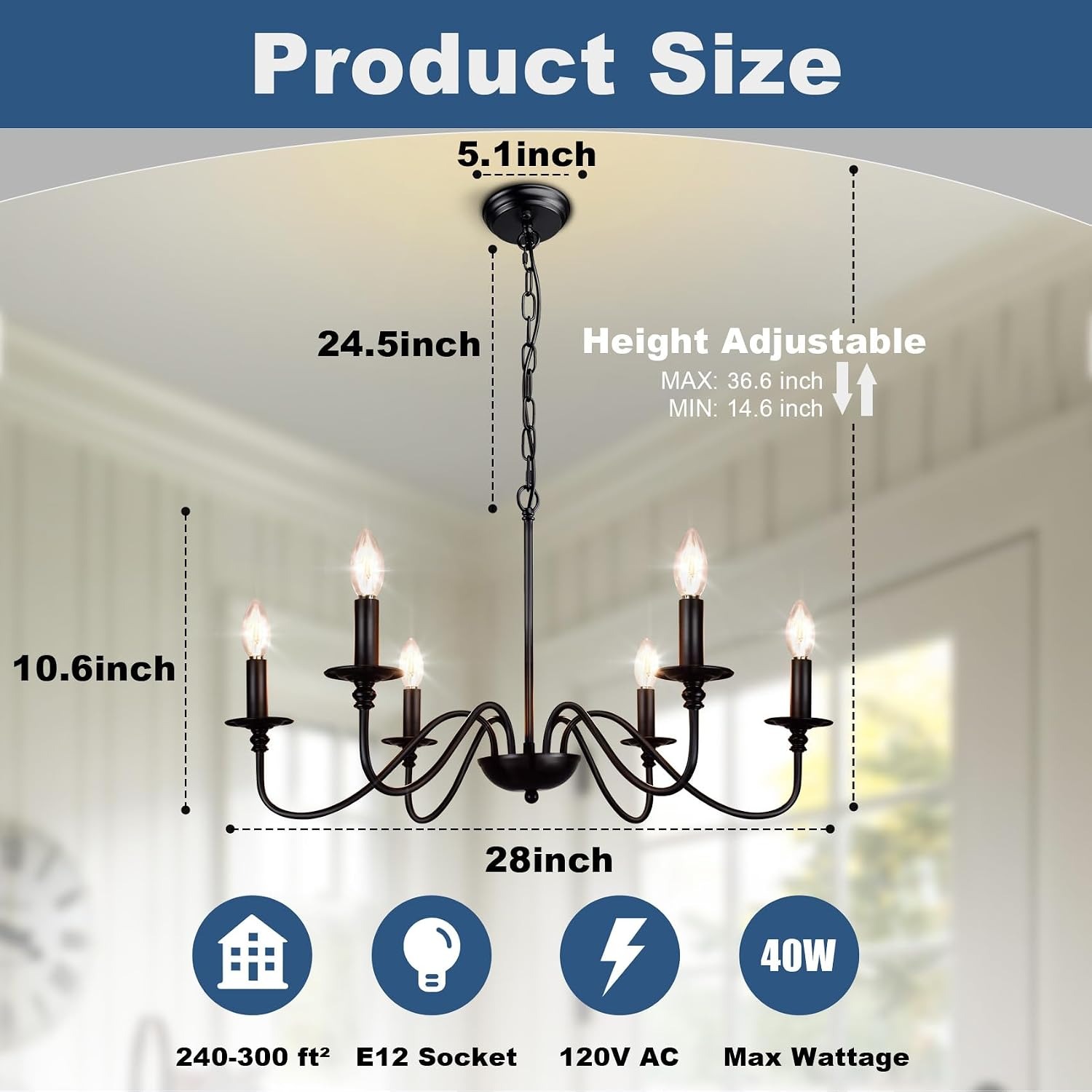
This is a six-light chandelier with a metal frame and arms, finished in matte black. It is hardwired, rated at 120 volts AC, and intended for indoor ceiling mounting. The sockets are E12 candelabra bases rated up to 40 watts each, the listed light colour is warm white, and the fixture is dimmable.
Hung, it measures about 71 cm across and 108 cm tall, with the height taken from the ceiling plate to the bottom of the fixture including the suspension. That drop gets shortened during installation, which is how one fixture can suit a 2.4 metre ceiling and a 3 metre one. It weighs 2.41 kg, which is genuinely light for something this size, and it arrives pre-assembled in a carton measuring roughly 44 x 23 x 15 cm.
Country of origin and a specific metal grade are not stated by the maker, so we are not going to guess at either.
Why matte black works in so many rooms
Black has become the default finish for a reason, but it is the matte part that does the heavy lifting. A polished or lacquered fixture reflects every light source in the room back at you as a cluster of bright pinpoints. Your eye goes straight there. That is fine if the fixture is the one thing you want people to look at, less fine if you want it to sit in the room quietly.
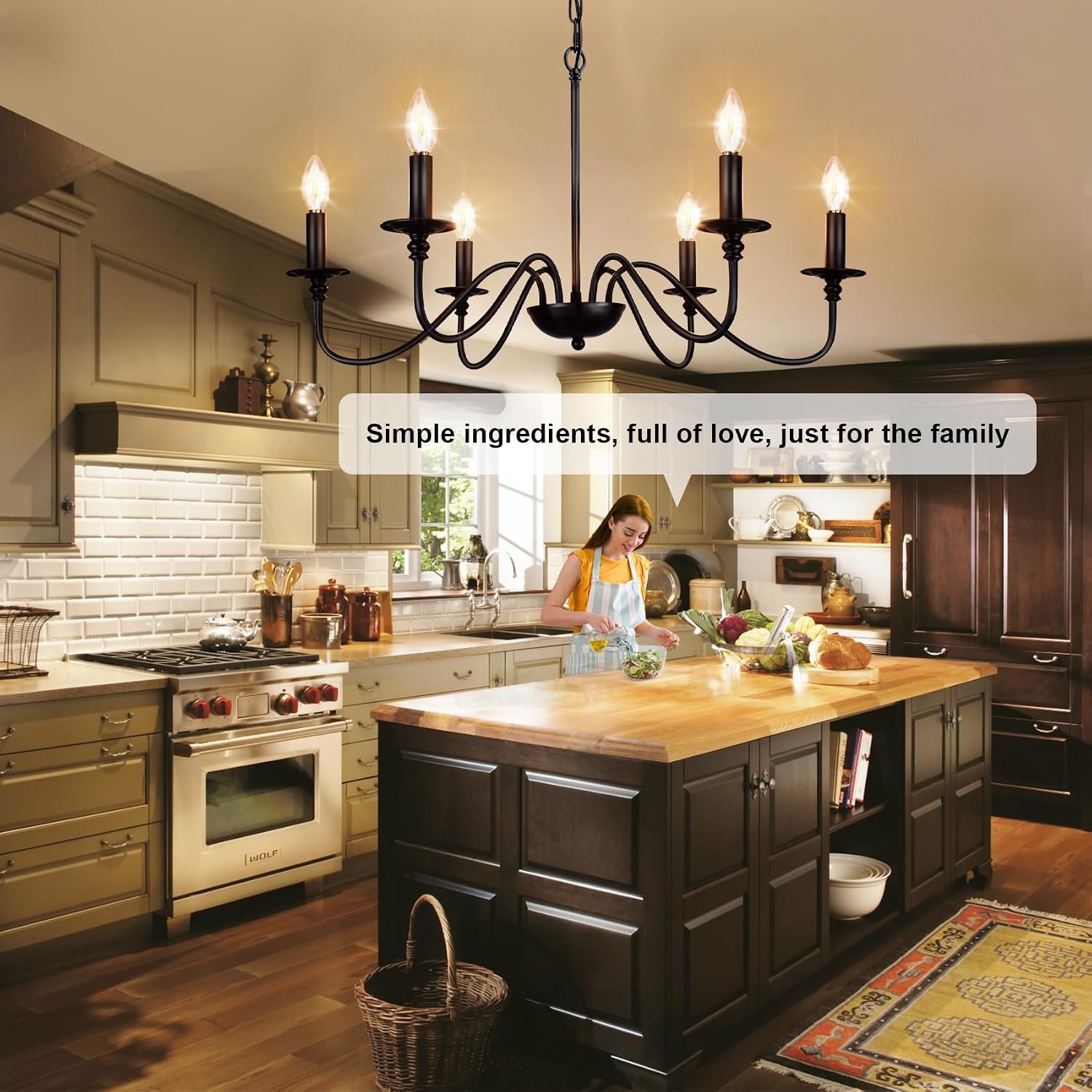
Matte black absorbs most of that. It reads as an outline. From across the room you see the shape of the arms against the ceiling rather than a series of highlights, and that tends to flatter both busy rooms and plain ones. In a country kitchen with wood and stone it echoes the hardware on the cabinets. In a white-walled apartment it works as a graphic line, close to the look people chase with the best industrial pendant lighting but less heavy-handed.
The practical upside is dust. Matte black hides a light film far better than chrome or brass, so you can go longer between wipes without it looking neglected.
Choosing your bulbs
Here is the part people skip, and it matters more than the fixture itself.
Candle-style chandeliers show their bulbs. There is no diffuser hiding them, so the bulb you pick is half the finished look. You have three broad choices.
Clear candle bulbs with a visible filament give the most traditional result and the warmest, most sparkly light. They also show glare if you sit directly under them, which is worth knowing before you fit six.
Frosted candle bulbs soften everything. Less sparkle, less glare, a gentler overall feel. This is the safe choice above a table where people sit for a long time.
Small globe bulbs change the character entirely, pushing the fixture towards a more modern, slightly playful look. Same fitting, different room.
Whatever you choose, keep all six identical. Mixing warm and neutral white bulbs in one fixture looks like a mistake even when nobody can say why.
On brightness, somewhere around 400 to 500 lumens per bulb is a sensible starting point for a dining room. That lands you near 2,500 to 3,000 lumens total, which is plenty for a typical space and still pleasant at full output. Tall entryways and stairwells can take more, because the light has further to fall before it reaches anyone.
If you want to dim, buy bulbs marked dimmable and pair them with a dimmer rated for LED loads. The old rotary dimmers built for incandescent bulbs often flicker or buzz with modern LEDs. This is the single most common complaint with any dimmable chandelier, and it is nearly always the switch, not the fixture.
Getting the hanging height right
Over a dining table, aim for roughly 75 to 90 cm of clear space between the tabletop and the lowest point of the fixture. Lower than that and tall guests knock their heads or lose sight of the person opposite. Higher and the light spreads thin and the chandelier starts to float away from the table it is supposed to serve.
If your ceiling is above the standard 2.4 metres, a common rule is to add around 7 cm of drop for every extra 30 cm of ceiling height. It is a rough guide, not a law.
In a hallway or entry, the rule changes. There, the only hard requirement is clearance, with at least 2.1 metres from the floor to the bottom of the fixture so nobody walks into it. Within that limit, hang it where it looks balanced against the door and any windows.
For stairwells, think about bulb changes before you think about looks. If you cannot reach it safely with a standard ladder from a stable surface, pick a different spot.
Scale and table size
A chandelier roughly 70 cm across suits tables somewhere between 90 and 150 cm wide. On anything narrower it will overhang awkwardly. On a long farmhouse table of 200 cm or more, a single fixture of this size looks lost, and two smaller ones spaced evenly almost always look better than one struggling to cover the distance.
A quick sanity check for round rooms and round tables: the fixture should be noticeably narrower than the table, usually around half to two thirds of the table's width.
Installation, honestly
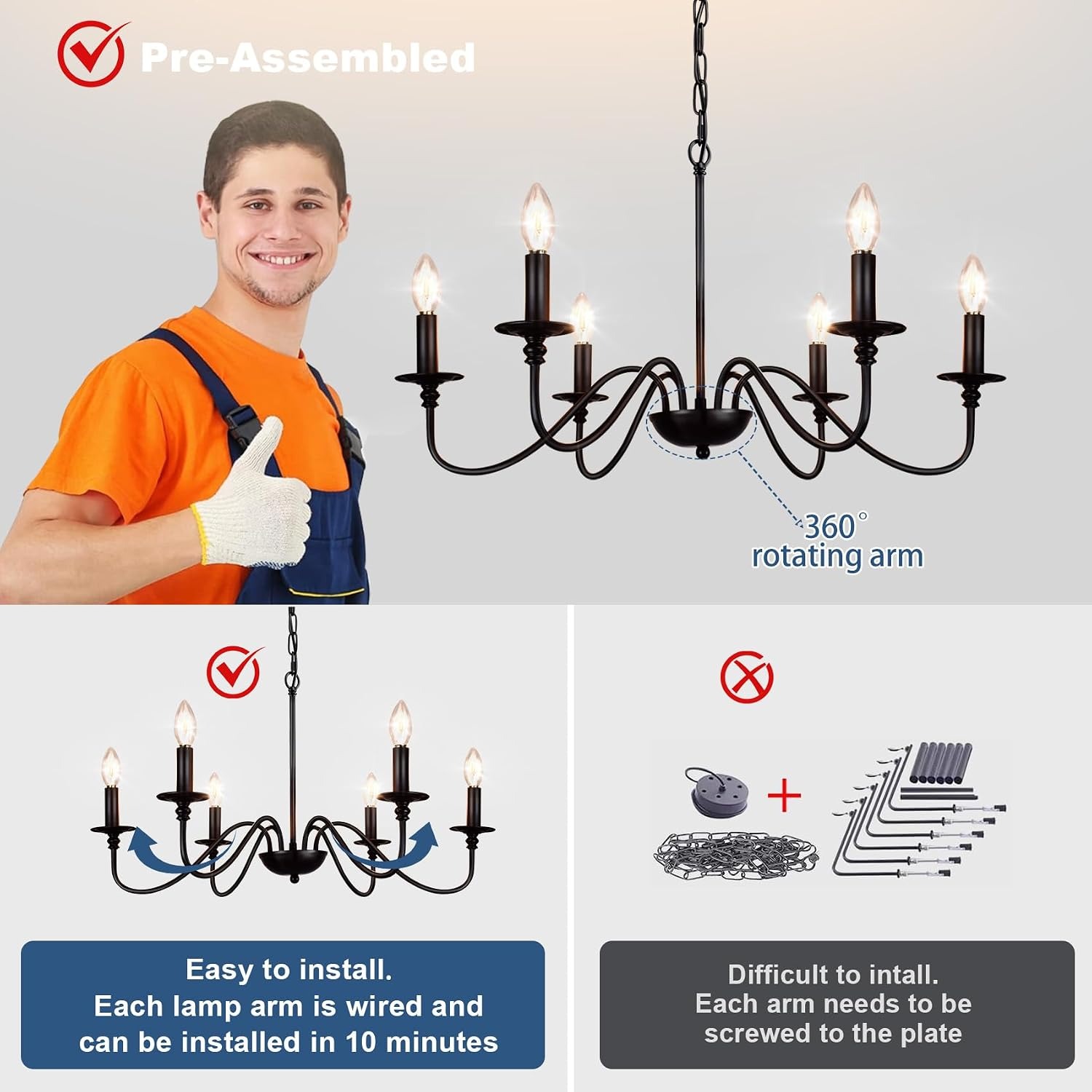
This fixture ships pre-assembled, which removes the worst part of the job. You are not holding six arms in place while trying to find a thread. The remaining work is mounting the bracket to the ceiling box, making the electrical connections, setting the drop length and lifting the body up.
That said, it is hardwired. In most places that means a licensed electrician, and even where it does not, the power needs to be off at the breaker and the ceiling box needs to be rated to carry a suspended load. At 2.41 kg this is not a heavy fixture, but old boxes in older homes are sometimes only rated for a flush fitting.
One tip worth following. Before anything is permanently connected, have someone hold the fixture up at the intended height while you stand back and look at it from the doorway and from a seated position at the table. It takes two minutes and it saves the slow regret of a chandelier hung 10 cm too low.
Keeping it looking right
Matte finishes ask for a light touch. Turn the power off, wipe the arms and frame with a dry or barely damp soft cloth, then dry immediately. Avoid spray cleaners, solvents and anything abrasive, because all three can polish small patches of a matte surface and leave uneven shine that is impossible to undo.
Once or twice a year, check that the bulbs are seated firmly and the canopy screws are still tight. Vibration from doors and footsteps gradually loosens things, and a slightly crooked chandelier is one of those details nobody can name but everybody notices.
Keep it dry. It is listed as not water resistant and for indoor use, so steamy bathrooms and covered porches are out.
The short version
If your dining room is lit by one harsh fitting, a six-arm candle chandelier will change how the room feels more than almost anything else you could spend the same money on. This one is matte black metal, takes six common E12 bulbs up to 40 watts, runs at 120 volts, dims, and arrives assembled at a light 2.41 kg.
Measure your table, work out your hanging height, buy six matching warm white bulbs, and get an electrician to connect it. That is the whole job.